Supreme court rules Rwanda asylum plan unlawful
On 15 November 2023, the supreme court delivered a unanimous ruling upholding the court of appeal’s decision that the government’s Rwanda deportations scheme was unlawful.
The Migration and Economic Development Partnership, known as the Rwanda scheme, was first announced in April 2022 under the premiership of Boris Johnson. Spearheaded by the then home secretary, Priti Patel, it included an “asylum partnership arrangement” under which the UK could ask Rwanda to assume responsibility for individuals arriving in the UK via “illegal, dangerous or unnecessary methods” to Rwanda. Under the terms of the agreement, those relocated would have their asylum claims processed in Rwanda, not the UK; if successful, they would be granted refugee status and allowed to stay in the East African country, with no legal route to return to Britain.
The policy faced significant political and legal challenges from its inception; the inaugural deportation flight, scheduled for 14 June 2022, was grounded at the eleventh hour after an intervention by the European Court of Human Rights (ECtHR). The ECtHR issued an interim measure (or ‘Rule 39 order’), which are only produced in “exceptional circumstances” where there is an “imminent risk of irreparable harm”.
This ruling led to a protracted legal struggle over the Rwanda scheme, which lasted three prime ministers and several home secretaries. Attempts to operationalise the deportations plan also pitted the Conservative Party against itself.
Two days before the supreme court delivered its verdict, the prime minister, Rishi Sunak, dismissed Suella Braverman as home secretary. Tensions between Braverman and Downing Street had been rising for some months; she was sacked shortly after she penned an article for the Times, which stated there was a “perception that senior police officers play favourites when it comes to protesters” and were tougher on right-wing protesters than pro-Palestinian demonstrations.
On 14 November, in the wake of her dismissal, Braverman sent a scathing letter to Sunak, suggesting he had reneged on the terms of a deal the two had agreed during the October 2022 Conservative leadership contest.
The terms of that agreement, according to Braverman’s account of events, pertained directly to the Rwanda scheme. She accused the prime minister of reneging on plans to “block off the ECHR, the HRA [Human Rights Act] and any other obligations” which inhibited the government’s ability to operationalise the scheme.
She also accused the government of lacking a “Plan B”.
Braverman added: “If we lose in the supreme court, an outcome that I have consistently argued we must be prepared for, you will have wasted a year and an act of parliament, only to arrive back at square one.
“Worse than this, your magical thinking – believing that you can will your way through this without upsetting polite opinion – has meant you have failed to prepare any sort of credible Plan B.”
***
On 15 November 2023, supreme court found that there were “substantial grounds for believing” that asylum seekers sent to Rwanda faced a “real risk of ill-treatment as a consequence of refoulement” – the practice of being returned to a country where they might face persecution or human rights abuses.
The ruling of the court of appeal on 29 June 2023 was upheld.
Lord Reed, the president of the court, said: “The evidence shows that there are substantial grounds for believing that there is a real risk that asylum claims will not be determined properly, and that asylum seekers will therefore be at risk of being returned directly or indirectly to their country of origin.”
He said that “the changes and capacity-building needed to eliminate that risk may be delivered in the future”, but that they were not currently in place.
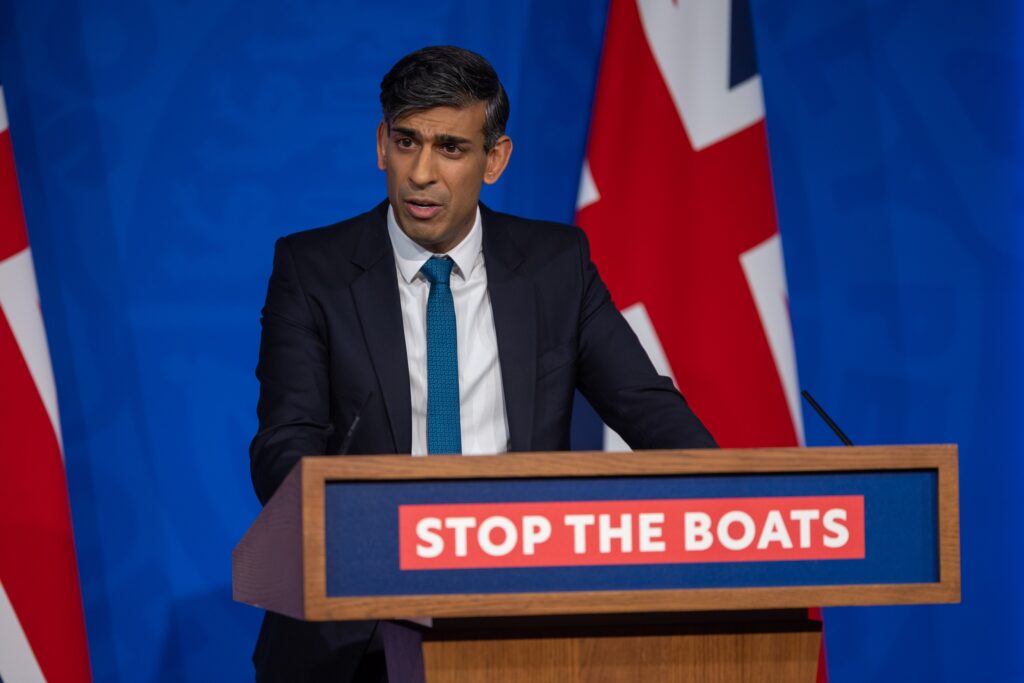
This decision represented a major setback for Sunak, who had pledged to “stop the boats” as one of his government’s five priorities and repeatedly stressed his commitment to the scheme.
The supreme court’s judgment cited evidence regarding deficiencies in Rwanda’s asylum system, including its failure to adhere to an earlier agreement with Israel concerning the removal of asylum seekers. “Despite the terms of the agreement… asylum seekers were frequently moved to another country from which they were likely to be refouled”, Reed said.
Lee Anderson, the Conservative deputy chair, called on the government to “ignore the law” and start flights anyway.
Anderson said: “I think the British people have been very patient, I’ve been very patient, and now they’re demanding action.
“And this has sort of forced our hand a little bit now. My take is we should just put the planes in the air now and send them to Rwanda and show strength. It’s time for the Government to show real leadership and send them back, same day”
In response to the judgment in a Downing Street press conference, Sunak stated: “I do not agree with this decision – but I respect it and I accept it.”
Sunak unveiled a two-pronged strategy to overcome the court ruling: first, negotiate a new international treaty with Rwanda that would provide a legally binding guarantee against refoulement; and second, introduce emergency legislation that would enable parliament to confirm Rwanda as a safe country under UK law.
The prime minister said: “So I am also announcing today that we will take the extraordinary step of introducing emergency legislation. This will enable parliament to confirm that, that with our new treaty, Rwanda is safe.”
He also stated the government would still be vulnerable to “challenges from the European Court of Human Rights in Strasbourg.”
He added: “So let me tell everyone now – I will not allow a foreign court to block these flights. If the Strasbourg court chooses to intervene against the express wishes of parliament, I am prepared to do what necessary to get flights off.”
James Cleverly, the newly appointed home secretary, travelled to Kigali on 5 December 2023 to sign the new legally binding treaty. “The supreme court recognised that changes may be delivered which would address their conclusions”, Cleverly said, “this treaty responds directly to that.”
Sunak’s stated strategy, however, sparked a revolt on the right of the Conservative Party.
Robert Jenrick, the immigration minister and erstwhile Sunak ally, resigned on 6 December. He argued that the proposed legislation was “a triumph of hope over experience” and did not go far enough to disapply international law and end the “merry-go-round of legal challenges.”
In his resignation letter, Jenrick wrote: “A bill of the kind you are proposing is a triumph of hope over experience.
“The stakes for the country are too high for us not to pursue the stronger protections required to end the merry-go-round of legal challenges which risk paralysing the scheme and negating its intended deterrent.”
Sunak responded that the bill was “the toughest piece of legislation ever put forward by a UK government”.
He argued that ignoring the courts entirely would have resulted in Rwanda pulling out of the scheme.
***
The Safety of Rwanda (Asylum and Immigration) Bill sought to disapply certain aspects of domestic law and the Human Rights Act 1998, and legally declare – for the purposes of the government’s deportation scheme – that Rwanda was a safe country. It directed decision-makers and court to “conclusively treat” Rwanda as a safe country.
The bill contained an “ouster clause” prohibiting a court from hearing a legal challenge to removal to Rwanda based on safety. A crucial element of the proposed legislation was that it would allow ministers to ignore the ECHR’s Rule 39 orders.
The bill passed its commons second reading by 313 votes to 269 – a majority of 44.
During the bill’s committee stage, around 60 MPs from the party’s right wing backed amendments to strengthen the bill.
Jenrick, the former immigration minister, described the government’s approach as “pulling the pin out of a grenade but not being prepared to throw it”.
He stated: “We have kicked the can down the road and now there is no more road—at the end of the road there is a precipice. We are moving forward with a scheme, but we do not know how to implement it.”
Braverman, the former home secretary, said that the government’s decision making was being “stymied, thwarted and undermined by a heavily resourced, activist legal industry”.
She declared: “Who governs Britain? Is it us, the democratically elected representatives… Or is it an opaque forum many miles away, in a different country, that is distant, outsourced, foreign and does not share our values?”
Amendments to strengthen the Rwanda Bill with regard to the ECHR were supported by around 60 Conservative MPs, who voted in defiance of their government. Among those rebels were Anderson, Brendan Clarke-Smith and Jane Stevenson, who stepped down from their posts in order to support attempts to strengthen the bill. Anderson and Clarke-Smith both resigned as Conservative deputy chairmen, while Stevenson left her post as parliamentary private secretary (PPS) in the Department for Business and Trade.
The bill later passed its third reading in the commons on 17 January 2024, by 320 votes to 276. 11 Conservative MPs, including Braverman and Jenrick, voted against the legislation.
Notably, Lee Anderson was not among the Conservative MPs to vote against the proposed legislation. The Tory MP said he had planned to vote against the bill but changed his mind after he saw Labour MPs “giggling and laughing and taking the mick”.
In an interview with GB News, Anderson said: “I got into the no lobby and I spent about two or three minutes with a colleague in there. The Labour lot were giggling… I couldn’t do it: In my heart of hearts, I couldn’t vote no.
“So I walked out and abstained.”
After the bill passed its commons third reading stage, Sunak called a press conference for the following day, 18 January. He urged the House of Lords to accept the “will of the people”.
He said: “The Conservative party last night demonstrated that they are completely united in wanting to stop the boats. This bill passed with an overwhelming majority in parliament…
“The Conservative party is completely united in wanting to deliver for the country, cut their taxes and, crucially, to stop the boats…
“It’s now time for the Lords to pass this bill. This is an urgent national priority. The treaty with Rwanda is signed and the legislation which deems Rwanda a safe country has been passed unamended in our elected chamber.”
***
The bill faced determined opposition in the House of Lords. Peers repeatedly voted in favour of amendments intended to insert legal safeguards, exempt Afghan allies who had supported British forces from deportation and ensure the policy complied with domestic and international law. Each time the bill returned to the commons, however, the government used its majority to vote down the Lords’ amendments. The official “Reasons” sent back to the Lords argued that the proposed changes were unnecessary as a commons majority considered that “the provisions of the bill are compliant with domestic and international obligations”.
The final standoff took place on 22 April 2024.
After several rounds, critical peers announced they would not insist on its amendments further, which would have forced the government to invoke the 1911 and 1949 Parliament Acts.
Lord Anderson of Ipswich, a crossbench peer and former independent reviewer of terrorist legislation, had argued in favour of an amendment calling for a monitoring committee to advise on whether Rwanda is safe. Speaking at 11:57 pm on 22 April, Anderson stated that further opposition “did not command the necessary political support” and deferred to the “primacy of the elected house”.
He told the Lords: “The purpose of ping pong is to persuade the government through force of argument to come to the table and agree a compromise.
“They have refused pointedly to do so. And after four rounds of ping pong, the control of the commons remains as solid as ever. The time has now come to acknowledge the primacy of the elected House and to withdraw from the fray.”
The Safety of Rwanda Bill thereby received royal assent on 25 April 2024.
The prime minister, however, went on to call a general election for 4 July 2024. It meant the Rwanda deportations scheme was never fully operationalised.
In total, only four asylum seekers were voluntarily relocated under the scheme before its cancellation. The total cost of the scheme is said to have been £700 million.
The Labour government under Keir Starmer subsequently announced the cancellation of the policy. Yvette Cooper, the home secretary, referred to the Rwanda scheme as a “costly con”.

Politics.co.uk Newsletters
DAILY
Politics@Lunch
WEEKLY
Week in Review
