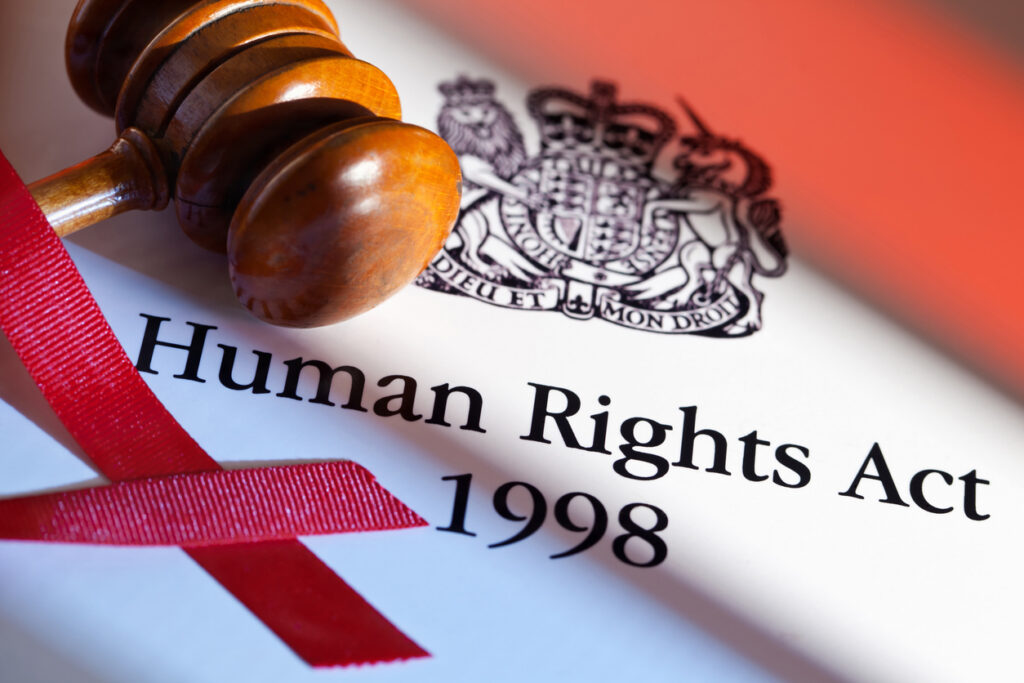
The Human Rights Act 1998 (HRA) is a landmark piece of UK law that incorporates the rights and freedoms set out in the European Convention on Human Rights (ECHR) into domestic British law. Its primary purpose is to enable people to defend their rights in UK courts and to require public authorities, from government departments to local councils and the police, to treat everyone with fairness, dignity and respect.
For decades, a citizen with a grievance under the ECHR had to pursue a lengthy and expensive case at the European Court of Human Rights (ECtHR) in Strasbourg.
The act, introduced by the first Blair government to “bring rights home”, allows individuals to have their human rights cases heard in UK courts.
Anyone who believes that their rights protected by the Human Right Act have been violated, can bring a challenge through the courts.
The rights protected
The Human Rights Act protects a series of fundamental rights and freedoms, derived directly from the Articles of the European Convention on Human Rights.
The “convention rights” protected by the Human Rights Act include the right to life (Article 2); the prohibition of torture (Article 3); the prohibition of slavery and forced labour (Article 4); the right to liberty and security (Article 5); the right to a fair trial (Article 6); the prohibition of extra-legal punishment (Article 7); the right to respect for private and family life (Article 8); freedom of thought, conscience and religion (Article 9); freedom of expression (Article 10); freedom of assembly and association (Article 11); the right to marry (Article 12); the prohibition of discrimination (Article 14).
The HRA also protects rights found in later protocols added to the ECHR. The First Protocol, moreover, proclaims the right to the enjoyment of private property, the right to education and the right to free elections. The Sixth Protocol forbids the death penalty.
Articles 1 and 13 of the ECHR are not explicitly included in the Human Rights Act. This is because, by enacting the act, the UK effectively fulfilled these obligations.
Article 1 of the ECHR requires states to secure the convention’s rights within their own jurisdiction – the central purpose of the Human Rights Act.
Article 13 guarantees that individuals whose rights have been violated have access to an effective remedy, typically through the courts. The Human Rights Act is designed to ensure that such remedies are available and accessible.
How the Human Rights Act works
Interpreting legislation
Section 3 of the act requires UK courts to read and give effect to all legislation, as far as is possible, in a way that is compatible with the convention rights.
Declarations of incompatibility
If a senior court finds it impossible to interpret an act of parliament in a way that is compatible with the Human Rights Act, it can issue a “declaration of incompatibility.”
Such a declaration does not invalidate or strike down the legislation, nor is it legally binding on parliament. It serves as an invitation to ministers and MPs to amend the law so that it is compatible.
Evaluation question
How effectively does the “declaration of incompatibility” strike a workable balance between the protection of individual human rights and the doctrine of parliamentary sovereignty?
Duty on public bodies
Section 6 of the act states that it is “unlawful for a public authority to act in a way which is incompatible with a convention right.” The act applies to all public authorities (such as central government departments, local authorities and NHS Trusts), as well as other bodies, whether a public body or private organisation, which perform public functions. If an individual thinks their rights have been breached they can take the accused organisation to court.
Section 7 of the act states that any “person who claims that a public authority has acted (or proposes to act) in a way which is made unlawful by section 6… may bring proceedings against the authority under this Act in the appropriate court or tribunal, or rely on the convention right or rights concerned in any legal proceedings,”
Statements of compatibility
Under section 19 of the Human Rights Act, the minister in charge of a bill making its way through parliament must, before its second reading (in either the commons or Lords), make a “statement of compatibility”. The act defines this as a “statement to the effect that in his view the provisions of the bill are compatible with the convention rights”.
If the minister is unable to do this, they must make a statement declaring that although the government is unable to make a statement of compatibility, it “nevertheless wishes the House to proceed with the bill”.
Proposals for reform and developments
A British bill of rights
The Conservative-Liberal Democrat coalition government showed some enthusiasm for reform of the Human Rights Act. The coalition agreement featured a pledge to “establish a commission to investigate the creation of a British bill of rights that incorporates and builds on all our obligations under the European Convention on Human Rights, ensures that these rights continue to be enshrined in British law, and protects and extends British liberties.”
In March 2011, the government launched the independent commission on a bill of rights. The commission’s report, published in December 2012, was titled A UK Bill of Rights? – The Choice Before Us.
Of the Commission’s nine members, seven believed that, on balance, there was a strong argument in favour of a UK bill of rights. However, two members, namely Philippe Sands QC and Baroness Kennedy QC, remained unconvinced and expressed concern over the potential implications of a domestic rights framework, which could see the UK de-couple from the ECHR. Two members of the commission who supported a British bill of rights advocated withdrawing from the ECHR.
The shadow justice secretary, Sadiq Khan, responded: “The commission was a classic political fudge, designed to paper over the cracks within the Tory-led government, and [the] report is a dog’s breakfast as a result.”
The lack of consensus did not provide a sustainable basis for legislative progress. The Conservative Party, however, remained attached to the idea and included it in their 2015 general election manifesto.
The manifesto stated: “The next Conservative government will scrap the Human Rights Act, and introduce a British bill of rights. This will break the formal link between British courts and the European Court of Human Rights, and make our own supreme court the ultimate arbiter of human rights matters in the UK.”
Britain’s departure from the European Union necessarily occupied much of the government’s constitutional bandwidth.
Then, in June 2022, the justice secretary, Dominic Raab, introduced a formal Bill of Rights Bill to parliament. This proposed to repeal the Human Rights Act 1998 and give legal supremacy to the UK supreme court and make it explicit that UK courts can disregard rulings from the ECHR.
Liz Truss, upon becoming prime minister in September 2022, initially shelved the bill. Robert Buckland, the secretary of state for Wales, had previously warned that the proposals to “elevate certain parts of our existing statute law” risked politicising the courts.
However, the bill was then resurrected during Rishi Sunak’s tenure as prime minister, who reappointed Raab to the post of justice secretary. In April 2023, Raab resigned after a bullying inquiry found he acted in an “intimidating” and “aggressive” way towards officials.
Raab’s successor as justice secretary, Alex Chalk, then announced the government would drop the bill in June 2023.
Chalk told the House of Commons: “Having carefully considered the government’s legislative programme in the round, I can inform the House that we have decided not to proceed with the bill of rights.”
He added: “It is right that we recalibrate and rebalance our constitution over time, and that process continues.”
The Rwanda scheme
On 15 November 2023, the supreme court delivered a unanimous ruling upholding the court of appeal’s decision that the government’s Rwanda deportations scheme was unlawful. The court found that there were “substantial grounds for believing” that asylum seekers sent to Rwanda faced a “real risk of ill-treatment as a consequence of refoulement” – the practice of being returned to a country where they might face persecution or human rights abuses.
This principle is woven into several layers of law. But it would also contravene Article 3 of the ECHR, as applied by the Human Rights Act 1998, that “no one shall be subjected to torture or to inhuman or degrading treatment or punishment.”
The prime minister, Rishi Sunak, responded by introducing emergency legislation that would enable parliament to confirm Rwanda as a safe country under UK law. The Safety of Rwanda (Asylum and Immigration) Bill, later act, sought to disapply certain aspects of domestic law and the Human Rights Act 1998, and legally declare – for the purposes of the government’s deportation scheme – that Rwanda was a safe country.
Evaluation question
Is the Human Rights Act 1998 too weak to effectively restrain a determined government with a parliamentary majority?
The cross-party joint committee on human rights found that the bill was fundamentally incompatible with the UK’s human rights obligations. Specifically, the committee argued that by denying access to court to challenge the safety of Rwanda the Bill, the bill was not compatible with Article 13 of the ECHR – the right to an effective remedy.
The home secretary, James Cleverly, was not able to issue a “statement of compatibility” under section 19 of the Human Rights Act.
Cleverly stated: “I am unable to make a statement that, in my view, the provisions of the Safety of Rwanda (Asylum and Immigration) Bill are compatible with the convention rights, but the government nevertheless wishes the House to proceed with the Bill.”
The legislation avoided the more radical option of withdrawing from the ECHR altogether, which was opposed by the Rwandan government.
The Safety of Rwanda (Asylum and Immigration) Act was repealed by the Border Security, Asylum and Immigration Act 2025 passed by the Labour government elected at the 2024 general election.
Leaving the ECHR?
During the 2024 Conservative leadership election, candidate Robert Jenrick, who went on to be appointed shadow justice secretary, said that his party would “die” if they didn’t leave the ECHR and that it makes it “impossible to secure our borders”.
In June 2025, the Conservative leader Kemi Badenoch launched a review into whether the UK should withdraw from the ECHR, commenting that Britain “will likely need to leave” the convention.
Addressing the Conservative Party’s annual conference in October 2025, Badenoch announced that a future Conservative government will leave the ECHR.
In June 2025, Justice secretary Shabana Mahmood told the council of Europe that Britain will pursue reform of the ECHR and that “public confidence in the rule of law is fraying”.
Cases brought under the Human Rights Act
The Human Rights Act has led to several important court decisions.
In 2000, 19-year-old Zahid Mubarek was murdered in prison by a cell mate, who had a history of racist violence. Mubarek’s family won a ruling in 2003 ordering a public inquiry into the killing. The law lords, members of the House of Lords who also served as judges, ruled that the then-home secretary, David Blunkett, had wrongly refused to order the inquiry into how Mubarek had been incarcerated with a hardened criminal. The judges ruled that under the Human Rights Act the state has a duty to protect a prisoner’s right to life (Article 2) and also to investigate publicly a failure of the system.
The law lords ruled that an investigation must “ensure so far as possible that the full facts are brought to light; that culpable and discreditable conduct is exposed and brought to public notice; that suspicion of deliberate wrongdoing (if unjustified) is allayed; that dangerous practices and procedures are rectified; and that those who have lost their relative may at least have the satisfaction of knowing that lessons learned from his death may save the lives of others.”
In 2004, the law lords ruled that Part 4 of the Anti-terrorism, Crime and Security Act 2001 was incompatible with the Human Rights Act. The law had allowed for the indefinite detention without trial of non-UK nationals suspected of terrorism – a power that was being used to hold eight men (the “Belmarsh 8”) in Belmarsh Prison.
The law lords determined that this practice breached Article 5 of the ECHR (right to liberty), in conjunction with Article 14 (prohibition of discrimination), because only non-UK nationals could be detained indefinitely.”
Baroness Hale stated: “Democracy values each person equally. In most respects, this means that the will of the majority must prevail. But valuing each person equally also means that the will of the majority cannot prevail if it is inconsistent with the equal rights of minorities.”
The government had invoked Article 15 of the ECHR, which allows states to suspend certain rights “in time of war or other public emergency threatening the life of the nation… to the extent strictly required by the exigencies of the situation.”
The court ruled that the this derogation of Article 5 was not authorised by Article 15 of the ECHR.
Lord Hoffmann argued: “The real threat to the life of the nation, in the sense of a people living in accordance with its traditional laws and political values, comes not from terrorism but from laws such as these.”
This ruling forced the government to change the law, leading to the Prevention of Terrorism Act 2005. This new act, which was rushed through parliament in 17 days, replaced indefinite detention with “control orders”, which allowed the home secretary to restrict the movement and activities of suspects.
The Prevention of Terrorism Act and control orders were repealed by the Terrorism Prevention and Investigation Measures Act 2011.
In 2008, the boss of Formula One motor racing, Max Mosley, successfully brought a case after the News of the World newspaper had published an article about his private sex life, arguing they had made an unauthorised invasion of his private life. He won £60,000.
In 2014, the families of victims of the 1989 Hillsborough football disaster were able to request a second inquiry into the deaths of their loved ones under Article 2. This found that the 96 victims were unlawfully killed, identifying errors in the conduct of both the police and the ambulance service.
The Human Rights Act has also been used to protect freedom of the press, and protect secrecy when it comes to journalists’ sources. One such case was that of Sally Murrer, a reporter for the Milton Keynes Citizen, who was bugged by Thames Valley Police in 2006. Evidence brought in a subsequent case by Thames Valley Police was ruled inadmissible because the surveillance in this case was deemed to have breached Article 10 (freedom of expression) of the Human Rights Act, failing to respect rights in relation to journalistic source protection.
Quotes
“We will by statute incorporate the European Convention on Human Rights into UK law to bring these rights home and allow our people access to them in their national courts. The incorporation of the European Convention will establish a floor, not a ceiling, for human rights. Parliament will remain free to enhance these rights, for example by a Freedom of Information Act. We will seek to end unjustifiable discrimination wherever it exists. For example, we support comprehensive, enforceable civil rights for disabled people against discrimination in society or at work, developed in partnership with all interested parties.” – Labour Party manifesto for the 1997 general election.
“Across Europe, public confidence in the rule of law is fraying. There is a growing perception – sometimes mistaken, sometimes grounded in reality – that human rights are no longer a shield for the vulnerable, but a tool for criminals to avoid responsibility. That the law too often protects those who break the rules, rather than those who follow them… The European Convention on Human Rights is one of the great achievements of post-war politics. It has endured because it has evolved. Now, it must do so again.” – Shabana Mahmood, Justice Secretary, 2025.
Additional resources
- The Human Rights Act 1998): https://www.legislation.gov.uk/ukpga/1998/42/contents
- Liberty – Human Rights Organisation: https://www.libertyhumanrights.org.uk/

