The House of Commons must elect a speaker at the beginning of each new parliamentary term after a general election – or after the death, retirement or resignation of the incumbent.
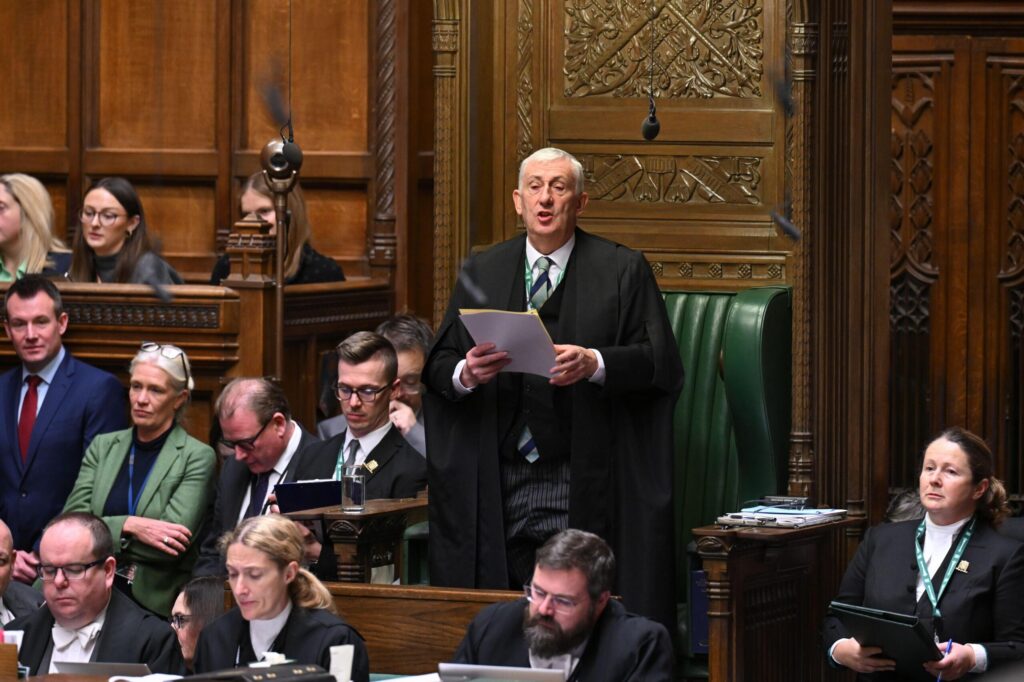
The speaker, perhaps best known for their shouts of “Order!”, is an MP who is elected by all other MPs to serve as the impartial chair of debates, the guardian of the House’s rules and its official representative. They sit in the chair at the head of the chamber, between the government and opposition MPs.
The process for electing a speaker is set out in the House’s standing orders (the parliamentary rulebook). The procedure differs depending on whether an incumbent speaker wishes to continue in the role or if a new speaker is being chosen.
The entire process is presided over by the father of the House, the MP with the longest record of continuous service, or the mother of the House (in the event that the longest-serving member is a woman).
The speaker election process: an uncontested re-election
This is the most common scenario and occurs when the speaker from the previous Parliament wishes to continue in the role after being re-elected to the House as an MP.
- The father of the House presides over the House and ascertains that the previous speaker is willing to stand again.
- A single motion is put to the House: “That [candidate name] do take the chair of this House as speaker.”
- This motion is typically agreed to by acclamation (a verbal “Aye”). If it were challenged, a division (formal vote) would be held.
- Once the motion is passed, the re-elected speaker is ceremonially “dragged” from their seat to the speaker’s chair. The speaker-elect then makes a short speech of thanks to the House.
- Finally, the monarch must signify their approval of the speaker, which is done by the appointment of a royal commission.
This was the procedure used to re-elect the current speaker, Sir Lindsay Hoyle, at the start of the new parliament in July 2024.
The speaker election process: a contested election
A contested election takes place when there is no returning speaker (due to retirement, resignation, or death) or, in the highly unlikely event, that the House votes against the incumbent.
Any MP can stand for election. Candidates must be nominated by between 12 and 15 other MPs. At least three of these signatories must be from a party different from the candidate’s own.
The election is conducted via the exhaustive ballot.
- Voters are given a list of candidates and place an “X” next to the candidate of their choice. If a candidate receives more than 50% of the vote, the question is put to the House that they take the chair as speaker.
- If no candidate receives 50% of the vote, the candidate with the fewest votes, alongside those with less than 5% of the vote, are eliminated.
- This process continues with successive ballots until one candidate receives more than 50% of the votes cast. That candidate is then declared the winner.
- The speaker-elect is then invited to take the chair and makes a short speech, followed by speeches of congratulation from the party leaders.
- The monarch subsequently signifies their approval of the new speaker.
The most recent example of a contested election was in November 2019, when Lindsay Hoyle was first elected. He won on the fourth and final ballot with 325 votes out of a total of 540 cast.
Who can stand in for election as commons speaker?
Any MP can stand to be Speaker. Although, in practice, those successful in the process tend to be backbenchers who have rarely if ever held a frontbench post. This is because the MP in question must convince the House that they can preside over commons business impartially.
Evaluation question
Why is it that successful speaker candidates are often backbenchers who have never held a senior frontbench post?
For this reason, successful candidates have often already served for a period as a deputy speaker. Lindsay Hoyle served as deputy speaker from 2010 to 2019.
A candidate must be nominated by at least 12 and no more than 15 MPs, including at least three elected to the House as members of a party other than the candidate’s or as members of no party.
Why is the speaker dragged to the chair?
The speaker officially represents the commons to the monarch. Historically, the position was precarious and sometimes perilous. Seven Speakers were executed by beheading between 1394 and 1535.
As a result – despite the substantial salary and grand accommodation provided within the Palace of Westminster – the speaker, upon their election, still demonstrates the traditional reluctance to assume the role by being ceremonially “dragged” from the backbenches.
Previous results of speaker elections
The current speaker, Lindsay Hoyle, was first elected to the role in November 2019 and was re-elected by the House after the 2019 general election in December as well as the 2024 general election.
In the first ballot of the November 2019 speakership election, the votes received were as follows:
- Sir Lindsay Hoyle – 211
- Chris Bryant – 98
- Dame Eleanor Laing – 113
- Harriet Harman – 72
- Dame Rosie Winterton – 46
- Sir Edward Leigh – 12
- Meg Hillier – 10
Sir Lindsay’s predecessor, John Bercow, was first elected on 22 June 2009 following the resignation of speaker Michael Martin over the parliamentary expenses scandal. Bercow was subsequently re-elected after the general elections in 2010, 2015 and 2017 on uncontested motions.
Bercow stepped down as Speaker on 31 October 2019.
In 2009, Bercow was one of 10 MPs to put their name forward. The candidates in question took part in unofficial hustings, organised by the Hansard Society.
In the first ballot of 2009, the votes received were as follows:
- John Bercow – 179
- Sir George Young – 112
- Margaret Beckett – 74
- Alan Haselhurst – 66
- Sir Alan Beith – 55
- Ann Widdecombe – 44
- Parmjit Dhanda – 26
- Richard Shepherd – 15
- Patrick Cormack – 13
- Michael Lord – 9
How the system has changed: the 2000 speakership election
The present system was introduced in 2001.
The last speaker election to be conducted under the old system took place in 2000, which saw Michael Martin selected, following the retirement of Betty Boothroyd. Martin’s election took place by means of a conventional parliamentary motion.
Under this system, a candidate for speaker would be nominated and seconded, with any alternatives put forward as amendments to that original motion. In 2000, 11 candidates came forward.
Edward Heath, the former prime minister and Father of the House, decided that Martin should be nominated first and therefore form the substance of the motion. In the end, no rival candidate was able to secure more support than Martin in any of the ballots, and as each opponent (amendment) was eliminated, the House finally decided on the original motion that Martin be elected speaker.
Heath initially put the question “on the voices”, but because there was audible disagreement among MPs, a division followed. The House then approved the motion by 370 votes to 8, and Martin was elected as speaker.
The repeated ballots took nearly six hours. Following a review of the election process in 2001, MPs agreed that the procedure should be made more transparent and straightforward.
In memorandum to the House of Commons procedure committee at the time, the Electoral Reform Society (ERS) set out four criteria for assessing the fairness of a speakership electoral system:
- The winning candidate should have the support of more than 50% of those voting.
- Members should be able to vote for the candidate of their choice without fear of their vote being wasted.
- All candidates should be treated equally.
- The procedure should be transparent and efficient.
During the debate on the procedure committee’s ultimate recommendation (the exhaustive ballot), MPs had the opportunity to vote on whether the ballot should be secret or not. Labour MP David Winnick moved an amendment “to leave out the word ‘secret’”. The amendment was rejected by 84 votes to 82.
The main question to amend the standing orders was agreed to without a division.
The 2015 attempt to change the rules: Bercow controversy
On 26 March 2015, the final day of commons business before parliament dissolved for the general election, the government suffered a humiliating defeat on a motion widely seen as an attempt to oust the speaker, John Bercow.
The proposal, spearheaded by the leader of the House of Commons, William Hague, sought to introduce a secret ballot to re-elect Bercow as speaker in the next parliament. This would have brought the process for re-electing an incumbent speaker into line with the rules used for a contested speakership election. Crucially, a secret ballot would have provided political cover for critical Conservative MPs who wished to remove Bercow from his post.
Evaluation question
What does this episode suggest about the capacity of the independent chair to withstand political pressure and government interference?
Michael Gove, the chief whip, was also said to be a key proponent of the measure in government.
Hague told MPs: “I think a secret ballot frees members of this House completely from pressure from their parties or from the chair… that is the right thing in principle to do.”
The timing of the motion sparked an acrimonious and at times emotional debate. Critics, comprising Labour, Liberal Democrat and some Conservative MPs, condemned the move as a cynical ploy to remove Bercow – who was unpopular with many on the government frontbench.
In a deeply unusual final sitting day, Bercow was said to have granted three urgent questions to buy supportive MPs more time to rush back to the commons to defeat the government measure. Just one hour had been allotted by the government for MPs to debate the measure. And while the vote was nominally a ‘free vote’, Conservative MPs had been instructed to remain in parliament on a three-line whip.
Conservative MP Charles Walker, the chair of the commons procedure committee, said he had been “played for a fool” by ministers in a tearful speech.
He said: “I have been played as a fool and when I go home tonight I will look in the mirror and see an honourable fool looking back at me and I would much rather be an honourable fool in this and any other matter than a clever man.”
MPs, including a Conservative backbencher, rose to their feet to applaud Walker’s contribution – a symbolic break with commons convention. A tearful Bercow rose to bring the House to order.
Walker, like the rest of the House, had been given virtually no notice of the government’s intention to bring the motion. He was informed of the government’s intention to consider the procedure committee’s report on the election of the speaker – his committee’s report – on the evening before the debate.
Sir Gerald Kaufman, a veteran Labour MP, accused Hague of a “grubby, squalid and nauseous” attempt to change the rules.
Having presided over the debate, Bercow was visibly emotional upon announcing the result. The government’s motion was defeated by 228 votes to 202 – a majority of 26. Opponents of the measure included 23 Conservative MPs and 10 Liberal Democrats.
The result was a personal victory for the speaker, but highlighted tensions between the government and the chair that would emerge again during the fraught debates on Brexit from 2016 to 2019.
Bercow was re-elected as speaker of the House unopposed following the 2015 election.
What happens to the speaker’s seat during a general election?
Although the Speaker renounces their party affiliation on taking the chair, they continue to represent their constituency. At general elections, the incumbent Speaker stands as an independent “Speaker” candidate and, by convention, the main political parties do not contest the seat.
Evaluation question
Is the convention of not challenging the speaker in their constituency at a general election a necessary protection, or is it an undemocratic practice that effectively disenfranchises the voters in that seat?
At the 2024 general election, Lindsay Hoyle was returned with 74% of the vote. His only significant challenge came from the Green Party, which secured 14% of the vote.
The election of deputy speakers
After the speaker is elected, the House also elects three deputy speakers who are also MPs. These elections are conducted using the single transferable vote (STV) system.
The rules are designed to ensure political balance. Two of the deputy speakers must be from the opposite side of the House to the speaker; as such, if the speaker is from the Labour Party (like Hoyle), two deputies must be from the Conservative Party. The results must also ensure that, across the four posts of speaker and the three deputies, there is at least one man and at least one woman.
The role of senior deputy speaker, who serves as the chairman of ways and means, is awarded to whichever candidate from the opposite side of the House (to the speaker) wins the first seat in the election.
In 2024, MPs elected Nusrat Ghani (Conservative), Judith Cummins (Labour) and Caroline Nokes (Conservative) as deputy speakers. This was the first time all three deputy speakers were women, and it represented the most diverse group ever to hold the roles.
Hoyle responded: “This parliament is breaking more glass ceilings than ever before, with the biggest number of women MPs ever – and now an all-female team of deputies.
“All three MPs are incredible politicians who are well-respected by this House, and I am looking forward to working with them.”
The role of deputy speakers is to assist the speaker of the House. Ghani, as chairman of the ways and means committee, also chairs the budget debate, supervises the arrangements for sittings in Westminster Hall and serves as chair of the panel of chairs.
The panel of chairs is made up of MPs chosen by the commons speaker, typically at the beginning of every parliament, to chair public bill committees and other commons general committees. They also chair debates in Westminster Hall and may also act as temporary chair during a committee of the whole House.
Deputy speakers also oversee the selection of amendments during a committee of the whole House, where they preside as chair.
Like the speaker, they withdraw from an active political role while in office. However, unlike the speaker, they stand for their political parties in contested elections at general election time.
Pending the election of deputy speakers, the commons speaker may appoint temporary deputy speakers.
1992 speakership election: the rise of Betty Boothroyd
On 27 April 1992, Betty Boothroyd made parliamentary history when she was elected as the speaker of the House of Commons, the first – and to date only – woman to hold the office in its more than 700-year history. Her election followed the retirement of the previous speaker, Bernard Weatherill, in the wake of the 1992 general election.
In a rare contested election for the post, Boothroyd, who had served as a deputy speaker for five years, defeated former Conservative cabinet minister Peter Brooke by 372 votes to 238 – a majority of 134. It was the first such contest since 1951, and the sixth since 1800.
It was presided over by Conservative MP Edward Heath, the prime minister from 1970 to 1974, in his capacity as father of the House.
Boothroyd’s election also marked the first time since the Second World War that a member of the opposition party had taken on the role of speaker. She was a Labour MP during a period of Conservative government. More than 70 Tory MPs voted for Boothroyd.
Presiding over the first meeting of the commons since the 1992 election, Heath first explained the rules to the House.
The central motion originally proposed that MPs elect Peter Brooke as speaker, but was amended to provide for Boothroyd’s election.
In her contribution, Boothroyd famously called on MPs to “elect me for what I am and not for what I was born. That is crucial.”
She concluded: “I now have to offer myself as the voice of the House – sensitive to the concerns of every Member, aware of the supreme duty of the Speaker to safeguard the rights of this House, abandoning all my previous commitments to party, and content to serve the House for as long as it may require.”
One division took place on the amendment to endorse Boothroyd as speaker. It was passed by 372 votes to 238 – a majority of 134. The House subsequently agreed the amended motion that “Betty Boothroyd do take the chair of this House as speaker.”
MPs defied commons protocol in standing and applauding Boothroyd’s election.
In an otherwise convention-shattering day, Boothroyd was ceremonially dragged to the chair. Boothroyd, addressing the House as speaker-elect, thanked MPs for the “very great honour that it has bestowed on me.”
She added: “I pray that I shall justify its confidence, and I pledge that I shall do all in my power to preserve and cherish its traditions.”
John Major, the prime minister, congratulated Boothroyd on her election, noting she was the “the first honourable lady to assume the awesome responsibilities of speaker”.
Major told the commons: “I shall not dwell on that point, except to note that you have made history today. It seems to me, however, that the question of why you have made history is relevant.
“You have become our speaker-elect because the House trusts you. It believes that you enjoy in abundance the qualities necessary to protect and sustain the House, and to safeguard its rights. For those reasons and no other, you have become our speaker, and I offer you my warmest congratulations.”
Upon her election to the chair in 1992, Boothroyd declined to wear the traditional wig and found herself having to confront MPs who still referred to her as “Mr Speaker”.
Boothroyd quickly established a reputation as firm, fair and formidable as speaker, using her powerful voice and direct, no-nonsense style to maintain order.
Her distinctive catchphrases, particularly “Right – time’s up!”, became familiar to a wide audience as she presided over the newly televised proceedings of the commons. She became a popular and respected public figure, greatly raising the profile of the speakership.
Boothroyd served as speaker for eight years from April 1992 to October 2000. She was re-elected unopposed to the role following the 1997 general election.
She announced her intention to stand down as speaker on 12 July 2000.
1835 speakership election: the fall of Manners-Sutton
On 19 February 1835, the first meeting of the House of Commons since the recent general election led to the deposition of the incumbent speaker, Charles Manners-Sutton. The Whig opposition successfully blocked Manners-Sutton’s bid for an eighth term, electing James Abercromby in his stead.
Manners-Sutton had served as speaker since 1817. He was reelected unopposed in 1819, 1820, 1826, 1830 and 1831. The move to displace Manners-Sutton in 1835, orchestrated by the Whig leadership, represented the first time a speaker had been removed by a vote of the House since 1780.
The debate centred on the accusation that Manners-Sutton had colluded with King William IV and the Duke of Wellington to subvert the previous Whig government.
In the final months of the 1832-1834 parliament, William IV dismissed the Whig administration of Viscount Melbourne. He reportedly objected to the appointment of Lord John Russell as a senior minister in Melbourne’s government, believing Russell to be a radical. These moves came despite the Whigs holding a commons majority.
The 1835 speakership election therefore represented an opportunity for the Whigs to exhibit their parliamentary strength.
Parliament’s reassembly on 19 February marked both the first meeting since the 1835 general election – and the first since a devastating fire destroyed most of the medieval Palace of Westminster.
Conservative MP Lord Francis Egerton was the first to speak in the new parliament.
Egerton argued that the blaze necessitated the re-election of Manners-Sutton as speaker. Egerton referenced the destruction of documents containing records of parliamentary precedent. He maintained that the House had lost its written memory, and therefore needed Sutton’s personal memory to function in its temporary accommodation.
Egerton’s defensive posture owed to the aggressive stance adopted by the Whigs. For the inferno had inspired a sense of political intrigue.
In his contribution to proceedings, Manners-Sutton argued that his frequent meetings with the king and attendance at the privy council – which the Whigs viewed as plotting – were actually about the fire.
William Joseph Denison rose to propose James Abercromby as the Whig candidate for the speakership.
Lord John Russell, the leader of the Whigs in the commons, acquitted Sutton of “any share in any political intrigues” regarding the dismissal of the government. However, he argued that Manners-Sutton’s attendance at the privy council during the crisis – even if it was regarding the fire – was “conduct unbecoming the speaker of the House of Commons”.
Russell argued that Manners-Sutton should have made excuses to avoid meetings dominated by the new Conservative government. By failing to do so, he stated, Sutton’s “political bias… had got the better of him” and “induced him to concur in acts, which, as speaker of the House of Commons, he had much better have avoided.”
Manners-Sutton was a Tory parliamentarian before assuming the speaker’s chair, and the Whigs saw him as an opponent of the Reform Act 1832. (Following the act’s passage, the speaker was even considered as a possible prime minister at the head of pro-reform Conservative ministry – largely because, in his capacity as speaker, he had maintained a technically neutral stance on the reform question.)
Robert Peel, the new Conservative prime minister, characterised the attempt to remove Manners-Sutton as an act of “singular ingratitude.” He reminded the House that the reformers were happy to support Manners-Sutton in the 1833 speakership election, but now sought to “unfairly take the very first opportunity to subject him to disgrace.”
Manners-Sutton had faced a challenge in 1833, but only from disgruntled Radical members (notably Joseph Hume, Francis Burdett and Daniel O’Connell). At the time, Whig ministers preferred the prospect of an experienced speaker to preside over the first parliament elected since the 1832 Great Reform Act.
Peel concluded that the “precincts of the chair ought not to be converted into ground on which political battles might be fought”.
The House proceeded to a division – an immediate test of the strength of the parties in the new parliament. The result was a narrow victory for the Whig opposition. Abercromby was elected speaker by 316 votes to 306 – a majority of 10.
Among those who voted for Manners-Sutton included William Gladstone, a young Conservative MP, and John Evelyn Denison, a future speaker of the House.
Quotes
“Colleagues you have just bestowed upon me the greatest honour that I have enjoyed in my professional life. I thank you from the bottom of my heart for the confidence that you have placed in me and I am keenly aware of the obligations into which I now enter. I want just to say this about the responsibility of the office of speaker. I said only a few hours ago in my speech that if elected the speaker has a responsibility immediately and permanently to cast aside all of his or her political views. I said it and I meant it. My commitment to this house is to be completely impartial between members of one political party and another. That is what it is about. I will do my best faithfully and honourably and effectively to serve this house in the period ahead.” – John Bercow, speaking upon his election as speaker in 2009
“I hope that this House will be once again a great, respected House, not just in here but across the world. I hope that once again it is the envy, but we’ve got to make sure that the tarnish is polished away, that the respect and tolerance that we expect from everyone who works in here will be shown and we will keep that in order.” – Sir Lindsay Hoyle, speaking upon his election as speaker in 2019.

