Bercow casts deciding vote on day of immense Brexit drama
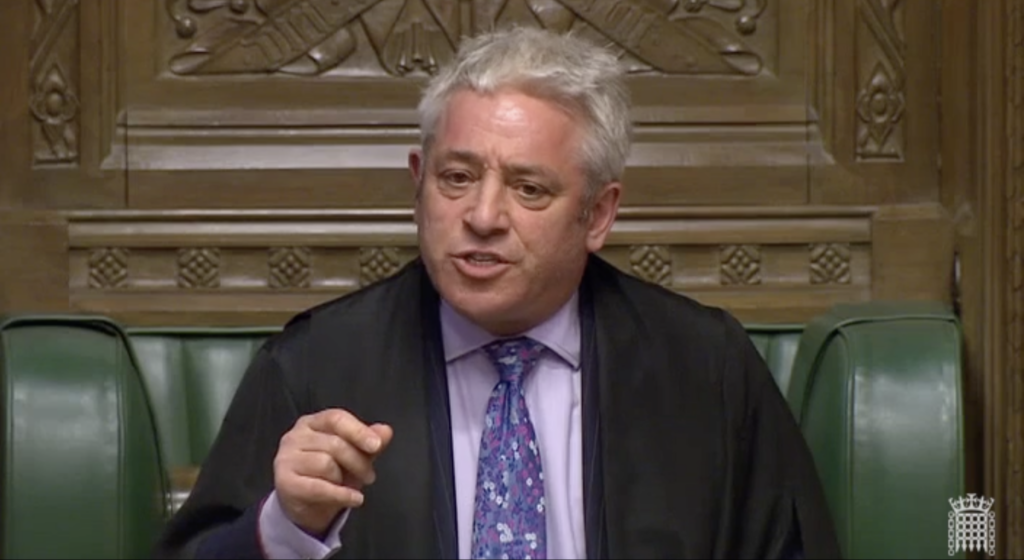
On 3 April 2019, in a day of high Brexit drama, the speaker of the House of Commons, John Bercow, was forced to use his casting vote to break a deadlocked vote; MPs rushed through a private member’s bill designed to block a “no-deal” outcome; two ministers resigned; and the prime minister, Theresa May, began cross-party talks with Labour leader Jeremy Corbyn in an effort to break the Brexit impasse.
These developments came as the Brexit deadline under Article 50 of the Treaty on European Union – 12 April – approached.
***
During this phase of the “Brexit wars”, the normal commons standing orders – which maintain that government business should take “precedence at every sitting” – were suspended. In late March, Conservative MP Oliver Letwin tabled a successful amendment which allowed MPs to debate and vote on alternative Brexit paths.
Under this arrangement, referred to as the “Letwin days”, MPs held two rounds of “indicative votes” on alternative Brexit options. The first, on 27 March 2019, produced no majority for any option. A second round on 1 April also failed to produce agreement. However, a proposal from the Conservative father of the House, Kenneth Clarke, advocating a permanent customs union with the European Union came within three votes of passing (276 to 273).
The debate on 3 April was a result of procedural “daisy-chaining”, whereby backbench business motions included provisions allowing further business motions to be tabled on subsequent days. In this way, a business motion approved on 1 April (by 322 votes to 277) allowed a further business motion to be tabled on 3 April which created time for MPs to consider the European Union (Withdrawal) (No. 5) Bill through all its commons stages in a single day. This bill was introduced by Labour MP Yvette Cooper and Letwin to compel the government to allow parliament to debate a motion directing the prime minister to seek an extension to Article 50.
The tied vote, 310 to 310, came on a backbench amendment to the original business motion tabled by senior Labour MP Hilary Benn that sought to secure further parliamentary time for a third round of indicative votes. Benn’s amendment was supported by Cooper and Letwin. In accordance with precedent, which dictates that the speaker should not create a majority where one does not otherwise exist, Bercow cast his vote with the “Noes”.
Upon announcing the tied vote, Bercow confirmed that, “In accordance with precedent, and on the principle that important decisions should not be taken except by a majority, I cast my vote with the Noes, so the Noes have it.”
He added: “By casting vote, it is 311 to 310. That is the proper way in which to proceed.”
Independent Group MP Mike Gapes asked the speaker if the House could be certain the vote was in fact a tie. Bercow admitted that he did not have “Kantian perfect information on the subject”, but he had been advised that a possible discrepancy – raised by a government whip – would have fallen in the government’s favour.
He added: “In the event that there was an error, I think that I will resort to the Willie Whitelaw defence at this stage: let us cross that bridge if we come to it.”
***
Tied votes in the House of Commons are immensely rare.
Bercow told the commons that the situation had not occurred since 1993 on a vote concerning the ratification of the Maastricht treaty on European integration. This tie came on an amendment to a motion approving the government’s policy on the social chapter of the Maastricht treaty. The speaker, Betty Boothroyd, voted against the amendment.
In January 1980, the commons speaker was forced to intervene on a motion for leave to bring in the Televising of Parliament Bill. Bernard Weatherill cast his vote in favour to allow for further debate.
The precedent that defines the speaker’s agency in this area is referred to as ‘speaker Denison’s rule’ – named after John Evelyn Denison, the speaker from 1857 to 1872. Denison was in the chair when a tie arose on an 1867 motion on fellowships at Trinity College, Dublin. Denison, casting his vote against the motion, declared that any decision must be approved by the majority.
This rule saved James Callaghan’s Labour government (1976-1979), which had lost its majority in the House, from several defeats. In 1976, a division held on a Conservative amendment to accept the speaker’s ruling that a proposed bill was a Hybrid Bill (meaning it would be subject to separate and more complex standing orders) resulted in a 303-303 tie. The government had indicated its intention to bypass the speaker’s ruling. Ironically, the speaker, George Thomas, voted against the Conservative amendment and therefore against his own ruling to preserve the bill.
More recently, in December 2025, the deputy speaker, Caroline Nokes, cast a deciding vote in favour of the UK-EU Customs Union (Duty to Negotiate) Bill. The bill, introduced under the 10-minute rule procedure by Liberal Democrat Europe spokesperson Al Pinkerton, sought to mandate the government to enter into negotiations with the European Union to establish a bespoke customs union.
Nokes voted in favour of the bill, breaking a 100-100 tie, to ensure further debate.
***
After the defeat of Benn’s amendment, Letwin’s main motion – relating to the European Union (Withdrawal) (No. 5) Bill – was approved by just 312 votes to 311.
The day’s proceedings were subsequently dominated by an unprecedented sprint to secure the passage of Cooper’s bill, according to the timetable set out in the business motion.
Cooper, moving the second reading of the bill, said that parliament had a responsibility to ensure there was a system in place “to prevent no deal”.
Conservative MP Antoinette Sandbach accused some of her colleagues of “revisionism”.
She told the House: “We are seeing the revisionism of history by European Research Group members, who claim that 17.4 million people voted for no deal. That was not on the ballot paper; what was on the ballot paper was our membership of the EU.”
The government frontbench argued that the bill, which sought to prevent a no-deal exit by legally compelling the prime minister to seek an extension to Article 50, was unnecessary. They pointed to the fact Theresa May, the prime minister, had already indicated her intention to seek an extension to Article 50.
Stephen Barclay, the Brexit secretary, characterised the bill as “constitutionally irregular”, arguing that it ignored the logistical and legal realities of negotiating with the EU. Barclay warned of the precedent the debate was setting “for this and successive governments.”
Speaking in the previous debate, Letwin said the government’s plan to seek an extension was an “enormously welcome development”, but nonetheless insisted on the need to pass legislation.
He told the House: “There is concern that there should be a transparent and orderly statutory framework where the House has the opportunity to consider the length of the extension which is asked for and to provide the prime minister with backing for that request to the EU.”
The veteran Brexiteer Bill Cash called the bill “reprehensible” and “profoundly undemocratic”.
The bill was approved at second reading by 315 votes to 310 – a majority of five.
The bill’s committee stage was especially chaotic, with questions arising as to the nature of the bill itself, proposed amendments, and the grouping of those amendments. The deputy speaker, Lindsay Hoyle, conceded that the commons was “trying to play catch-up a little bit.”
Indeed, the bill’s proponents were forced to table their own amendments to fix drafting errors.
Conservative MP Michael Tomlinson said this raised the “difficulty of trying to make law on the hoof.”
He added: “We have had only 55 minutes for second reading and there is a most obvious drafting error in her [Cooper’s] original bill. There was a simple mistake, getting the section wrong, and reading through it I simply did not understand at all which bill she was referring to.”
Cash, the Conservative chair of the European scrutiny committee, said he had “never seen a bill that is more likely to drive everybody mad than this one. I really am astonished at what rubbish it is… In short, the bill is a complete and total rubbish dump.”
In the end, the bill secured its commons third reading by 313 votes to 312 at 11:09 pm.
Conservative MP Mark Francois said the bill amounted to a “constitutional outrage”, adding: “Forgive them, Father, for they know not what they do.”
The European Union (Withdrawal) Act 2019, or the “Cooper-Letwin act”, received royal assent on 8 April.
The day’s events coincided with two ministerial resignations.
Chris Heaton-Harris resigned as a junior minister at the Department for Exiting the EU. Heaton-Harris, who became the 30th minister to resign from May’s government (and the eighth from the Brexit department), said he could not support a further delay to leaving the EU.
In his resignation letter, Heaton-Harris referenced his responsibility for no-deal preparations.
The Conservative MP, who supported a no-deal Brexit, added: “However, I completely understand you do not want to leave the European Union without a negotiated deal and that obviously makes my job in government irrelevant.”
He said the UK should have “honoured the result of the 2016 referendum” and left on 29 March, the original Brexit deadline.
On top of this, Nigel Adams resigned as a junior Wales Office minister, arguing that Britain could have coped with a “managed no-deal”. Adams also pointed to the prime minister’s purported strategy to “cook up a deal with a Marxist”.
This accusation came as May began discussions with Jeremy Corbyn, the Labour leader of the opposition, over how Britain should navigate the Brexit impasse. A Labour spokesperson, reporting on the evening of 3 April, said May and Corbyn had held “constructive exploratory discussions about how to break the Brexit deadlock.”
***
On 9 April 2019, the commons debated a government motion introduced under the terms of the European Union (Withdrawal) Act 2019. It was agreed by 420 votes to 110, compelling the prime minister to “seek an extension of the period specified in Article 50(3) of the Treaty on European Union to a period ending on 30 June 2019.”
At this stage, May had already journeyed to Brussels to formally file a request for an extension – and so the 9 April motion was passed retrospectively.
However, the EU rejected the 30 June request – which was intended to avoid upcoming European Parliament elections. Instead, an extension until 31 October was agreed. As the EU noted, this extension meant Britain was now under an “obligation to hold the elections to the European Parliament in accordance with Union law.”
The Cooper-Letwin act showed parliament at its most powerful, overriding the wishes of the government of the day. It would not be the last time that backbenchers would foist legislation onto the executive. The European Union (Withdrawal) (No. 2) Act 2019, or the “Benn act”, similarly compelled the prime minister to seek an extension if no deal was agreed.
The Benn act was agreed in October 2019 during Boris Johnson’s tenure as prime minister. Theresa May announced her resignation on 24 May, shortly before the results of the recent European parliament elections were announced.
Corbyn had previously pulled out of the cross-party Brexit talks on 17 May, telling the prime minister that they had “gone as far as they can”. The Labour leader pointed to “important policy gaps between us”. The negotiations helped alienate Tory MPs beyond the point of no return.

Politics.co.uk Newsletters
DAILY
Politics@Lunch
WEEKLY
Week in Review