The lord speaker is the presiding officer of the House of Lords, responsible for chairing daily business in the chamber and acting as the highest authority within the House. The role is similar to the speaker of the House of Commons, but the post possesses significantly fewer powers.
The difference in stature between the lords speaker and their commons counterpart reflects the self-regulating nature of the upper chamber.
The lord speaker is elected by the members of the House of Lords and is expected to be politically impartial, resigning their party affiliation upon election. As well as their procedural duties, the lord speaker acts as a key public figure; they represent the House of Lords both in the UK and internationally.
The current lord speaker is Lord Forsyth of Drumlean, who succeeded Lord McFall of Alcluith in February 2026.
Commenting following his election Lord Forsyth said: “I would like to thank all my supporters for the trust and confidence they have shown in me. I am grateful too to my opponent Baroness Bull who ran a vigorous, courteous, and friendly campaign.
“I would also like to pay tribute to Lord McFall, the outgoing lord speaker. He has made great strides in improving the governance of the House and the accountability of the administration to Members. I intend to build on that work as chair of the House of Lords commission and lord speaker.”
The lord speaker’s role in a self-regulating chamber
The House of Lords is a self-regulating body, meaning its members are collectively responsible for maintaining order and upholding the rules of the House. This nature means the lord speaker’s role in the chamber is very different from that of the commons speaker.
The lord speaker has no power to:
- Call members to order for disruptive behaviour.
- Decide who speaks next if two members rise at the same time.
- Select which amendments to legislation are debated.
Instead, the lord speaker’s primary procedural functions during debates are to formally put the question to the House before a vote and to announce the result of any vote. They may also offer procedural advice to the House when required.
Administrative and ambassadorial duties
Beyond the chamber, the Lord Speaker has significant administrative and representative responsibilities.
Chair of the House of Lords commission
The lord speaker chairs the House of Lords commission, the senior governing body that provides strategic direction for the administration of the House of Lords.
Security
They have formal responsibility for security in the parts of the Palace of Westminster occupied by the House of Lords.
Ceremonial role
The lord speaker speaks on behalf of the House on major state and ceremonial occasions.
Ambassador for the House
A key part of the role is to engage with the public, particularly young people, to explain the work of the House of Lords. This includes attending conferences with speakers of other parliaments from around the world.
Podcaster(?)
During his tenure as lord speaker, Lord McFall began a podcast series entitled Lord Speaker’s Corner. In this capacity, McFall interviewed a series of high-profile peers including Lord Heseltine, Lord Gove and Lord Kinnock.
History of the role
The office of lord speaker is a modern creation, established by the Constitutional Reform Act 2005. Before this act, the presiding officer of the House of Lords was the lord chancellor.
This historic arrangement was reformed to promote a clearer separation of powers. The lord chancellor was previously a member of all three branches of government. They were a government minister (executive), a judge (judiciary), and the presiding officer of the Lords (legislature).
The 2005 act transferred the legislative function of presiding over the House to the newly created, politically impartial role of the lord speaker. The first election for the post was held in 2006.
How the lord speaker is chosen
The lord speaker is elected by the members of the House of Lords using the alternative vote (AV) system. Candidates are typically senior members with extensive experience of the House’s procedures. Each candidate requires a proposer and a seconder. They produce an election address of up to 300 words and take part in hustings.
In his election pitch, Lord Forsyth promised “leadership for a more effective, respected and influential House” and had argued that “as the commons continues to struggle to scrutinise legislation effectively, greater pressure will fall on this House”.
He added: “I offer experience, financial expertise, communication skills and collaborative leadership. Together we can make this House more effective, respected and united.”
An online voting system is used.
Forsyth, a Conservative peer, won 383 votes (56.3%), thereby defeating crossbencher Baroness Bull, who secured 297 votes (43.7%).
The successful candidate serves a five-year term and may be re-elected for one further five-year term. Upon election, the lord speaker must relinquish any party or group affiliation to remain politically impartial.
Current and previous lord speakers
- Lord Forsyth of Drumlean (2026 – )
- Lord McFall of Alcluith (2021 – 2026)
- Lord Fowler (2016 – 2021)
- Baroness D’Souza (2011 – 2016)
- Baroness Hayman (2006 – 2011)
The Woolsack
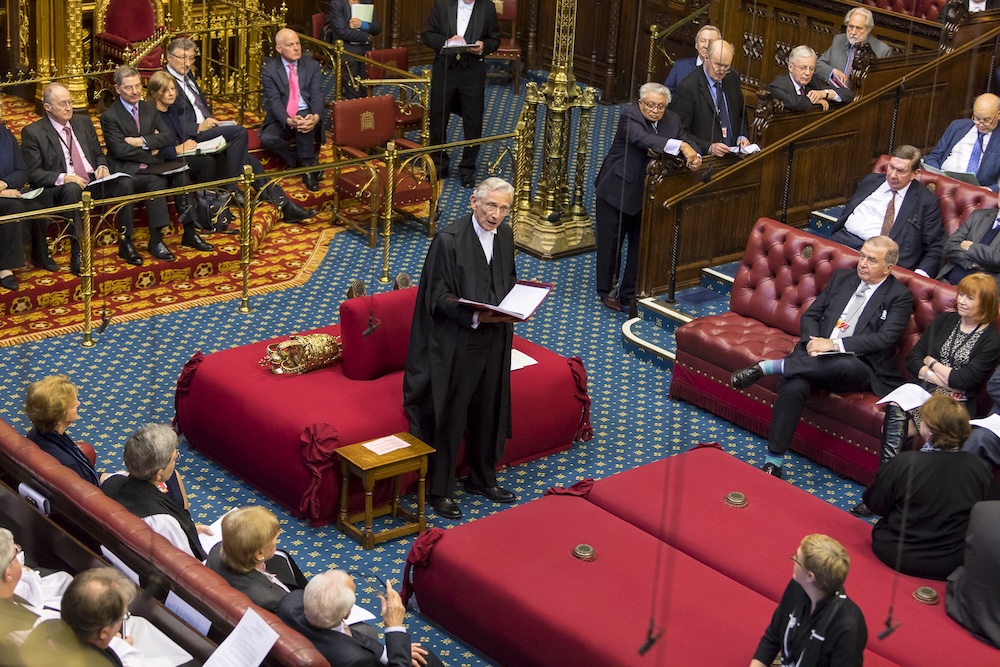
The lord speaker presides from the Woolsack, a large, armless seat stuffed with wool and covered in red cloth. Dating to the 14th century, it is said to symbolise the historic importance of the wool trade to the wealth of the English economy. The Woolsack is technically not located within the formal bounds of the House, so the lord speaker must step to the side of it to address the members as a peer.
Additional resources
- UK Parliament – Former Lord Speakers: https://www.parliament.uk/business/lords/lord-speaker/history-of-the-lord-speakers-role/former-lord-speakers/
- UK Parliament – Election of the Lord Speaker 2026: https://www.parliament.uk/business/lords/lord-speaker/the-role-of-lord-speaker/election-of-the-lord-speaker-2026/
- UK Parliament – Lord Forsyth of Drumlean is next Lord Speaker: https://www.parliament.uk/business/news/2026/jan-2026/lord-speaker-election-result/
- UK Parliament – Lord Speaker’s thanks to President Zelenskyy: https://www.parliament.uk/business/news/2023/february-2023/lord-speakers-remarks-to-president-zelenskyy/
- UK Parliament – About Lord McFall of Alcluith: https://www.parliament.uk/business/lords/lord-speaker/about-lord-speaker/