The crown in parliament, also known as the king in parliament, is the constitutional term for the supreme law-making authority in the United Kingdom.
It describes the legal entity of the monarch acting on the advice and with the consent of the two Houses of Parliament – the House of Commons and the House of Lords. This composite body (sovereign, commons and Lords) finds formal expression in the preamble to every act, known as the enacting formula.
The preamble reads: “BE IT ENACTED by the King’s most Excellent Majesty, by and with the advice and consent of the Lords Spiritual and Temporal, and Commons, in this present Parliament assembled, and by the authority of the same, as follows:”
Under the doctrine of the crown in parliament, an act of parliament is the highest form of law in the UK.
The crown in parliament is thereby said to be the source of sovereignty in the British constitution.
According to constitutional scholar A.V. Dicey: “Parliament means, in the mouth of a lawyer (though the word has often a different sense in ordinary conversation), the king, the House of Lords, and the House of Commons; these three bodies acting together may be aptly described as the ‘king in parliament’ and constitute parliament.”
However, while the monarch is an integral part of the legislative process, their role today is mostly ceremonial governed by long-standing constitutional convention. The monarch acts on the advice of their ministers and does not exercise any independent political power over the legislative agenda.
The monarch’s function in the legislative process
The monarch has a series of key constitutional duties. These include the state opening of parliament, the formal appointment of the prime minister, giving royal assent to parliamentary legislation, and approving official appointments and secondary legislation through the privy council.
The king’s speech
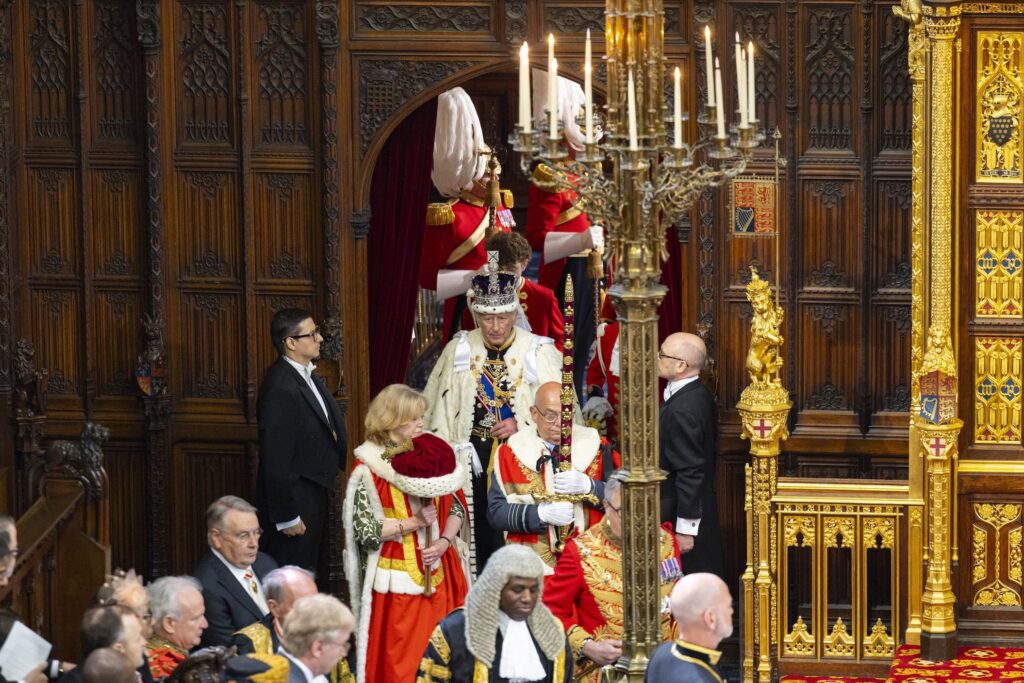
Each new parliamentary session begins with the state opening of parliament, a ceremony in which the monarch travels to the House of Lords. From the throne in the Lords chamber, the monarch reads the king’s speech, which is written by the government and outlines its proposed policies and legislative programme for the session ahead.
The speech from the throne in July 2024 was the first delivered under a Labour government in 15 years.
Oath of allegiance
All MPs and peers in the House of Lords must swear or affirm their loyalty to the monarch of the day upon their election and/or at the beginning of a new parliament in order to assume their seats. By convention, MPs also retake the oath following the death of a monarch.
The nature of the oath of allegiance and affirmation have been the cause of considerable controversy over the years. Reforms in 1829 and 1888 allowed Catholics and atheists respectively to swear allegiance to the sovereign and thereby take up their place in parliament.
Republicans and Irish nationalists still voice protests over the oath/affirmation. In July 2024, Social Democratic and Labour Party (SDLP) MP Colum Eastwood described the affirmation and oath of allegiance to the King as an “empty formula”.
Taking part in the compulsory swearing-in ceremony, historically an awkward and contentious moment for nationalist politicians, Eastwood told the House: “I read out this empty formula in order to represent my constituents, but it’s under protest.
“I do solemnly, sincerely and truly declare and affirm that I will be faithful and bear true allegiance to His Majesty King Charles, his heirs and successors according to law.
“My true allegiance is to the people of Derry and to the people of Ireland.”
Meanwhile, Labour MP Clive Lewis, a prominent supporter of Britain becoming a republic, initially declared his allegiance to the king “under protest” as he took his seat in the commons after the 2024 election.
Lewis stated: “I take this oath under protest and in the hope that one day my fellow citizens will democratically decide to live in a republic.”
The Labour MP also did not refer to “his heirs and successors”. He was made to retake the oath due to this omission. Had Lewis not taken the oath, a by-election would have been triggered in his Norwich South constituency.
Evaluation question
To what extent can the tradition of a compulsory swearing-in ceremony be defended against the criticism that it forces some MPs to compromise their personal political principles?
NEW: Labour MP Clive Lewis has been made to swear in again, having taken the House of Commons oath “under protest” last week
In his initial rendition, Lewis also *forgot* to swear allegiance to King Charles’ “heirs and successors” — which I suppose was a no no
Attempts 1 & 2: pic.twitter.com/rWtZ8zMi7F
— Josh Self (@Josh_Self_) July 16, 2024
Royal assent
Royal assent is the final step required for any parliamentary bill to become law. It is the formal agreement of the monarch to a bill that has been passed by both the House of Commons and the House of Lords. This is a formality that is never refused by long-established convention.
The last time royal assent was withheld was in 1708 by Queen Anne over the Scottish Militia Bill. Even in this case, the decision was driven by the deteriorating security situation facing the recently formed Kingdom of Great Britain – as opposed to a disagreement between the sovereign and parliament. Before Anne’s reign, King William III had vetoed five public bills passed by parliament between 1692 and 1696.
Today, the monarch does not sign individual bills. Assent is granted via a mechanism known as letters patent and is announced in both Houses by their respective speakers.
In this regard, the influence of the crown over legislation extends to the devolved legislatures of the United Kingdom. For a bill passed by the Scottish Parliament, the Senedd Cymru (Welsh Parliament), or the Northern Ireland Assembly to become law, it must receive royal assent.
Appointment of peers
The monarch also creates life peers in the House of Lords on the advice of the prime minister and the independent House of Lords Appointments Commission (HOLAC). The crown also appoints the archbishops and bishops of the Church of England some of whom form part of the House of Lords as the “lords spiritual”.
Election of speakers
MPs elected by their colleagues to assume the post of the speaker of the House of Commons must then be approved by the sovereign. The same process is required for the elections of lord speakers. In practice, this is a formality.
The ceremonial mace
The ceremonial mace in the commons is a symbol of royal authority in parliament. Without the mace being present on the table in the chamber, the House of Commons cannot lawfully sit, debate or pass laws. It is a silver-gilt ornamental club, around 1.5 metres long, and dates from the reign of King Charles II.
When the House prorogues or dissolves, the serjeant at arms of the commons is required to return the mace to the Jewel Tower at the Tower of London.
Removing the mace from its place while the House is sitting is considered a grave act of disorder.
On 27 May 1976, the shadow industry secretary, Michael Heseltine, seized the ceremonial Mace in the House of Commons and brandished it towards the government benches. The protest came at the climax of a chaotic debate on a government bill to nationalise large parts of the aircraft and shipbuilding industries.
In a July 2018 interview with the BBC, Heseltine said he seized the mace because he was “appalled” by the parliamentary chicanery on the government benches.
In December 2018, Labour MP Lloyd Russell-Moyle seized the ceremonial mace during an especially heated debate over the government’s Brexit policy.
Speaking to reporters afterwards, Russell-Moyle said: “The symbolic gesture of lifting the mace and removing it is that the will of parliament to govern is no longer there has been removed. I felt parliament had effectively given up its sovereign right to govern properly.
“They stopped me before I got out of the chamber and I wasn’t going to struggle with someone wearing a huge sword on their hip.”
Prorogation and dissolution
The monarch also formally ends each parliamentary session in a ceremony known as prorogation. On the advice of the prime minister, the monarch can utilise their prerogative powers to dissolve parliament ahead of a general election.
This power was the subject of a supreme court case in 2019.
On 28 August 2019, the government led by Boris Johnson announced that it had advised Queen Elizabeth II to prorogue parliament. The Queen, acting on the prime minister’s advice at a privy council meeting at Balmoral, approved an Order in Council to suspend parliament for five weeks. The prorogation – typically an uncontroversial and insignificant procedure – was scheduled to begin between 9-12 September and last until a state opening on 14 October. But the approach was denounced by critics, including those within the Conservative Party, as an anti-democratic, unconstitutional ploy to bypass MPs to pursue the government’s Brexit policy.
The controversy culminated on 24 September 2019, when the supreme court, in the landmark Miller/Cherry case, unanimously ruled that the prime minister’s advice to the Queen was unlawful.
Historical development
Over time, the monarch’s role has evolved from that of an active political leader with a direct ability to dismiss and appoint prime ministers and effectively veto legislation to a constitutional head of state. Key developments, such as the Glorious Revolution of 1688, helped establish the supremacy of parliament over the monarch.
On 12 February 1689, the convention parliament produced a Declaration of Right – a constitutional document that looked to limit the power of the monarchy, asserted the rights of parliament, and enabled the formally offering of the throne to William of Orange and his wife, Mary.
The declaration was in many ways the decisive act of the Glorious Revolution. After the flight of the Catholic King James II to France in December 1688, the specially convened parliament declared that he had abdicated and the throne was vacant. The document went on to affirm a series of fundamental rights and liberties. It asserted that elections of MPs ought to be free, that freedom of speech in parliament, the need for regular parliaments, and that cruel and unusual punishments should not be inflicted.
The declaration was later given statutory force, with some amendments, as the Bill of Rights 1689.
Over the following centuries, a series of conventions developed that transferred all political power to elected ministers responsible to parliament. The monarch’s legislative functions, while constitutionally necessary, thereby became ceremonial duties performed on the advice of the government.
King’s consent and prince’s consent
The position of the sovereign is also relevant to the legislative process due to the mechanism known as king’s consent or queen’s consent.
This is a long-established convention, distinct from royal assent, where the government must seek the monarch’s permission for parliament to debate any bill that affects the royal prerogative or the private property and interests of the crown (such as the Duchy of Lancaster).
This is understood to be a formality.
Questioned about what was then known as queen’s consent in October 2021, the attorney general, Michael Ellis, said it was “routinely sought by the government and agreed by the monarch as a matter of course.”
He added: “Consent to bills has never been refused by the monarch in modern times and legislation is not amended in order to ensure queen’s consent.”
Evaluation question
To what extent does the convention of king’s and prince’s consent give the monarchy an inappropriate level of influence over the legislative agenda?
A similar procedure, prince’s consent, is required for any bill that affects the interests of the Duchy of Cornwall. This consent is sought from the Prince of Wales. In both cases, consent is granted on the advice of ministers and is not a personal veto by the monarch or prince.
Paragraph 30.81 of Erskine May, the crucial guide to parliamentary practice, states: “The Prince’s consent is required for a bill which affects the rights of the principality of Wales and earldom of Chester, or which makes specific reference to, or special provision for, the Duchy of Cornwall; and the Prince’s consent may (depending on the circumstances) be required for a bill which amends an act which does any of those things.”
Prince’s consent was thereby obtained for the House of Lords Act 1999, which removed the majority of hereditary peers from the Lords, including the Prince of Wales. Before this legislation, some members of the royal family (including the Prince of Wales) were also members of the Lords, with a right to speak and vote.
Prince’s consent was also required for the Data Protection Bill 1998 and the Data Protection Bill 2018, in each case because the legislation expressly applied to data processed by the Duchy of Cornwall.
Queen’s consent and the Military Action Against Iraq (Parliamentary Approval) Bill
In January 1999, Labour MP Tam Dalyell introduced a bill to the House under the 10-minute rule which would require a simple majority vote in the commons to authorise any future strikes or military action.
The bill’s long title stated its objective to “require the prior approval, by a simple majority of the House of Commons, of military action by United Kingdom forces against Iraq”.
Dalyell’s bill followed Operation Desert Fox, the US-led bombing campaign intended to degrade Iraq’s ability to manufacture and use weapons of mass destruction. The four-day bombing campaign lasted from 16 to 19 December 1998.
Dalyell condemned the fact that even members of cabinet had not been consulted in the lead up to the December bombing campaign. “Britain is, after all, supposedly a parliamentary democracy, not a presidential state”, Dalyell declared.
The Labour MP stated that the real object of the bill was to try and “bring home to each MP, by vote… exactly what he or she is supporting, and the moral dilemmas… that they face”.
In this way, Dalyell said there was a “simple proposition” behind the bill.
He told the House: “In circumstances in which Britain is embarking on a protracted military operation with no clear end in sight, parliament must be formally consulted and a decision must be made by majority vote, before our country drifts into a conflict whose consequences and objectives are far from clear.”
Dalyell said before getting deeper and deeper into a “Vietnam-like conflict with Iraq, the pros and cons should have been hammered out on the anvil of parliamentary argument.”
However, the proposed legislation did not progress to second reading because it did not receive “queen’s consent”.
This is a long-established convention, distinct from royal assent, where the government must seek the monarch’s permission for parliament to debate any bill that affects the royal prerogative or the private property and interests of the crown. The bill required queen’s consent because it sought to alter the royal prerogative power relating to the decision to deploy military force.
The queen, acting on ministerial advice, did not give her consent.
Speaking before the bill’s rejection, Dalyell said: “I am not going crawling to the queen. This has nothing to do with her.”
In April 1999, Dalyell raised the rejection of his bill on a point of order. He questioned whether it was right that queen’s consent was used to block a bill regarding the rights of parliament.
The deputy speaker on duty responded: “As Erskine May on page 605 makes plain, without queen’s consent, I cannot propose the question on the second reading.”
When members of the royal family last sat in parliament
The House of Lords Act 1999 removed the right to sit and vote for the following royal peers: the Prince of Wales (later King Charles III), the Duke of Edinburgh (Prince Philip), the Duke of York (Prince Andrew), the Duke of Gloucester, the Duke of Kent and the Earl of Wessex.
Lord Snowdon, however, the husband of Princess Margaret (sister of Queen Elizabeth II), accepted the offer of a life peerage. Since Lord Snowdon’s retirement from the Lords, there have been no members of the royal family in the upper House.
Due to the 1999 reforms, King Charles III, during his long tenure as Prince of Wales, was the last heir to the throne to address the upper chamber.
The Prince of Wales delivered his maiden speech in the House of Lords on 13 June 1974. The 25-year-old prince chose to speak in a debate on sport and leisure, highlighting the need for better recreational facilities and opportunities for young people. Specifically, the debate concerned the recent publications of the House of Lords select committee on sport and leisure.
In his contribution, the Prince of Wales called for better co-ordination of leisure facilities to meet the challenge of “removing the dead hand of boredom and frustration from mankind”.
Before this, the last Prince of Wales to have spoken in the Lords was the future King Edward VII on 22 February 1884. In his contribution, Prince Albert gave his full support to the establishment of a Royal Commission to conduct a “searching inquiry” into the housing of the poor and working classes.
He expressed his “keenest and liveliest interest” in the subject, telling the House that upon acquiring his Norfolk estate 21 years previously, he had found some of dwellings to be in a “most deplorable condition”.
He added: “Only a few days ago I visited two of the poorest courts and districts in St Pancras and in Holborn, where I can assure your Lordships that the condition of the poor, or rather of their dwellings, was perfectly disgraceful.”
Charles, therefore, was breaking a protracted period of princely silence with his 13 June 1974 speech.
Additional resources
- UK Parliament – How laws are made: https://www.parliament.uk/about/how/laws/
- The Royal Family – The Monarch and Parliament: https://www.royal.uk/monarch-and-parliament
- GOV.UK – King’s and Prince’s Consent: https://www.gov.uk/government/publications/kings-or-princes-consent/kings-and-princes-consent