Queen Anne exercises final monarchical veto
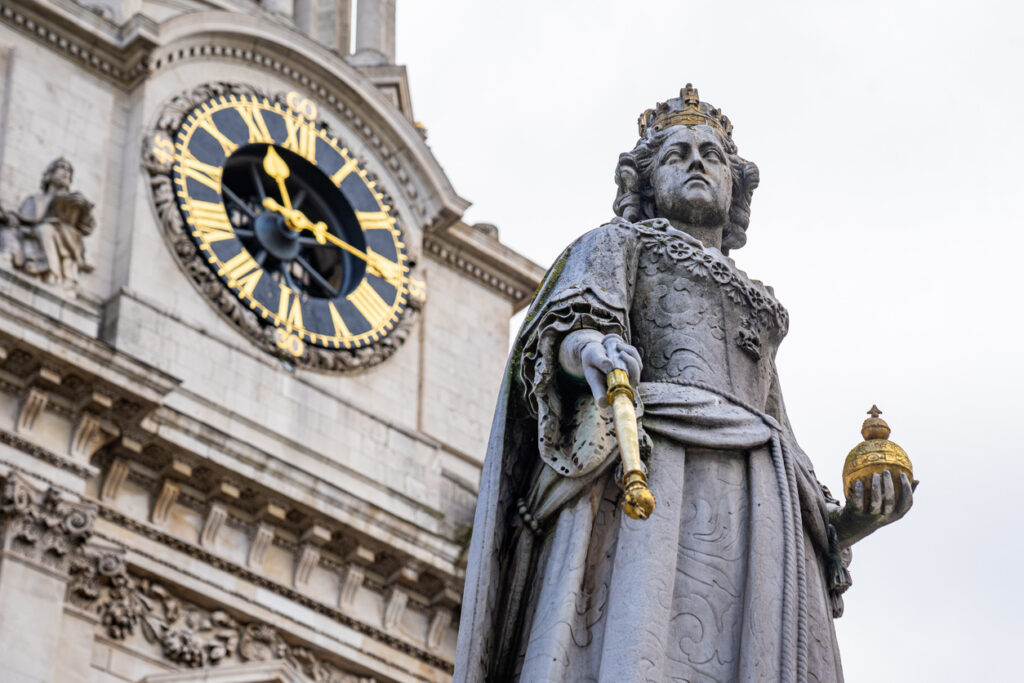
On 11 March 1708, Queen Anne withheld royal assent from the Scottish Militia Bill – the last time a British monarch vetoed legislation passed by parliament.
The decision was driven by the security situation facing the recently formed Kingdom of Great Britain. The Acts of Union 1707 had taken effect less than a year earlier, and pro-Jacobite sentiment remained strong in parts of Scotland.
On the day the Scottish Militia Bill was due to be signed, the government in London received intelligence that a Franco-Jacobite fleet carrying 5,000-6,000 soldiers was preparing to sail with the objective of crowning James Francis Edward Stuart, Anne’s Catholic half-brother and son of King James II and VII, as king.
The Scottish Militia Bill’s purpose was to recreate Scotland’s militia, which had not been revived at the Restoration (1660).
However, the prospect of a Jacobite coup – with the intention of returning the Protestant nation to Catholicism – raised fears among ministers that a new Scottish militia could prove disloyal and support the invasion. Anne’s veto, therefore, was not a straightforward subversion of the will of parliament, and the undramatic intervention attracted little contemporary comment.
Acting on the advice of her ministers, the Queen attended the House of Lords to use her royal prerogative of veto. Instead of the usual Norman French phrase for assent, La Reyne le veult (The Queen wills it), the bill was met with the words, La Reyne s’avisera (The Queen will consider it) – a polite-sounding but nonetheless absolute veto.
In the end, the Jacobite invasion fleet was scattered by the Royal Navy.
***
No monarch has since refused assent, meaning the ominous formula La Reyne s’avisera or Le Roy s’avisera has never again been uttered in parliament. After Anne, no bill has been thwarted from reaching the statute books by monarchical intervention. Rather, royal assent is regarded as a formality.
For the monarch to refuse royal assent to a bill passed by parliament today would be to act against the will of the democratically elected commons. This development would provoke an immediate and unprecedented constitutional crisis.
Before Anne’s reign, King William III had vetoed five public bills passed by parliament between 1692 and 1696. (The Judges Bill in 1692, the Royal Mines Bill in 1692, the Triennial Bill in 1693, the Place Bill in 1694 and the Qualifications Bill in 1696).
Moreover, while Anne’s veto was the last exercised by a monarch for a bill passed by the parliament at Westminster, British colonies and former colonies were still subjected to legislative vetoes by governors acting on royal instructions.
The US Declaration of Independence (1776) prominently featured the complaint that King George III had “refused his assent to laws, the most wholesome and necessary for the public Good.”

Politics.co.uk Newsletters
DAILY
Politics@Lunch
WEEKLY
Week in Review