UK rejects electoral reform as AV referendum ends in landslide ‘No’ vote
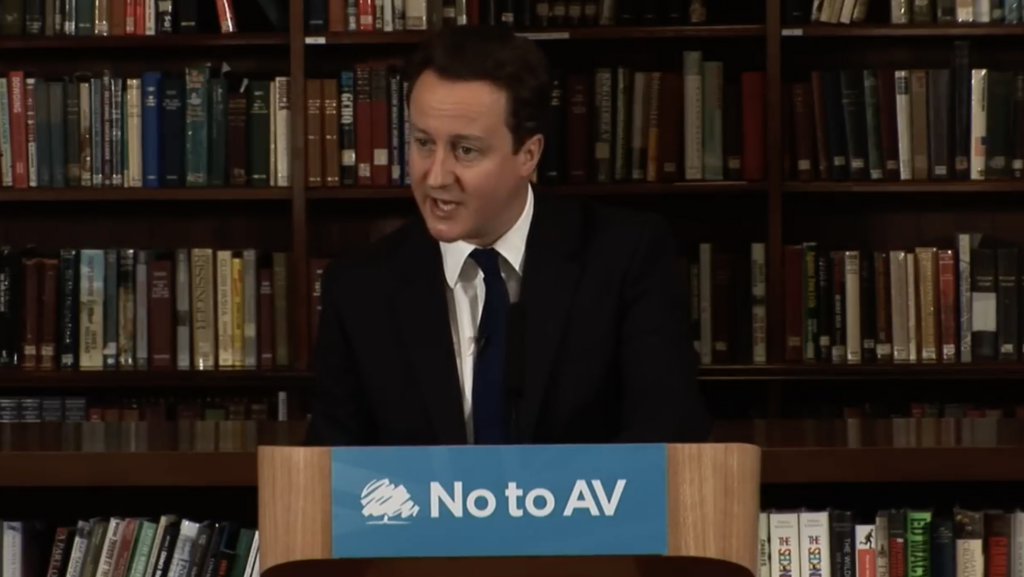
On 5 May 2011, the United Kingdom held its second-ever nationwide referendum, decisively rejecting a proposal to change the voting system for general elections from first-past-the-post (FPTP) to the alternative vote (AV).
The result was a landslide for the ‘No’ campaign, with 67.9% of voters choosing to keep the existing system, against 32.1% who voted for change. Turnout for the referendum was 42.2%. The No vote was comfortably in the majority in every UK region – but voters in England were more opposed to changing to AV than voters in Scotland, Wales and Northern Ireland.
Northern Ireland had the highest proportion of Yes votes (43.7%), followed by London (39.5%). The single transferable vote (STV) and the supplementary vote (SV) are used to elect the Northern Ireland assembly and the London mayoralty respectively – which could explain these results. STV and SV are both preferential voting systems.
The question asked on the ballot paper was as follows: “At present, the UK uses the ‘first past the post’ system to elect MPs to the House of Commons. Should the ‘alternative vote’ system be used instead?”
***
The referendum was a key part of the coalition agreement forged between the Conservative party and the Liberal Democrats after the 2010 general election. Electoral reform was a flagship policy of the Liberal Democrats, who had long argued that FPTP was unfair to smaller parties.
The coalition agreement read: “We will bring forward a Referendum Bill on electoral reform, which includes provision for the introduction of the alternative vote in the event of a positive result in the referendum, as well as for the creation of fewer and more equal sized constituencies.
“We will whip both parliamentary parties in both Houses to support a simple majority referendum on the alternative vote, without prejudice to the positions parties will take during such a referendum.”
The referendum’s inclusion in the coalition deal was a significant concession on the part of the Conservatives. The proposal was hated by many of its MPs.
AV was a more modest reform than the Liberal Democrats’ preferred system of proportional representation – Clegg even described it as a “miserable little compromise” before the 2010 general election. The comments came after Gordon Brown, the incumbent prime minister, pushed for a post-election referendum on moving to AV.
These factors meant the political enthusiasm was clearly identifiable with the ‘No’ campaign throughout the contest.
Under AV, voters would rank candidates in numerical order. If a candidate then received 50% of the first preference votes, the result would be declared. However, if no candidate receives 50% of the vote, the candidate with the least votes is removed. Their second preference votes are then redistributed among the remaining candidates. This process is repeated until a candidate has 50% of the vote.
This referendum led to the incongruous political situation of the two governing parties openly campaigning against each other. The ‘No’ campaign, led by senior Conservative figures, argued that AV was a complicated, expensive, and unfair system that could lead to the candidate who finished third in the first round ultimately winning and weak governments. The ‘No’ argument was also supported by key Labour figures such as John Prescott, Margaret Beckett and John Reid.
Cameron articulated the ‘No’ case in a campaign speech, delivered February 2011. In it, he questioned why supporters of “the BNP or Monster Raving Loony Party should get their votes counted more times than supporters of the Conservatives or for that matter Labour or Liberal Democrats.”
He added: “It could mean that those who are courageous and brave and may not believe in or say things that everyone agrees with are pushed out of politics, and those who are boring and the least controversial limping to victory.
“It could mean a parliament of second choices. We wouldn’t accept this in any other walk of life. Can you imagine giving the gold medal to someone who finishes third? No. Of course not.”
The No campaign also successfully framed the referendum around cost, with a widely-used if controversial claim that changing the system would cost £250 million.
Matthew Elliott, director of No to AV, said: “The British people will be staggered to learn that our politicians are considering squandering £250 million of taxpayers’ money on a new voting system at a time when they are being told to tighten their belts.”
Elliott’s campaign then sought to highlight how this money could be better spent. One notable poster, depicting a newborn baby, read: “She needs a maternity unit NOT an alternative voting system.”
Another ad carried a picture of a soldier, with the message that £250 million would be better spent on body armour.
The ‘Yes’ campaign, championed by the Liberal Democrats and supported by the Labour leader Ed Miliband, argued that AV would make MPs work harder for votes, reduce the need for tactical voting, and ensure candidates had to secure broader support to win a seat.
In an article for the Guardian, Miliband wrote: “I respect the views of my Labour colleagues who are for retaining first past the post. But I disagree with them. Why? Fundamentally, because AV offers an opportunity for political reform, ensuring the voice of the public is heard louder than it has been in the past.
“And given the standing of politics that is an opportunity we should take. It is a system that combines the direct representation of first-past-the-post with one that will make the votes of more people count.”
***
The acrimonious campaign and the resounding defeat were major political blows to Clegg as deputy prime minister. It also marked an acute point of tension between the Conservatives and Liberal Democrats in the 2010-2015 parliament. The relationship between the two parties would never quite recover to its pre-referendum peak.
The ‘No’ campaign had ruthlessly sought to associate AV in the public mind with the Liberal Democrats and their unpopular leader. One poster pictured Clegg holding a sign saying he would oppose any increase in tuition fees, with the message: “AV will lead to more broken promises”.
On 3 May, the Liberal Democrat energy secretary, Chris Huhne, confronted Cameron and chancellor George Osborne over these campaign leaflets. He challenged the prime minister to sack any Conservative official linked to the offending literature.
Cameron responded that he was not responsible for the cross-party ‘No’ campaign literature.
Responding to the result, Clegg said the outcome was a “bitter blow” at the end of a “disappointing day” following election results elsewhere. The AV referendum coincided with elections to the Scottish parliament, national assembly for Wales, Northern Ireland assembly and local authorities across England.
The deputy prime minister said: “I wish I could say this was a photo-finish but it isn’t. The result is very clear.
“I am a passionate supporter of political reform, but when the answer is as clear as this, you have got to accept it. In a democracy when you ask a question and you get an overwhelming answer, you just have to accept it and move on.”
Lord Mandelson, a supporter of electoral reform and New Labour political strategist, said AV supporters had paid a “big price” for staging the poll on the same day as the first elections to be held since the general election.
Mandelson added: “Nobody could have foreseen the extent to which the whole vote over the last 24 hours has become a referendum on the Liberal Democrats in general and Nick Clegg in particular.”
In his 2019 memoir, For the Record, Cameron suggested the anti-AV campaign could be summed up in three ‘Cs’: “costly”, “complicated” and “Clegg”.
He added: “I don’t look upon the victory with much fondness. It was, in the coalition story, a miserable little episode. And things between our parties would never quite be the same.”

Politics.co.uk Newsletters
DAILY
Politics@Lunch
WEEKLY
Week in Review
