Asquith forced to form coalition, ending last all-Liberal government
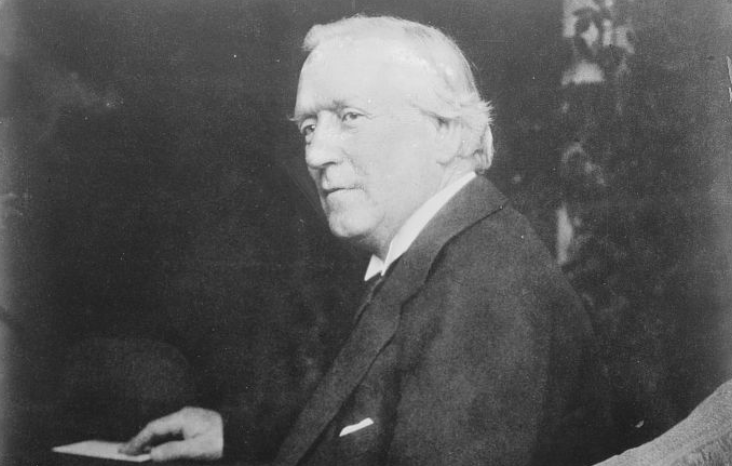
On 17 May 1915 prime minister H. H. Asquith began the process of forming a wartime coalition government. The move brought to an end the last all-Liberal Party administration in British history.
***
Asquith succeeded Henry Campbell-Bannerman as prime minister in 1908, two years after a Liberal general election landslide confirmed the party in power following a decade of Conservative government. From 1905 to 1915, Campbell-Bannerman and Asquith presided over the longest continuous period of non-Conservative rule in the 20th century.
Asquith’s tenure in office from 1908 to 1915 was momentous. He oversaw the introduction of the landmark People’s Budget in 1909, and curtailed the power of the House of Lords through the Parliament Act 1911. Asquith’s confrontation with the Lords led to two general elections in 1910 (January and December). The Liberal Party lost its parliamentary majority but remained in power with the support of the Irish Parliamentary Party (IPP).
Asquith legislated for Irish home rule under the Government of Ireland Act 1914. But the creation of an Irish parliament in Dublin was deferred by the outbreak of war on the continent under the Suspensory Act.
The wartime coalition in 1915 was formed against the backdrop of internal dissatisfaction, especially on the part of leading Liberal David Lloyd George, with Asquith’s governing style and the prosecution of the war effort.
In the end, however, it was two simultaneous crises that forced Asquith’s hand.
The first was the shell crisis, a “scandal” exposed by the Times newspaper which reported that the British Expeditionary Force was being hampered by a critical shortage of artillery shells on the western front. The newspaper directly cited the disastrous defeat at the Battle of Aubers Ridge on 9 May 1915. The Times story, published on 14 May, led with the headline: “Need for shells: British attacks checked: Limited supply the cause: A Lesson From France”
The article held Asquith directly responsible for the shortages, declaring: “We had not sufficient high explosives to lower the enemy’s parapets to the ground… The want of an unlimited supply of high explosives was a fatal bar to our success”.
Asquith sought to ward off criticism, insisting that no “army has ever either entered upon a campaign or been maintained during a campaign with better or more adequate equipment.”
He added: “I saw a statement the other day that the operations, not only of our army but also of our allies, are being crippled, or, at any rate, hampered, by our inability to provide the necessary ammunition. There is not one word of truth in that statement.”
But the report caused a public outcry and critically undermined confidence in the government’s war management.
The second and more immediate trigger was the abrupt resignation of the first sea lord, admiral Lord Fisher, on 15 May. Fisher resigned in protest at the Dardanelles campaign, an amphibious assault on Gallipoli championed by the first lord of the admiralty, his ministerial superior, Winston Churchill.
Asquith was now faced with accusations of mishandling the war effort, a collapse in political support, and the prospect of a far longer war than had been anticipated. He was confronted by the Conservative leader, Andrew Bonar Law, and the chancellor of the exchequer, Lloyd George.
***
Asquith was persuaded to form a new Liberal-Conservative coalition government, with Lloyd George serving as minister for munitions. The discussions between Asquith, Lloyd George and Bonar Law are said to have lasted a mere 15 minutes.
On 17 May, the prime minister wrote to his cabinet colleagues informing them that a coalition was necessary, and by 25 May the new government, including prominent Conservatives such as Bonar Law, Austen Chamberlain, and Arthur Balfour, was in place.
Arthur Henderson became the first Labourite to accept and hold a cabinet post as president of the board of education.
The cabinet of 22 members was composed of 12 Liberals, eight Conservatives and Henderson. The remaining member, Lord Kitchener, was not identified with a party. He maintained his place on account of his public popularity. Having already taken over responsibility for munitions, Lloyd George succeeded Kitchener as secretary of state for war – as had initially been intended – in June 1916. That came after the latter’s death aboard the ship HMS Hampshire.
As leader of the new Ministry of Munitions, Lloyd George had significantly enhanced his standing. He oversaw a marked increase in the production of shells, from 70,000 a week in May 1915, to 238,000 a week by January 1916 – to 1,125,660 a week by July 1916. The Munitions of War Act 1915 had prohibited strikes and lockouts “in any work connected with the supply of munitions”.
But the formation of the coalition did not redress Lloyd George’s concerns over Asquith’s alleged lethargy.
Speaking in December 1915, Lloyd George stated the government was often “too late” with its war policy. The remark came as the minister defended his approach to accelerating munitions production.
He told the commons: “The contract was entered into with labour. We are carrying it out. It can be done. I wonder whether it will not be too late? Ah! two fatal words of this War! Too late in moving here. Too late in arriving there. Too late in coming to this decision.
“Too late in starting with enterprises. Too late in preparing.”
He argued that unless the government could “quicken our movements, damnation will fall on the sacred cause for which so much gallant blood has flowed.”
The former chancellor and People’s Budget author aligned himself with the Conservatives in supporting conscription. The issue divided the Liberals; leading Asquithian Liberals, notably John Simon, the home secretary, and Reginald McKenna, the chancellor, were opposed to conscription on these terms. Asquith ultimately used his considerable political stature to steer the measure through his party and parliament, but it left him weakened. Simon resigned in January 1916 when conscription was eventually introduced for single men.
Military setbacks at the Siege of Kut (April 1916) and the Somme (July 1916) further imperilled the prime minister’s position.
In December 1916, Asquith resigned after a protracted power struggle with Lloyd George over the prospect of a streamlined “war council”.
Lloyd George answered the challenge to construct a stable administration by forming a five-member war cabinet. The new government drew support from the Conservatives, Labour and some supporters of his own party. As a result, the Liberals bisected: the Lloyd George-supporting faction was now allied with the Conservatives, and Asquith’s Liberals entered opposition.
***
The Liberal split was not remedied in time for the watershed 1918 general election. A total of 127 coalition Liberals, identified by special coupons, were elected – alongside 379 Conservatives. Asquith’s Liberal opposition won just 36 seats.
Lloyd George resigned as prime minister on 19 October 1922, having been turfed out of office by his critics in the Conservative Party.
While Lloyd George remains the last Liberal to have held the office of prime minister, Liberal politicians have held ministerial positions since – notably during the 2010-2015 coalition government.

Politics.co.uk Newsletters
DAILY
Politics@Lunch
WEEKLY
Week in Review