Tactical voting
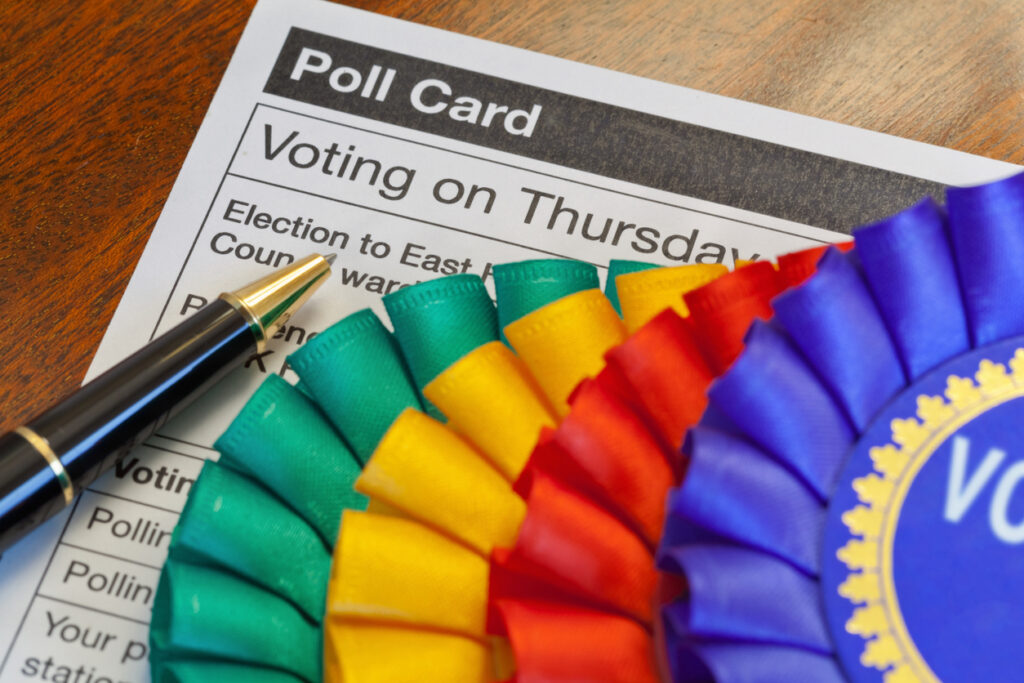
Tactical voting is the act of casting a vote for a candidate who is not the voter’s first preference, in order to prevent an even less desirable candidate from winning. It is a pragmatic calculation, where a voter opts for a “lesser evil” to block a “greater evil.” Ultimately, tactical voters fear an idealistic vote […]
Think tanks

A think tank is a non-governmental organisation that conducts research and advocacy on public policy issues. Their primary purpose is to influence public policy and political debate by introducing new ideas and analysis. Think tank proposals, which are shaped by engagement with and contributions from academia, business and civil society, often find their way into […]
UK opinion polls

Opinion polls are surveys of public opinion used to estimate the voting intentions of the electorate. They are a prominent feature of British political life, delivering insights into party support and leader approval ratings, courtesy of a host of polling companies. In the lead up to a general election and during the campaign, they dominate […]
UK voting age
The current voting age for UK-wide general elections is 18. However, in Scotland and Wales, the voting age for devolved and local elections has already been lowered to 16. The Labour Party’s 2024 general election manifesto included a commitment to lower the voting age to 16 for all elections across the UK. In July 2025, […]
Voting systems in the United Kingdom
The United Kingdom uses a variety of different electoral systems for its elections. They can broadly be categorised into two families: plurality/majoritarian systems, such as first past the post (FPTP), and proportional representation (PR) systems. Hybrid systems, which combine elements of FPTP and PR systems, are also active in the UK. The choice of voting […]
Proportional representation

Proportional representation (PR) describes a category of electoral systems where the share of seats won by each political party closely reflects its share of the total votes cast. This principle contrasts with plurality/majoritarian systems like first past the post (FPTP), which is used for UK general elections. Under FPTP, the candidate with the most votes […]
Referendums in the United Kingdom
A referendum is a direct vote in which an entire electorate is invited to vote on a particular proposal. In the United Kingdom, they have been used to decide major questions of constitutional significance. While referendums are not a traditional feature of the UK’s system of representative democracy and parliamentary sovereignty, they have become an […]
Parliamentary e-petitions

A parliamentary e-petition is a formal request from a member of the public asking the UK government or the House of Commons to take action on a specific issue. It is a direct way for citizens to raise issues with parliament and the government. All official e-petitions are hosted on the petition.parliament.uk website, which is […]
Pressure groups
A pressure group is an organised group of people united in the promotion of a common cause or interest. They are so-called because of their role in applying “pressure” on government, public opinion and other institutions to advance their political and/or policy objectives. Unlike political parties, pressure groups do not typically seek to win political […]
First past the post (FPTP)

First past the post (FPTP) is the electoral system used to elect MPs to the House of Commons in UK general elections. It is a plurality/majoritarian system where the country is divided into 650 constituencies, and the candidate who wins the most votes in each individual constituency wins the seat. The system is also used […]
