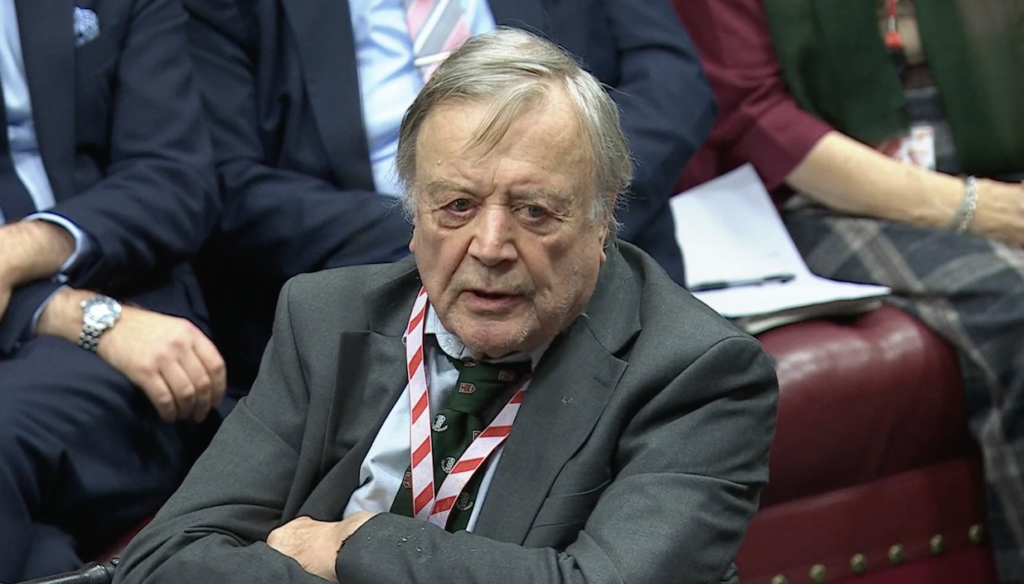
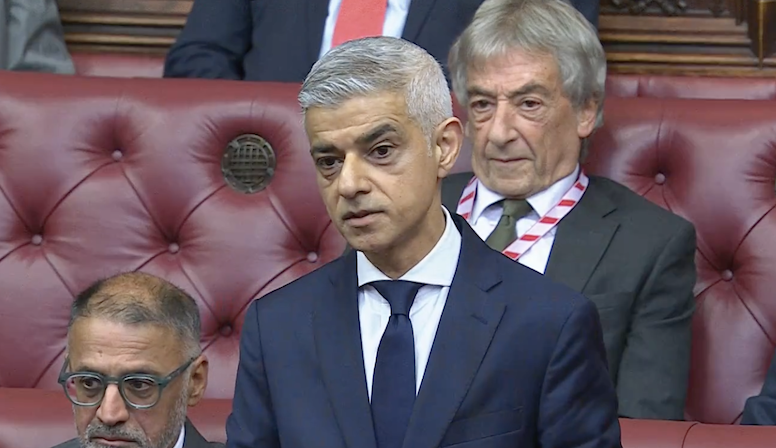
Sadiq Khan has used his maiden speech in the House of Lords to describe himself as a “proud Englishman” and to back closer ties with the European Union.
The mayor of London, who sits as Lord Khan of Tooting, spoke during a debate on the UK-EU deal agreed last week.
Khan has served as London mayor since 2016, and was mostly recently re-elected in 2024 to secure a historic third term. He was elevated to the peerage by Keir Starmer in the former prime minister’s resignation honours list.
Khan is expected to make a decision about whether to run for a fourth term as mayor next year.
In his Lords maiden speech, Khan began by thanking peers for their “warmth and generosity”, and said that the Lords chief whip “has lent me his tie to make my maiden speech”.
Khan paid tribute to Baroness Kennedy and Lord Kinnock, who formally introduced him to the Lords. He said he joined the Labour Party aged 15 “because of a speech made by Neil Kinnock”, and had been drawn to the law by a book written by Helena Kennedy.
“To get to meet them would have been a big deal. To call them friends and mentors is a big deal”, he said.
Recalling his introduction ceremony, Khan said his mother had watched from her wheelchair, with his wife, Sadia, and his daughters in the galleries. “I’m not sure if the book I swore on was the right one. I’m not sure if the words I said were the correct ones”, he joked.
Khan then spoke about his family history. He said his grandparents and parents “were born as British subjects in British India.”
He told peers: “[My grandparents] had to leave India and go to Karachi in Pakistan from Lucknow due to partition. They were brave and they were courageous. My parents left Pakistan and came to London in the mid-1960s. They were brave, and they were courageous.
“I was born in 1970, and they gave me the name Sadiq Khan. In Arabic, Sadiq means being truthful and being sincere, and Khan means being a leader. I’ve sought to live up to the name my parents gave me.”
Explaining his choice of title, he said: “I was born in Tooting. I was raised in Tooting. I went to school in Tooting. I fell in love in Tooting – had my children in Tooting. They were educated in Tooting. I live in Tooting.”
He added: “My noble friends, I will die in Tooting.”
Khan said his parents and grandparents had travelled thousands of miles in search of opportunity, while he had travelled only one, “because Tooting is synonymous with London”.
He set out what he called “the London Promise”
He said: “You work hard, you get a helping hand, and you can achieve anything – from a council estate to the House of Lords via a legal career, helping to run a business, being a cabinet minister, being the mayor of London.”
He said he was proud of “the various identities we can have: a proud Londoner, proud Englishman, proudly British, proudly European, proudly Muslim, proudly of Indian and Asian ancestry, and Pakistani ancestry”.
Khan concluded by quoting a verse from the Quran, stating: “I have created you as nations and tribes so that you may get to know one another.”
He added: “And I end with this as well: the European Union are our nearest allies and our biggest trading partners – jobs, wealth, opportunity, and our security rely on closer alliance.
“I support this prime minister and the last one on getting closer alignment.”
Farage condemns Suella Braverman for sparking ‘unwelcome’ Englishness debate
Khan’s remarks represent an intervention in the debate over Englishness ignited by Reform UK MP Suella Braverman, who has repeatedly argued that national identity is rooted in ancestry and ethnicity.
Braverman first articulated her position on Englishness last year.
In February 2025, she authored an article for the Telegraph writing that she considered herself British Asian but not English due to a lack of “generational ties to English soil”.
Braverman wrote: “Englishness has never been static or simple. From the arrival of the Romans to the waves of Saxons, Vikings, and Normans, English culture has always absorbed and adapted. How many generations must pass before one can claim to be English? Five? Six? It is a question without an easy answer.
“If we are to defend Judeo-Christian civilisation, British values, and the distinctiveness of English culture, there must be some form of consensus.”
Kemi Badenoch, the leader of the Conservative Party, criticised Braverman over her position on Englishness in her keynote address to Tory conference last month. Badenoch said she did not want to live in “a country run by people who threaten journalists, who call veterans traitors and debate whether my mixed-race children are English”.
Earlier this month, Liberal Democrat MP Josh Babarinde brought a cross-party bill to the House of Commons to broaden the range of ethnicity options in the census, enabling Britons to define themselves as “Black English” and “Asian English”.
The proposed legislation, which Babarinde referred to as the “St George’s bill”, was sponsored by Labour MP and former deputy prime minister David Lammy, Conservative MPs Sir James Cleverly and Mark Pritchard, and Liberal Democrat MPs Victoria Collins, Munira Wilson and Layla Moran.
Speaking at prime minister’s questions on 11 November, Andy Burnham expressed support for the bill. Burnham said he “would want to support that bill to directly take on the poisonous politics that we’ve seen from some in this House seeking to divide us.”
Lib Dem MP brings ‘St George’s bill’ to add Black English and Asian English to census