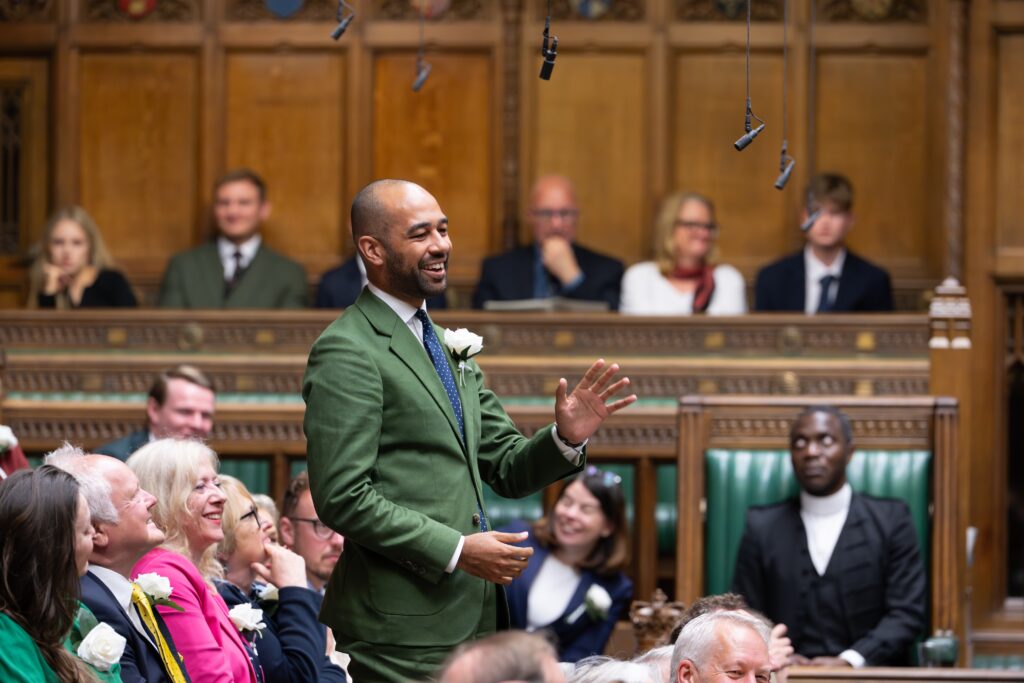
It was a busy summer for Josh Babarinde, the Liberal Democrat president and MP. Soon after parliament rose for recess, he and his husband tied the knot in Scotland before throwing a party in his constituency of Eastbourne.
The other part of Babarinde’s summer was spent reckoning with his party’s current course. As the elected president of the Liberal Democrats, a role he has held since January 2026, Babarinde spent the summer months consulting members on the party’s future direction. He branded this exercise, with some relish, the “summer of strategy”.
The Liberal Democrat presidency is a distinctive role. Babarinde describes his job as split between external responsibilities and internal administration of the party machine. He is also clear, and unapologetic, that he has tilted the balance of the job towards its more public-facing side.
Babarinde contrasts this approach with that of his predecessor, Mark Pack, who took over after the Liberal Democrats’ near-wipeout at the 2019 election. Pack’s tenure was dominated by fixing the party’s internal machinery. “That was the right approach at the time”, Babarinde reflects. But now with over 70 MPs and the electoral landscape more competitive than ever, he believes the moment demands a more prominent presidential voice.
Babarinde points to his role in referring Nigel Farage to the parliamentary standards commissioner – part of the chain of events that precipitated Farage’s resignation and the Clacton by-election. “We have been causing a scene from the presidency”, he says, “and will continue to.”
Babarinde cites Charles Kennedy, the Liberal Democrat president from 1991 to 1994, as a source of “huge inspiration”. In particular, he celebrates Kennedy’s opposition to the Iraq War during his time as leader: “When everyone else was kind of going along with it in the political establishment, Charles Kennedy stuck his neck out and said, this isn’t right. And history has very much proved him right.”
He adds: “He was the kind of guy who called a spade a spade, and we need more of that in British politics.”
This instinct for plain speaking runs through Babarinde’s approach to the “summer of strategy”.
The resulting tranche of recommendations – shaped by over a thousand submissions from Liberal Democrat activists – fits three clear themes. Firstly, Babarinde stresses the importance of attempting to “clarify and refine” a national message. “We’ve got loads of policy as a party, and that’s great, but we need to get far better at telling that story”, he tells me.
Babarinde adds that the party needs to re-evaluate how it communicates that narrative. “Lib Dems are famed for having an addiction to producing and distributing leaflets, and that will never change”, he says. “But we need to match our physical leaflet prowess with digital campaigning prowess.”
For his final point, Babarinde refers to the “reach” of the Liberal Democrats. He acknowledges the success in breaking the “blue wall” at the last election, but calls for the party to now look beyond it.
Babarinde states: “If we really want to be a party of the whole country, we need to look more like, sound more like, and relate more to those parts of the country that maybe we don’t reflect as much now, and so that particularly means doubling down on our successes in the north of England, in the Midlands, in urban Britain, but also building our presence in Wales as well…
“We need to make sure that we are a broad church and not just a party of Middle England.”
Babarinde’s verdict is shaped by feedback from Liberal Democrat foot soldiers. But it clearly chimes with his own view of how the party should adapt to a fracturing political landscape and the heightened competition it has delivered. The strategy also reflects wider concerns within the party that the Liberal Democrats have failed to make sustained inroads since emerging as the largest third parliamentary party in over a century following the 2024 general election.
“It comes down to storytelling again and narrative”, Babarinde remarks when pushed on these concerns.
“We have s***loads of policy on every issue under the sun. But what we’ve not been as good at is communicating all of that in a way that inspires people, in a way that motivates people to get out there and vote for it.
“That’s why storytelling and engagement with people all across the country, not just in Middle England, is really important.”
Underpinning all this is Babarinde’s own analysis of the political moment and its new fault lines.
The postwar “dream” of hard work leading to a better life, he argues bluntly, is “dead.”
“It was the case in the post-war period that if you dream big, if you work hard, you will get to where you want to go, or you’ll at least be able to make yours and your family’s life better…
“People working f***ing hard – they are on the treadmill of life, of work, and more, and they are staying in the same place or worse, sliding into greater financial insecurity, poverty, feeling less safe in their communities.”
Babarinde borrows from William Beveridge, the famed Liberal thinker and architect of the welfare state, to frame the challenges facing modern Britain.
“My view is that there is a modern set of ‘giants’ that are plaguing our society today. Take the water companies taking our money and dumping s*** in the sea, and we are all paying for that. Or whether it is big government – domestic government that’s taking our liberties away; look at the attempted ID cards – or big foreign government that’s doing it, the likes of Trump.
“You have got the likes of big tech, [Elon] Musk, and others, taking our money, taking our liberties, and not taking responsibility. And in all these areas, you have big, unaccountable corporations or governments that are p***ing over our freedoms and p***ing our money away, and that is in huge part responsible for the hardship and the disempowerment that people feel today.”
It is, Babarinde says – in a very Liberal Democrat turn of phrase – time for “folks to rise up.”
Babarinde is willing to grant that Andy Burnham’s instincts – on constitutional reform, Europe and social care – overlap substantially with his own party’s. “On paper… tick, tick, tick”, he says. But he points to a gap between rhetoric and delivery. He singles out electoral reform, which Burnham has ruled out before the next election, and single market membership, which Labour has declined to back.
On the prospect of a hung parliament – something Ed Davey recently floated as built into Liberal Democrat strategy – Babarinde is cautious about getting ahead of voters. “The public don’t like people presupposing how they’re going to vote”, he says. But he is unambiguous that one of the party’s “top missions” is to “deny Reform a majority at any level of government.”
Coalition itself, Babarinde insists, no longer carries the stigma it once did within the party. “Coalitions are not a dirty word”, he says, pointing to local government arrangements across the country.
He is candid about the mixed legacy of the 2010-2015 government – he campaigned against the tuition fee rise as an activist – while defending its achievements, including same-sex marriage. But he resists dwelling on it. “Andy Burnham gets criticised for constantly talking about the past… we can reflect on lessons of the past, but let’s not be stuck in it.”
***
Babarinde has been branded a “rising star” within the Liberal Democrats. And the presidency, his personal fiefdom, has often served as a springboard to the leadership. Several of his predecessors have gone on to challenge for the party’s top job.
Does Babarinde recognise this pattern?
“For me, politics has never been about pursuing positions”, he responds.
“It’s been about pursuing impact, and actually not just politics, but my career generally. Before I got involved in politics, you know, as a CEO of a social enterprise, supporting kids out of gangs. I didn’t aspire to be a CEO for CEO’s sake; I aspired to provide opportunities for those young people who have been let down…
“I feel exactly the same about being an MP… And I’m party president not for the purpose of being party president. I’m party president for the purpose of being a megaphone for our liberalism as our party, and getting our party in the best place possible internally to fight and win elections.”
The rise of the Liberal Democrat “rising star” is a consequence of the party’s significantly improved stature since 2024. I ask whether Babarinde feels a sense of responsibility to make good on his perceived potential.
He replies: “I’ve been a councillor for the party. I’ve been a parliamentary candidate for the party, I’ve occupied no office for the party. I’m now an MP and of course party president.
“In all of those roles, irrespective of you know what others attach to them or project onto them, it has been my mission to make sure that power and cash sit closest to people who it’s meant to empower – to ensure that people can go as far as their talents, their motivation, their commitment can take them, and to abolish the role that luck, particularly bad luck, plays in shaping people’s respective courses and qualities of life…
“The key thing is to focus on what folks in places like Eastbourne and across the country are saying about what they need, rather than a kind of TripAdvisor-style review that they might be offering on my career and prospects.”
Asked to sum up the party’s task between now and the next election, Babarinde returns to the three prongs of the Liberal Democrat party strategy review: sharper message, heavier digital investment, broader geographic reach.
“Our top mission must be to get Liberal Democrats into power. We’re not a pressure group. We are a political party that exists to wield power in order to create a more liberal society in which people can be free.
“My job as president and our party’s job is to win those elections, and we will win those elections by having a clearer national narrative, by upping the way in which we engage with people, particularly digitally, and making sure that we are reaching out across the whole country and not just Middle England.”






Alison Hume MP: ‘Britain’s science facilities are facing cuts we cannot afford to make’