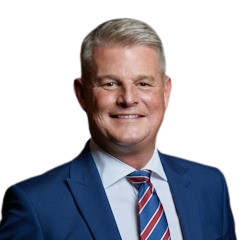
Stuart Andrew is the Conservative MP for Daventry, and was first elected to parliament for the constituency of Pudsey at the 2010 general election. He was subsequently elected MP for Daventry at the 2024 general election after his previous Pudsey seat was abolished in boundary changes.
In the 2024 general election for Daventry, Andrew received 17,872 votes, representing 33.7% of the vote share. The Labour candidate, Marianne Kimani, received 14,860 votes (28.0%), while the Reform UK candidate, Scott Cameron, secured 10,636 votes (20.0%). Stuart Andrew was duly elected with a majority of 3,012 votes.
The Daventry constituency is located in Northamptonshire in the East Midlands region of England. It is generally considered a safe Conservative seat.
The previous MP for Daventry was Chris Heaton-Harris, who served from 2010 until he stood down at the 2024 general election. Notable previous MPs include Reg Prentice (Conservative, formerly Labour) and Tim Boswell (Conservative).
Political Career
Andrew left the Conservative frontbench as part of the August/September 2026 shadow cabinet reshuffle conducted by Kemi Badenoch. He served as shadow health secretary from July 2025 to August 2026 and shadow culture secretary from November 2024 to July 2025.
Following the 2024 general election, Andrew briefly served as opposition chief whip in the House of Commons (July – November 2024).
Prior to the 2024 general election, which saw the Conservatives ejected from government, Andrew held a series of government roles. Most recently under Rishi Sunak, he was parliamentary under-secretary of state at the Department for Culture, Media and Sport (February 2023 – July 2024) and concurrently parliamentary under-secretary of state for equalities (October 2022 – July 2024).
Andrew was first appointed as parliamentary under-secretary of state at the Department for Digital, Culture, Media and Sport in September 2022, during Liz Truss’ brief tenure as prime minister. He held this post from September 2022 to February 2023.
During the 2022 Fifa World Cup in Qatar, Andrew publicly wore a OneLove armband at the England vs Wales game to express support for the campaign promoting inclusion and opposing discrimination.
Speaking to the BBC before the game, the sports minister, who is gay, said he did not want to hide who he is. “In the unique position I have, as a sports minister, I feel I have to represent everybody and to say to Fifa to please have a look at these issues”, he commented.
“There are a lot of fans out there who want to come and support their teams. We have a great match going on tonight, it’s just sad some people feel they can’t come.”
Under Boris Johnson, Andrew served as minister of state at the Ministry of Justice (July – September 2022) and minister of state for housing (February – July 2022).
Andrew resigned as housing minister in July 2022 as part of the mass walkout of ministers that ultimately forced Boris Johnson to announce his own resignation.
In his resignation, Andrew said felt he could not tolerate hard working Conservative party members “having to defend the indefensible”. He praised the prime minister for his success in the 2019 election, delivering Brexit, handling the pandemic and his support for Ukraine saying there was “so much you have achieved and which I admire”.
But Andrew added: “Loyalty and unity are traits that I have always endeavoured to provide for our great party. However, I fear I have let these override my judgement recently.
“There comes a time when you have to look at your own personal integrity and that time is now. Therefore, given recent events I have no other choice than to resign.
“Our party, particularly our members and more importantly our great country, deserve better.
“Having a marginal seat I have seen the huge sacrifice our members make in volunteering considerable hours to campaign on our behalf and I cannot, in all good conscience, tolerate them having to defend the indefensible.”
Previously, Andrew was treasurer of HM household (deputy chief whip) from February 2020 to February 2022, and vice-chamberlain of the household (senior government whip) from July 2019 to February 2020.
During the Covid-19 pandemic, as deputy chief whip, Andrew wielded significant procedural power in the House of Commons. Under the emergency proxy voting arrangements implemented in early 2021, he at one stage personally controlled 333 proxy votes for fellow Conservative MPs – effectively representing a majority of the House’s voting power.
In October 2019, Andrew was selected to perform the traditional role of ceremonial “hostage” at Buckingham Palace during the state opening of parliament.
Under Theresa May, Andrew served as parliamentary under-secretary of state for defence procurement (July 2018 – July 2019), parliamentary under-secretary of state for Wales (January – July 2018), and assistant government whip (June 2017 – July 2018). He has also served as vice chair of the Conservative party (appointed September 2016).
On 22 February 2012, Andrew was headbutted and punched by Labour MP Eric Joyce in parliament’s most famous drinking spot, Strangers’ Bar. Andrew was reportedly left with blood pouring from his nose.
In a statement to the House of Commons, Joyce issued a personal apology to Andrew and others.
Andrew is a patron of LGBT+ Conservatives – the official LGBTQ wing of the Conservative Party.
Andrew delivered his maiden speech on 28 June 2010 in the debate on the first budget of the Conservative-Liberal Democrat coalition government.
He said: “Yes, this is a difficult budget, but these are difficult times and I am glad we have a responsible Budget, one which is sensible and is now clearly endorsed by members of the G20.”
He added: “I shall say a little about my background. I grew up on a council estate in a family that had very little money. I was the eldest, and even I had hand-me-downs. What helped my family and others was the ability to start a new business.
“I remember my father starting a small roofing company. It was not much, but it was something. It got him off the dole and it employed another person.”
He served on the Welsh affairs select committee from 2010 to 2012.
Andrew serves as vice chair of the all-party parliamentary group (APPG) for football supporters.
Andrew stood unsuccessfully as a parliamentary candidate for Wrexham in the 1997 general election.
Political Views
Leadership elections and loyalty
Tory leadership 2022 (I): Andrew supported Rishi Sunak’s candidacy in the Conservative Party’s July-September 2022 leadership election. The contest was triggered by the resignation of Boris Johnson, following the mass exodus of more than 60 frontbenchers.
Sunak, the former chancellor, warned against “comforting fairytales” regarding unfunded tax cuts. Although he won every round of the parliamentary ballots, securing 137 votes in the final stage, Sunak was defeated by Liz Truss in the membership vote, finishing with 60,399 votes (42.6%).
Tory leadership 2022 (II): Andrew supported Rishi Sunak’s candidacy in the Conservative Party’s October 2022 leadership election. The contest was triggered by the resignation of Liz Truss after just 45 days in office, following the financial and political tailspin triggered by her “mini-budget”.
Sunak, the former chancellor, had finished second to Truss in the previous contest. Unlike the summer contest, this election featured an expedited process requiring each candidate to secure at least 100 nominations from MPs to proceed. Sunak, having emerged as the clear frontrunner, was declared leader of the Conservative Party unopposed on 24 October.
Tory leadership 2019: Andrew supported Boris Johnson for the party’s leadership in 2019. The election was triggered by the resignation of Theresa May following her inability to secure a Brexit deal acceptable to the Conservative Party.
Johnson, the former foreign secretary and mayor of London, campaigned on the central pledge to “deliver Brexit” by 31 October 2019, “deal or no deal”. He thereby positioned himself as the candidate best-placed to break the parliamentary deadlock. Johnson secured 114 votes in the first parliamentary ballot, and reached 160 votes in the final MP round. In the subsequent ballot of the party membership, Johnson won a decisive victory with 92,153 votes (66.4%).
https://x.com/StuartAndrew/status/1133046268803145730
Tory leadership 2016: Andrew supported Theresa May for the party’s leadership in July 2016. The contest was triggered by the resignation of David Cameron following the UK’s vote to leave the European Union.
May, the then-home secretary, secured a commanding lead in the parliamentary stages, receiving 165 votes in the first ballot and 199 in the second. Following the withdrawal of her final rival, Andrea Leadsom, on 11 July, May was declared leader unopposed and was appointed prime minister two days later.
Factional identity and party tradition
Tory Reform Group: Andrew is listed as a member of the Tory Reform Group (TRG) – a pressure group within the Conservative Party that represents the “one nation” tradition of political thought. Historically associated with senior party figures such as Kenneth Clarke and Michael Heseltine, the TRG was established in 1975 to champion socially progressive and centrist policies – acting as an intellectual counterweight to the emerging free-market, Thatcherite wing of the party.
Bright Blue: Andrew is listed as a parliamentary supporter of Bright Blue, an independent centre-right think tank and membership organisation that champions liberal conservatism in the UK. Since its founding in 2014, it has been associated with the “modernising” or “one nation” wing of the Conservative Party. The organisation has since expanded its reach through a new cross-party strategy.
Brexit and Europe
Brexit referendum: Stuart Andrew supported leave in the 2016 Brexit referendum, and therefore disagreed with a majority of constituents, 51.4% of whom voted to remain.
Article 50: In February 2017, Andrew voted in favour of the European Union (Notification of Withdrawal) Bill. The legislation empowered the prime minister to notify the Council of the European Union of the UK’s intention to withdraw, formally triggering the process set out in Article 50 of the Treaty on European Union. MPs supported the bill by 498 votes to 114 at second reading.
Customs union vote (2025): In December 2025, Andrew voted against the UK-EU Customs Union (Duty to Negotiate) Bill. The bill, introduced under the ten-minute rule procedure by Liberal Democrat Europe spokesperson Al Pinkerton, sought to mandate the government to enter into negotiations with the European Union to establish a bespoke customs union.
Assisted dying
Andrew voted against the Terminally Ill Adults (End of Life) Bill, better known as the assisted dying bill, at both second reading (November 2024) and third reading (June 2025).
Social values and conscience issues
Same-sex marriage (2013): In February 2013, Andrew was one of the 131 Conservative MPs to vote in favour of the Marriage (Same Sex Couples) Bill at its second reading. The landmark piece of legislation, which received its second reading by 400 votes to 175, legalised marriage for same-sex couples in England and Wales.
Abortion decriminalisation (2025): Andrew voted against a backbench amendment to the Crime and Policing Bill that sought to decriminalise abortion in England and Wales in June 2025. The amendment, which was passed by a majority of 242 votes, removed women from the threat of prosecution for ending a pregnancy at any stage. As an issue of conscience, MPs were allowed to vote according to their personal beliefs.
Foreign policy and security
Sanctioned (Russia): In April 2022, Andrew was among the group of MPs placed on a sanctions list by the Russian government. The measure barred them from entering Russia and was presented by Moscow as a retaliatory response to the UK’s stance on the invasion of Ukraine.
Trident renewal (2016): Andrew voted in favour of a government motion calling for the renewal of the Trident nuclear deterrent system in July 2016. The motion, which was passed by 472 votes to 117, committed the UK to constructing a new fleet of submarines to carry the nation’s nuclear weapons.
Syria airstrikes (2015): Andrew voted in favour of a government motion to extend UK airstrikes against Isis from Iraq into Syria in December 2015. The motion, which was passed by 397 votes to 223 after a ten-hour debate in the House of Commons, authorised the RAF to conduct strikes against Isis targets in Syria.
Syria airstrikes (2013): Andrew voted in favour of the government’s motion on the principle of military intervention in Syria in August 2013. The government motion was defeated by 285 votes to 272, a move which effectively ruled out UK participation in any US-led military strikes.
Before Politics
Born on 25 November 1971 on the Isle of Anglesey, Wales, Andrew spent his early years living in Llanfairpwllgwyngyllgogerychwyrndrobwllllantysiliogogogoch. He attended state school Ysgol David Hughes in Menai Bridge. His father worked as a welder, and he grew up on a council estate.
After leaving school, he worked for the Department of Social Security. In 1994, he began working in the charity sector, initially as a fundraiser for the British Heart Foundation, followed by roles at Hope House Children’s Hospice and East Lancashire Hospice.
Andrew was first elected as a Conservative councillor for the Maesydre ward on Wrexham County Borough Council in 1995, serving until 1999. He defected to the Labour Party in 1998, reportedly citing issues with the Conservative Party’s direction at the time, before rejoining the Conservatives in 2000.
He later served as a Conservative councillor on Leeds City Council from 2003 until his election to Parliament in 2010.
Personal Life
Andrew has spoken previously about being attacked due to his sexuality. He currently resides in Guiseley, West Yorkshire, and London.
In 2024, PinkNews listed Andrew among a number of out LGBTQ+ parliamentarians.
Trivia
Andrew lived in the Welsh village with the longest place name in Europe, Llanfairpwllgwyngyllgogerychwyrndrobwllllantysiliogogogoch, during his childhood.
He briefly joined the Labour Party between 1998 and 2000 before rejoining the Conservatives.
Stuart Andrew has not written for Politics.co.uk.