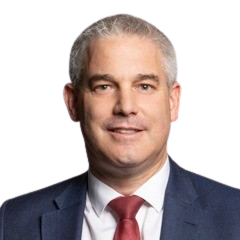
Stephen Barclay is the Conservative MP for North East Cambridgeshire, having first been elected to parliament at the 2010 general election.
In the 2024 general election for North East Cambridgeshire, Barclay received 16,246 votes, representing 41.5% of the vote share. The Reform UK candidate, Chris Thornhill, received 9,057 votes (23.1%), while the Labour candidate, Javeria Hussain, secured 8,008 votes (20.4%). Barclay was duly elected with a majority of 7,189 votes.
The North East Cambridgeshire constituency is a large, rural seat in the Cambridgeshire Fens, bordering Norfolk. It includes the towns of Wisbech, March, and Whittlesey. Farming and food production are important local industries. It is considered a very safe Conservative seat.
Political Career
Barclay currently chairs the finance committee (since December 2024). The finance committee is an internal body of the House of Commons responsible for overseeing the financial management of the House itself. Unlike a select committee, it does not scrutinise government departments. Instead, its remit is purely administrative and focused on the House’s own budget and expenditure.
By virtue of this role, Barclay sits on the liaison committee – the so-called “super committee” composed of the cross-party chairs of all the other commons select committees. It has a broad oversight role, but is best known for its questioning of the prime minister in sessions that take place two or three times a year.
Barclay briefly served as shadow secretary of state for environment, food and rural affairs (July-November 2024), in the interim/caretaker shadow cabinet created after the 2024 general election.
Barclay set out his intention to return to the backbenches just hours before the result of the 2024 Tory leadership contest, fought between Kemi Badenoch and Robert Jenrick, was declared.
https://x.com/SteveBarclay/status/1852651887192953195
In an article for the Telegraph, published January 2025, Barclay urged Badenoch to pull the UK out of the European Convention on Human Rights (ECHR) if the Tories return to power.
Barclay wrote: “Secure borders will not be delivered whilst porous legislation remains. Until the law is watertight in stopping the army of human rights lawyers, it will not stop the flotilla of small boats. The Conservative Party must not shy away from accepting what is required to make this change.
“Every recent Conservative leader has expressed concern about the ECHR and suggested that they would have been prepared to leave. Kemi Badenoch has made similar promises, saying that she will ‘review every policy, treaty and part of our legal framework – including the ECHR and the Human Rights Act’.
“This is welcome, but she can’t repeat the mistakes of her predecessors. Now is the time to commit to the fundamental change needed. We must leave the ECHR.”
From 2018-2024, Barclay held several cabinet positions under three prime ministers. He was secretary of state for environment, food and rural affairs from November 2023 to July 2024. Before that, he served two terms as secretary of state for health and social care, from July to September 2022 (under Boris Johnson) and October 2022 to November 2023 (under Rishi Sunak).
Truss dismissed Barclay in September 2022, bringing an end to his first tenure as health secretary.
https://x.com/stevebarclay/status/1567196208766062598
Previously, during Johnson’s tenure as prime minister, Barclay served as chancellor of the Duchy of Lancaster (September 2021 – July 2022). For the latter part of this period (February – July 2022), Barclay served concurrently as the prime minister’s chief of staff in Downing Street. He became the first serving MP to hold this position. In this role, Barclay vowed to pursue “a smaller state” approach.
In an article for the Sunday Telegraph, published February 2022, Barclay said that while public health interventions and vast amounts spent in the Covid pandemic were the right decisions, it was time for “a more enabling approach”.
Barclay wrote: “Now it is a priority to restore a smaller state – both financially and in taking a step back from people’s lives. It’s time to return to a more enabling approach. To trust the people, return power to communities, and free up business to deliver.”
https://x.com/SteveBarclay/status/1490023933004943362
The move was viewed as part of Johnson’s fightback – or “Operation Save Big Dog” – after months of damaging stories centering around “Partygate”.
In his Sunday Telegraph article, Barclay also noted “how frustrating the recent weeks of speculation about the workings of government have been – for the people of this country, and for political colleagues”.
However, he added: “The prime minister has apologised for the things we simply did not get right, and for the way that some matters have been handled … He is the best person to deliver the mission of renewal and recovery.
“This is a prime minister who won an 80-seat majority, delivered Brexit and then steered the country through the pandemic… Now he’s making the changes in government that will see us adjust to living with Covid, clear the backlogs, get the economy back up to full speed – and, crucially, he is taking a close look at where he can cut the size of the state.”
Under Johnson, Barclay was also chief secretary to the Treasury from February 2020 to September 2021.
Notably, Barclay served as secretary of state for exiting the European Union from November 2018 until the department closed on 31 January 2020, overseeing the UK’s formal departure from the EU. His appointment came at a tumultuous time during Theresa May’s tenure as prime minister, following the resignation of Dominic Raab, who objected to the withdrawal agreement negotiated by May.
https://x.com/SteveBarclay/status/1063497791815802883
https://x.com/trussliz/status/1063478788003110912
Barclay would ultimately outlast May as prime minister, retaining his Brexit brief in Boris Johnson’s first and second cabinets (the latter appointed after the 2019 general election). He ceased to be Brexit secretary at 11:00 pm on 31 January 2020, the moment the UK formally exited the EU.
In his resignation letter, Barclay stated that with Brexit secure, the department had “delivered its purpose.”
In a letter to the prime minister, Barclay wrote: “It has been a great honour to serve as the secretary of state for the Department for Exiting the European Union. With the purpose of the department now complete, and our departure secure, I write to resign formally at 11.01pm.”
Johnson responded: “On the day that the United Kingdom leaves the EU, you can take particular pride that we are delivering on our promise to the British people to get Brexit done.
“Your work, and that of your department, has been absolutely crucial in ensuring that we are leaving the EU with a great new deal and that we are in such a strong position going into the negotiations about our future relationship.”
https://x.com/SteveBarclay/status/1223410734945705989
Barclay’s earlier ministerial roles included minister of state for health (January – November 2018) and economic secretary to the Treasury (June 2017 – January 2018). He also served as a government whip (2016-2017).
In September 2012, Barclay was named by ConservativeHome as one of 24 backbench Tory MPs who had yet to rebel against the Conservative-Liberal Democrat coalition government.
He was a member of the public accounts committee from 2010 to 2014.
Barclay delivered his maiden speech on 6 July 2010 during a debate on the Finance Bill.
In it, he referenced his namesake, Steve Barclay, a “comedian and cabaret entertainer.”
He added: “I can assure the House that that is not me in an unregistered second job. My speech sadly lacks the zany comedy and musical backing that his performances offer…
“We need to target money more wisely. The budget was painful but necessary. However, I still feel that there are areas where policy needs to catch up with the new reality. Constituents in North East Cambridgeshire are staggered that we borrow money simply to give it away to countries such as China and India, which can afford their own space programmes.”
In the 2005 to 2010 parliament, Barclay was added to the Tory “A-List” of prospective parliamentary candidates (PPCs), drawn up by Conservative Central Office at the behest of then-party leader David Cameron. The A-List was a centrally-approved priority list of around 100-150 PPCs created as part of Cameron’s bid to modernise the party’s image. The primary goal was to increase the diversity of Conservative MPs by fast-tracking more women and candidates from ethnic minority backgrounds into safe and winnable seats.
Political Views
Leadership elections and loyalty
Tory leadership 2024: Barclay supported Kemi Badenoch’s candidacy in the 2024 Conservative Party leadership election. The contest was triggered by the resignation of Rishi Sunak following the party’s defeat in the 2024 general election.
Badenoch, the then-shadow housing secretary, was seen as a leading figure on the party’s right wing. After finishing first in the final parliamentary ballot with 42 votes, she defeated Robert Jenrick in the membership vote with 53,806 votes (56.5%). Badenoch was declared Conservative leader on 2 November.
Tory leadership 2022 (I): Barclay supported Rishi Sunak’s candidacy in the Conservative Party’s July-September 2022 leadership election. The contest was triggered by the resignation of Boris Johnson, following the mass exodus of more than 60 frontbenchers.
Sunak, the former chancellor, warned against “comforting fairytales” regarding unfunded tax cuts. Although he won every round of the parliamentary ballots, securing 137 votes in the final stage, Sunak was defeated by Liz Truss in the membership vote, finishing with 60,399 votes (42.6%).
Tory leadership 2022 (II): Barclay supported Sunak’s candidacy in the Conservative Party’s October 2022 leadership election. The contest was triggered by the resignation of Truss after just 45 days in office, following the financial and political tailspin triggered by her “mini-budget”.
Sunak, the former chancellor, had finished second to Truss in the previous contest. Unlike the summer contest, this election featured an expedited process requiring each candidate to secure at least 100 nominations from MPs to proceed. Sunak, having emerged as the clear frontrunner, was declared leader of the Conservative Party unopposed on 24 October.
Johnson confidence vote: In June 2022, Barclay publicly declared their loyalty to the prime minister, Boris Johnson, ahead of a vote of no confidence in his leadership. The vote was triggered by discontent within the parliamentary party following the “partygate” scandal and the publication of the Sue Gray report. While the prime minister ultimately won the vote, the scale of the rebellion against him, with 148 of his own MPs voting to remove him, severely weakened his authority and presaged his resignation the following month.
Tory leadership 2019: Barclay supported Boris Johnson for the party’s leadership in 2019. The election was triggered by the resignation of Theresa May following her inability to secure a Brexit deal acceptable to the Conservative Party.
Johnson, the former foreign secretary and mayor of London, campaigned on the central pledge to “deliver Brexit” by 31 October 2019, “deal or no deal”. He thereby positioned himself as the candidate best-placed to break the parliamentary deadlock. Johnson secured 114 votes in the first parliamentary ballot, and reached 160 votes in the final MP round. In the subsequent ballot of the party membership, Johnson won a decisive victory with 92,153 votes (66.4%).
Tory leadership 2016: Barclay supported Theresa May for the party’s leadership in July 2016. The contest was triggered by the resignation of David Cameron following the UK’s vote to leave the European Union.
May, the then-home secretary, secured a commanding lead in the parliamentary stages, receiving 165 votes in the first ballot and 199 in the second. Following the withdrawal of her final rival, Andrea Leadsom, on 11 July, May was declared leader unopposed and was appointed prime minister two days later.
Brexit and Europe
Brexit referendum: Barclay supported leave in the 2016 Brexit referendum, and therefore agreed with a majority of constituents, 69.4% of whom also voted to leave.
Article 50: In February 2017, Barclay voted in favour of the European Union (Notification of Withdrawal) Bill. The legislation empowered the prime minister to notify the Council of the European Union of the UK’s intention to withdraw, formally triggering the process set out in Article 50 of the Treaty on European Union. MPs supported the bill by 498 votes to 114 at second reading.
Customs union vote (2025): In December 2025, Barclay voted against the UK-EU Customs Union (Duty to Negotiate) Bill. The bill, introduced under the ten-minute rule procedure by Liberal Democrat Europe spokesperson Al Pinkerton, sought to mandate the government to enter into negotiations with the European Union to establish a bespoke customs union.
Assisted dying
Barclay voted against the Terminally Ill Adults (End of Life) Bill, better known as the assisted dying bill, at both second reading (November 2024) and third reading (June 2025).
In a statement setting out his position, published November 2024, Barclay said: “The principle of giving people more control over their end of life is one I support. The current law is also restrictive and creating problems for loving families. But I also believe no one should be coerced by others to end their life prematurely, or feel forced to do so due to lack of care.”
He added: “Specific concerns I hold include the evidence from other countries which have introduced similar legislation, the risk of elderly patients feeling pressure not to be a burden to others, and the likelihood of judicial activism weakening safeguards currently in the bill.”
Social values and conscience issues
Abortion decriminalisation (2025): Barclay voted against a backbench amendment to the Crime and Policing Bill that sought to decriminalise abortion in England and Wales in June 2025. The amendment, which was passed by a majority of 242 votes, removed women from the threat of prosecution for ending a pregnancy at any stage. As an issue of conscience, MPs were allowed to vote according to their personal beliefs.
Foreign policy and security
Sanctioned (Russia): In April 2022, Barclay was among the group of MPs placed on a sanctions list by the Russian government. The measure barred them from entering Russia and was presented by Moscow as a retaliatory response to the UK’s stance on the invasion of Ukraine.
Trident renewal (2016): Barclay voted in favour of a government motion calling for the renewal of the Trident nuclear deterrent system in July 2016. The motion, which was passed by 472 votes to 117, committed the UK to constructing a new fleet of submarines to carry the nation’s nuclear weapons.
Syria airstrikes (2015): Barclay voted in favour of a government motion to extend UK airstrikes against Isis from Iraq into Syria in December 2015. The motion, which was passed by 397 votes to 223 after a ten-hour debate in the House of Commons, authorised the RAF to conduct strikes against Isis targets in Syria.
Syria airstrikes (2013): Barclay voted in favour of the government’s motion on the principle of military intervention in Syria in August 2013. The government motion was defeated by 285 votes to 272, a move which effectively ruled out UK participation in any US-led military strikes.
Before Politics
Born Stephen Paul Barclay on 3 May 1972 in Lytham St Annes, Lancashire. After attending King Edward VII School in Lytham, he joined the army, serving as a second lieutenant on a short service limited commission in the royal regiment of fusiliers in 1991.
Following his army service, he studied history at Peterhouse, University of Cambridge. He then studied law at the college of law in Chester.
Barclay qualified as a solicitor in 1998. He worked as an insurance lawyer for Axa insurance, as a regulator for the financial services authority (FSA), and later worked at Barclays bank, becoming director of regulatory affairs and then head of anti-money laundering and sanctions for the retail bank.
Personal Life
Barclay is married to Karen Barclay. They have two children, a son and a daughter.
Trivia
Barclay remains the only sitting MP and government minister to have served as No 10 chief of staff, the prime minister’s most senior adviser.
He is said to be a rugby fan.
Steve Barclay has not written for Politics.co.uk.