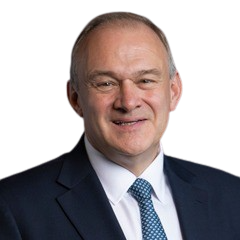
Mims Davies is the Conservative MP for East Grinstead and Uckfield, having first been elected for this seat at the 2024 general election. She previously represented the Eastleigh (2015-2019) and Mid Sussex (2019-2024) constituencies.
Davies currently serves on the Conservative frontbench as the shadow minister for women and shadow secretary of state for Wales.
In the 2024 general election, Davies won 19,319 votes, representing 38.3% of the vote. The Liberal Democrat candidate, Benedict Dempsey, received 10,839 votes (21.5%), while the Labour candidate, Ben Cox, secured 10,440 votes (20.7%). Davies was duly elected with a majority of 8,480 votes.
The East Grinstead and Uckfield constituency is a new seat created for the 2024 election, covering parts of east and west Sussex. It draws primarily from the former Mid Sussex and Wealden constituencies. The area is considered safe Conservative territory.
Davies’ predecessor as the MP for Mid Sussex was Sir Nicholas Soames, a former frontbencher, Brexit rebel and grandson of Winston Churchill. When sitting as a Conservative MP, Soames famously had the whip removed on 3 September 2019, alongside 20 Tory colleagues, for voting against the government over Brexit. Soames had the whip restored on 29 October after he announced he would not seek re-election and was made a peer in the 2022 special honours as Baron Soames of Fletching.
From 2005 to 2013, Davies’ former Eastleigh constituency was represented by senior Liberal Democrat and cabinet minister during the coalition government Chris Huhne.
Political Career
Davies serves in the shadow cabinet as shadow secretary of state for Wales (since November 2024). She was shadow minister for women from July 2024 to September 2026.
Prior to the 2024 election, which saw the Conservatives ejected from government, Davies served as minister of state for disabled people, health and work at the Department for Work and Pensions (DWP) from April to July 2024, and parliamentary under-secretary of state at the DWP from October 2022 to April 2024. Before this, she was briefly parliamentary under-secretary of state at the Home Office (September – October 2022).
Davies was appointed as parliamentary under-secretary of state for employment, again at the DWP, in July 2019. She resigned from this post in July 2022 as part of the mass walkout of ministers that ultimately forced Boris Johnson to announce his own resignation.
In her letter of resignation, Davies said the Conservative Party needed a “fresh start” and that she had become “increasingly concerned” about Johnson’s premiership.
She wrote: “Reaching this decision has been incredibly hard, especially when I consider your tremendous achievement and commitment in making Brexit work, public health decisions during the pandemic and your impeccable leadership as we face Russian aggression in Europe.
“However, over the last few months, I have become increasingly concerned about your premiership, those around you and our great party’s direction and what we truly stand for. Many people go into politics to make a difference and I would like to say I am one of them.”
She added: “But these last few months have led me to believe that we must strive to make that difference while fully upholding the highest standards in public life and remain true to our values as an individual”.
Following her resignation, Davies thanked Johnson for his “public service and kindness to me”. She said that the outgoing prime minister had a “very challenging wicket to bat from”, saying it was a “huge honour” to have served in government during his tenure as prime minister.
Davies’ previous ministerial roles included parliamentary under-secretary of state at the Department for Digital, Culture, Media and Sport (November 2018 – July 2019), parliamentary under-secretary of state at the Wales Office (July – November 2018), and assistant government whip (January – November 2018).
On 30 October 2019, Davies announced she would stand down as the MP for Eastleigh, her first constituency, in order to spend more time with her children. Referring to her responsibilities as a mother, parliamentarian and minister, Davies said her situation had “become impossible”. In a statement, she described her decision to stand down as “tremendously difficult” but insisted “it is always the children who must come first”.
Days later, Davies said she had secured a place on a three-person shortlist to be the Conservative candidate for the Mid Sussex constituency. Davies insisted that she had received no assurance or “offer I would be on any shortlist for any other constituency” when she announced she would not be seeking re-election in her erstwhile Eastleigh seat. “I left parliament for purely personal reasons”, she added.
Davies’ statement read: “The Conservative Association in Mid Sussex subsequently asked me to put my name forward to be interviewed, for its seat and this is the constituency where I have my family home, where my daughters live and where I was previously a local councillor.
“I haven’t abandoned anything and I am not scared of Lib Dems or anyone else for that matter.”
Eastleigh was a target seat for the Liberal Democrats at the 2019 general election, with Davies having won the constituency from the party at the 2015 general election.
Mid Sussex, meanwhile, was considered to be safe Conservative territory. Sir Nicholas Soames won the seat for the Conservatives with a 19,673-vote majority at the 2017 general election, before announcing his decision to stand down from parliament in late 2019.
Davies’ decision to run in the Mid Sussex constituency found her accused of going on a “chicken run” – a pejorative term for when a sitting member of parliament decides not to seek re-election in their current constituency, and instead seeks selection for a different, usually safer, seat. Davies’ decision to shift seats won national media attention and criticism from within the Conservative Party. A Tory candidate told The Times it “didn’t seem right” for Davies to flip her seat to somewhere safer. Another told the New Statesman: “It’s a case of who you know and ticking the right boxes. There is fury among decent Tory MPs about what Davies has done.”
The Conservative candidate Paul Holmes ultimately won the Eastleigh seat for the Conservative Party at the 2019 general election on an increased majority (15,607 votes). The Liberal Democrats secured the constituency at the 2024 general election, however, with Liz Jarvis emerging as victor (1,546 vote majority). But Holmes did not stand for re-election in Eastleigh; he was elected as the MP for the Hamble Valley constituency (4,802-vote majority). The Hamble Valley constituency is composed of 42.5% of Holmes’ former Eastleigh seat.
Davies’ current East Grinstead and Uckfield constituency is composed of 30.3% of her former Mid Sussex seat. At the 2024 general election, the Mid Sussex constituency (69.7% of the old seat of the same name) was won by Alison Bennett for the Liberal Democrats on a majority of 6,662 votes. Dave Rowntree, best known as the drummer for the rock band Blur, stood as the Labour candidate.
In the 2016-2017 session, Davies introduced the Parish Council Governance (Principles of Public Life) Bill, which aimed to ensure ethical standards in local government, specifically at the parish council level, by applying the Seven Principles of Public Life.
Davies was a member of the women and equalities committee from July 2015 to December 2016.
Davies is listed as a member of the all-party parliamentary groups (APPGs) for women in parliament, men and boys’ issues, youth affairs and brain tumours among others.
Davies delivered her maiden speech on 2 June 2015 during a debate on health and social care.
In it, she said: “I was a carer for my mum and dad in their older age, and I was a member of the ‘sandwich’ generation – someone looking after younger children as well as unwell parents. I would like to see us supporting people better. Carers week is coming up and I will be supporting Eastleigh and the One Community in that.
“Finally, I would like us, in the NHS and the bill we are considering, to bring through the technology and new practices that are so badly needed, and which I saw from the other side, by using it.”
She added: “Today is my 40th birthday, so do the maths — I will be here for a long time. I vow to work very hard for Eastleigh.”
Political views
Leadership elections and loyalty
Tory leadership 2024: Davies supported Mel Stride’s candidacy in the 2024 Conservative Party leadership election. The contest was triggered by the resignation of Rishi Sunak following the party’s defeat in the 2024 general election. Stride, the then-shadow work and pensions secretary, was eliminated in the second parliamentary ballot on 10 September 2024 after receiving 16 votes.
Davies then supported James Cleverly’s candidacy. During the contest, Cleverly, the shadow home secretary, urged the party to “be more normal”. On 9 October, in a major upset, Cleverly was eliminated in the fourth ballot after his support dropped to 37 votes. The result was widely attributed to a failure of tactical voting by supporters who assumed his place in the final two was secure.
Finally, Davies switched her support to Kemi Badenoch.
Johnson confidence vote: In June 2022, Davies publicly declared their loyalty to Boris Johnson ahead of a Conservative “no-confidence” in his leadership. The vote was triggered by discontent within the parliamentary party following the “Partygate” scandal and the publication of the Sue Gray report. While the prime minister ultimately won the vote, the scale of the rebellion against him, with 148 of his own MPs voting to remove him, severely weakened his authority and presaged his resignation the following month.
Tory leadership 2022 (I): Davies supported Penny Mordaunt’s candidacy in the Conservative Party’s July-September 2022 leadership election. The contest was triggered by Johnson’s resignation. Mordaunt, the international trade minister, was described as a “socially liberal Brexiteer”. She was narrowly overtaken by Liz Truss in the final round. Mordaunt was thereby eliminated in the fifth parliamentary ballot on 20 July after receiving 105 votes.
Davies described Mordaunt as a “positive force for change with an exciting mix of ideas and vision”.
Davies went on to support Truss’ candidacy.
In a statement, issued August 2022, Davies argued that Truss “is determined to deliver on the Conservative agenda” and characterised her as “straight-talking, honest and determined.”
She added: “With Liz as prime minister, we can look forward to an invigorated economy, stronger armed forces and a commitment to giving every child the opportunity to succeed in life regardless of background.
“Liz has a vision for our nation, of aspiration for all and delivery of a Conservative agenda to help everyone succeed – that’s why I am putting my trust in Liz Truss.”
Tory leadership 2022 (II): Davies supported Rishi Sunak’s candidacy in the Conservative Party’s October 2022 leadership election. The contest was triggered by the resignation of Truss after just 45 days in office, following the financial and political tailspin triggered by her “mini-budget”.
Sunak, the former chancellor, had finished second to Truss in the previous contest. Unlike the summer contest, this election featured an expedited process requiring each candidate to secure at least 100 nominations from MPs to proceed. Sunak, having emerged as the clear frontrunner, was declared leader of the Conservative Party unopposed on 24 October.
She backed Sunak to “deliver unity” in the Conservative Party.
Tory leadership 2019: Davies initially supported Sajid Javid for the party’s leadership in 2019. The election was triggered by the resignation of Theresa May following her inability to secure a Brexit deal acceptable to the Conservative Party.
Javid, the then-home secretary, successfully reached the final four of the parliamentary stages, but was eliminated in the fourth ballot on 20 June after receiving 34 votes.
Davies subsequently switched her support to Boris Johnson.
Tory leadership 2016: Davies supported May for the party’s leadership in July 2016. The contest was triggered by the resignation of David Cameron following the UK’s vote to leave the European Union.
May, the then-home secretary, secured a commanding lead in the parliamentary stages, receiving 165 votes in the first ballot and 199 in the second. Following the withdrawal of her final rival, Andrea Leadsom, on 11 July, May was declared leader unopposed and was appointed prime minister two days later.
Factional identity and party tradition
Conservative Environment Network: Davies is listed as a member of the Conservative Environment Network (CEN) parliamentary caucus. CEN is an independent forum for conservatives that supports conservation and decarbonisation. It calls for the environment to be given a higher profile at the heart of policy making, describing “biodiversity loss, climate change, and wasteful resource use are threats to our national security”, and promotes “market-based policies” to environmental challenges. Members of its parliamentary caucus, such as …, are thought to generally align with the group’s “green” message and environmentalism.
Brexit and Europe
Brexit referendum: Davies supported Leave in the 2016 EU referendum, and therefore agreed with a majority of her (Eastleigh) constituents, 54.3% of whom also voted to Leave.
Article 50: In February 2017, Davies voted in favour of the European Union (Notification of Withdrawal) Bill. The legislation empowered the prime minister to notify the Council of the European Union of the UK’s intention to withdraw, formally triggering the process set out in Article 50 of the Treaty on European Union. MPs supported the bill by 498 votes to 114 at second reading.
Customs union vote (2025): In December 2025, Davies voted against the UK-EU Customs Union (Duty to Negotiate) Bill. The bill, introduced under the ten-minute rule procedure by Liberal Democrat Europe spokesperson Al Pinkerton, sought to mandate the government to enter into negotiations with the European Union to establish a bespoke customs union.
Assisted dying
Davies voted against the Terminally Ill Adults (End of Life) Bill, better known as the assisted dying bill, at both second reading (November 2024) and third reading (June 2025).
In a statement setting out her position, issued following the bill’s third reading, Davies said the proposed legislation lacked the “rigour needed.”
She said: “This bill lacks the rigour needed to ensure assisted dying works in practice, for all, and that the NHS, professionals, and our community services are ready for it. It was a hugely sombre experience on a sobering week…
“My Dad became disabled after an attack at work and our world changed. He felt a burden, less valuable, and more importantly, there was very little help and respite to those that acquired an illness and/or a significant health condition.”
Social values and conscience issues
Abortion decriminalisation (2025): Davies voted against a backbench amendment to the Crime and Policing Bill that sought to decriminalise abortion in England and Wales in June 2025. The amendment, which was passed by a majority of 242 votes, removed women from the threat of prosecution for ending a pregnancy at any stage. As an issue of conscience, MPs were allowed to vote according to their personal beliefs.
Foreign policy and security
Trident renewal (2016): Davies voted in favour of a government motion calling for the renewal of the Trident nuclear deterrent system in July 2016. The motion, which was passed by 472 votes to 117, committed the UK to constructing a new fleet of submarines to carry the nation’s nuclear weapons.
Syria airstrikes (2015): Davies voted in favour of a government motion to extend UK airstrikes against Isis from Iraq into Syria in December 2015. The motion, which was passed by 397 votes to 223 after a ten-hour debate in the House of Commons, authorised the RAF to conduct strikes against Isis targets in Syria.
Sanctioned (Russia): In April 2022, Davies was among the group of MPs placed on a sanctions list by the Russian government. The measure barred them from entering Russia and was presented by Moscow as a retaliatory response to the UK’s stance on the invasion of Ukraine.
Before Politics
Born Miriam Jane Alice Davies on 2 June 1975 in Surrey, she was educated at the Royal Russell School in Croydon and then at Collyers Sixth Form College.
She studied politics and international relations at Swansea University.
After university, she worked as a producer and presenter for local radio and the BBC. She subsequently worked in communications and events roles for organisations including the AA (Automobile Association), Sussex police and Sussex Safe Roads Partnership.
Before entering parliament, Davies served on Mid Sussex District Council from 2011 to 2015, representing the Haywards Heath Lucastes ward.
Personal Life
Davies lives in Haywards Heath. She has two children.
She was previously a carer to her elderly parents, as referenced in her maiden speech.
Trivia
During her time as a radio DJ, Davies earned the nickname “DJ Love Spoon”.
https://x.com/WelshConserv/status/1925535619066761553
She is a member of the National Trust.
Mims Davies has not written for Politics.co.uk.