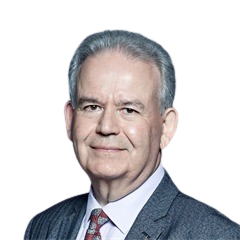
Sir Julian Lewis is the Conservative MP for New Forest East, and was first elected when the constituency was created at the 1997 general election.
In the 2024 general election, Lewis received 17,412 votes, representing 38.5% of the vote share. The Labour candidate, Sasjkia Otto, received 8,917 votes (19.7%), while the Reform UK candidate, Roy Swales, secured 7,646 votes (16.9%). Lewis was duly elected with a majority of 8,495.
The New Forest East constituency is located in southern Hampshire, covering the eastern part of the New Forest National Park and coastal areas along Southampton Water. Key settlements include Totton, Marchwood, Hythe, Fawley, Lyndhurst, and Brockenhurst. The Fawley oil refinery is a major industrial site in the area.
Lewis was awarded a knighthood in the 2023 New Year Honours list for political and public service.
Political Career
Lewis chaired the intelligence and security committee of parliament (ISC) from July 2020 until May 2024. His election to this role was somewhat controversial. He stood against the government’s preferred candidate for the post, Chris Grayling, and secured the position with support from opposition MPs.
Lewis’ election placed him in charge of scrutinising the UK’s intelligence agencies MI5, MI6, and GCHQ.
As a result of this election, the Conservative whip was withdrawn from Sir Julian Lewis between July 2020 and December 2020. A senior government source said the punishment was for “working with Labour and other opposition MPs for his own advantage”. Angela Rayner, the deputy leader of the Labour Party, responded: “What a grubby shower they are.” The whip was subsequently restored.
Previously, Lewis served as chair of the House of Commons defence select committee from June 2015 until November 2019. On top of this, Lewis was a member of the national security strategy (joint committee) (2024-2025, 2017-2019, and 2015-2017), the intelligence and security committee of parliament (2020-2024 and 2010 – 2015), the liaison committee (2015-2019), the defence committee (2014-2015 and 2000-2001), and the Welsh affairs committee (1998-2001).
Lewis served in several shadow ministerial roles while the Conservatives were in opposition. These included shadow minister for the armed forces (2002-2004 and 2005-2010) and shadow minister for the Cabinet Office (2004-2005). He was also an opposition whip (2001-2002).
Lewis is listed as a member of the all-party parliamentary groups (APPGs) for disability, haemophilia and contaminated blood, state pension inequality for women, Afghan women and girls, and publishing.
Lewis delivered his maiden speech on 20 May 1997 during the debate on the queen’s speech following the recent general election.
In it, he stated: “When I ask people to give me examples of dictatorships going to war with other dictatorships, they can give me many. When I ask them for examples of dictatorships going to war against democracies or democracies such as Britain in 1939 going to war against dictatorships, they can give me many, but when I ask for examples of democracies going to war against other democracies, they can usually come up with nothing or their examples are so obscure as to be virtually meaningless.”
He added: “That is why I strongly welcome the government’s decision – provided that they stick to it – to maintain a strong Armed Forces, which are our insurance premium for peace in Europe.”
Lewis previously contested the seat of Swansea West in the 1983 general election, finishing second behind incumbent Labour MP Alan Williams.
Political Views
Leadership elections and loyalty
Tory leadership 2022 (I): Lewis supported Suella Braverman’s candidacy in the Conservative Party’s July-September 2022 leadership election. The contest was triggered by the resignation of Boris Johnson following the mass exodus of more than 60 frontbenchers.
Braverman, the attorney general, announced her candidacy before Johnson had officially resigned. She positioned herself as a staunch Brexiteer on the party’s right wing, calling for the UK’s withdrawal from the European Court of Human Rights (ECHR). She was eliminated in the second parliamentary ballot on 14 July after receiving 27 votes.
Lewis subsequently shifted his support to Liz Truss’ candidacy. Truss, the then-foreign secretary, campaigned on a platform of sweeping tax cuts. After finishing second in the final parliamentary ballot with 113 votes, she won the subsequent vote of the party membership with 81,326 votes (57.4%) and was appointed prime minister on 6 September.
Tory leadership 2019: Lewis supported Boris Johnson for the party’s leadership in 2019. The election was triggered by the resignation of Theresa May following her inability to secure a Brexit deal acceptable to the Conservative Party.
Johnson, the former foreign secretary and mayor of London, campaigned on the central pledge to “deliver Brexit” by 31 October 2019, “deal or no deal”. He thereby positioned himself as the candidate best-placed to break the parliamentary deadlock. Johnson secured 114 votes in the first parliamentary ballot, and reached 160 votes in the final MP round. In the subsequent ballot of the party membership, Johnson won a decisive victory with 92,153 votes (66.4%).
Tory leadership 2016: Lewis supported Andrea Leadsom for the party’s leadership in July 2016. The election was triggered by the resignation of David Cameron following the UK’s vote to leave the European Union.
Leadsom, the minister of state for energy and climate change, emerged as a leading “Leave” candidate, securing 66 votes in the first ballot and 84 in the second. She withdrew from the contest on 11 July before the membership vote could take place.
Factional identity and party tradition
Mass deportation: In May 2025, Lewis signed an early day motion (EDM) concerning the mass deportation of illegal migrants. The motion, tabled by the independent MP Rupert Lowe, expressed “grave concern at the continued presence of over one million illegal migrants in the United Kingdom”.
The EDM urged the government to “implement a comprehensive national strategy to identify, detain, and deport all individuals found to be residing in the United Kingdom illegally, and to ensure that such policies are backed by the necessary legislative, diplomatic, logistical and financial resources to restore confidence in the rule of law and the security of our borders.”
European Research Group: Lewis has been associated with the European Research Group (ERG). During the Conservative Party’s last stint in government, the ERG emerged as a highly influential Tory faction composed of staunchly eurosceptic MPs. Founded in 1993, the group played a pivotal role in shaping the UK’s exit from the European Union, consistently advocating for a “hard” Brexit.
Blue Collar Conservatives: Lewis was previously listed as a member of the Blue Collar Conservatives group. This faction within the Conservative party was founded in 2012 by the former cabinet minister Esther McVey, but came to greater prominence following the 2019 general election. The group aimed to “champion working people and develop a conservative agenda to benefit the voters and communities most neglected by Labour”. In October 2022, McVey was succeeded by Lee Anderson as the group’s chair.
Brexit and Europe
Brexit referendum: Lewis supported Leave in the 2016 Brexit referendum, and therefore agreed with a majority of constituents, 60.2% of whom also voted to Leave.
Leave Means Leave: Lewis was a supporter of Leave Means Leave, a cross-party eurosceptic pressure group established in the aftermath of the 2016 EU referendum. The group, which described itself as “the campaign for a clean Brexit”, set out its opposition to any withdrawal agreement that it believed would keep the UK tied to EU rules and institutions – a position often referred to as a “hard Brexit”.
Article 50: In February 2017, Lewis voted in favour of the European Union (Notification of Withdrawal) Bill. The legislation empowered the prime minister to notify the Council of the European Union of the UK’s intention to withdraw, formally triggering the process set out in Article 50 of the Treaty on European Union. MPs supported the bill by 498 votes to 114 at second reading.
Brexit spartan: Lewis was one of the 28 so-called “Brexit spartans”, a group of hardline Eurosceptic Conservative MPs who voted against then-prime minister Theresa May’s Brexit withdrawal agreement on all three occasions it was put to parliament in 2019. The so-called “spartans” argued that May’s deal did not represent a genuine departure from the European Union. Their steadfast opposition was a critical factor in May’s resignation as prime minister.
Customs union vote (2025): In December 2025, Lewis voted against the UK-EU Customs Union (Duty to Negotiate) Bill. The bill, introduced under the ten-minute rule procedure by Liberal Democrat Europe spokesperson Al Pinkerton, sought to mandate the government to enter into negotiations with the European Union to establish a bespoke customs union.
Assisted dying
Lewis voted against the Terminally Ill Adults (End of Life) Bill, better known as the assisted dying bill, at both second reading (November 2024) and third reading (June 2025).
Social values and conscience issues
Abortion decriminalisation (2025): Lewis voted against a backbench amendment to the Crime and Policing Bill that sought to decriminalise abortion in England and Wales in June 2025. The amendment, which was passed by a majority of 242 votes, removed women from the threat of prosecution for ending a pregnancy at any stage. As an issue of conscience, MPs were allowed to vote according to their personal beliefs.
Same-sex marriage (2013): In February 2013, Lewis was one of the 139 Conservative MPs to vote against the Marriage (Same Sex Couples) Bill at its second reading. The landmark piece of legislation, which received its second reading by 400 votes to 175, legalised marriage for same-sex couples in England and Wales.
Foreign policy and security
Trident renewal (2016): Lewis voted in favour of a government motion calling for the renewal of the Trident nuclear deterrent system in July 2016. The motion, which was passed by 472 votes to 117, committed the UK to constructing a new fleet of submarines to carry the nation’s nuclear weapons.
Syria airstrikes (2015): Lewis voted against a government motion to extend UK airstrikes against Isis from Iraq into Syria in December 2015. The motion, which was passed by 397 votes to 223 after a ten-hour debate in the House of Commons, authorised the RAF to conduct strikes against Isis targets in Syria.
Syria airstrikes (2013): Lewis voted against the government’s motion on the principle of military intervention in Syria in August 2013. The government motion was defeated by 285 votes to 272, a move which effectively ruled out UK participation in any US-led military strikes.
Iraq War authorisation vote (2003): In March 2003, Lewis voted in favour of the government motion authorising military action against Iraq. The vote, one of the most contentious in recent parliamentary history, gave the prime minister, Tony Blair, the authority to join the US-led invasion.
Sanctioned (Russia): In April 2022, Lewis was among the group of MPs placed on a sanctions list by the Russian government. The measure barred them from entering Russia and was presented by Moscow as a retaliatory response to the UK’s stance on the invasion of Ukraine.
Civil liberties
Covid passes campaign (2021): Lewis was one of over 70 MPs and peers who launched a cross-party campaign against the “divisive and discriminatory use” of Covid passes in April 2021. The campaign was triggered by government reviews into “vaccine passports”, which signatories argued would create a two-tier society and infringe upon fundamental civil liberties.
Covid passes vote (2021): Lewis was one of 99 Conservative MPs to vote against Covid passes in England in December 2021.
Before Politics
Born in Swansea in 1951, Lewis was educated at Dynevor grammar school.
He studied philosophy and politics at Balliol College, Oxford, before gaining a doctorate (DPhil) in strategic studies from St Antony’s College, Oxford, in 1981. His thesis was titled “British military planning for post-war strategic defence, 1942–47”.
During the late 1970s, while posing as a member of the Labour party (1976-78), he worked to expose the activities of the Militant tendency group within the party. Between 1981 and 1985, he held leading roles in the Coalition for Peace Through Security, which campaigned against unilateral nuclear disarmament and the Campaign for Nuclear Disarmament (CND).
In 1985, he became director of the political consultancy Policy Research Associates. This organisation campaigned on issues including trade union democracy (advocating for postal ballots) and media bias. He also ran campaigning and speaking courses for Conservative activists, some jointly with future speaker John Bercow.
He is the author of the book Changing Direction: British Military Planning for Post-war Strategic Defence 1942-47, first published in 1988 with a second edition in 2003 (republished 2008).
Lewis was appointed deputy director of the Conservative research department in 1990. In 1995 he became director of the Conservative Central Office’s media monitoring unit, resigning in 1996 to campaign against the UK joining a single European currency.
He served in the Royal Naval Reserve from 1979 to 1982, reaching the rank of seaman, attached to HMS President and the 10th mine counter-measures squadron.
Personal Life
Lewis was born into a Jewish family in Swansea, Wales.
Trivia
Lewis competed with his school team for Television Top of the Form, broadcast on BBC One in 1966.
Julian Lewis has not written for Politics.co.uk.