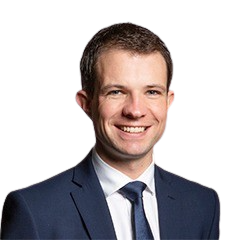
Andrew Bowie is the Scottish Conservative MP for West Aberdeenshire and Kincardine, having first been elected to parliament at the 2017 general election.
In the 2024 general election , Bowie received 17,428 votes in West Aberdeenshire and Kincardine, representing 35.6% of the vote share. The Scottish National Party (SNP) candidate, Glen Reynolds, received 13,987 votes (28.6%), while the Labour candidate, Kate Blake, secured 6,397 votes (13.1%). Bowie was duly elected with a majority of 3,441 votes.
The West Aberdeenshire and Kincardine constituency is a large, mainly rural seat west and south of Aberdeen, including towns such as Banchory, Portlethen and Stonehaven. Historically represented by Conservatives and then Liberal Democrats, it has recently been a closely contested marginal seat between the Conservatives and the SNP.
Political Career
Bowie currently serves as shadow secretary of state for energy security. Bowie was appointed to this role as part of the August/September 2026 shadow cabinet reshuffle, Kemi Badenoch’s second as Conservative leader.
Bowie previously served as shadow secretary of state for Scotland (2024-2026) and shadow minister of state for energy security and net zero (2024-2026). From July to November 2024, he held the latter position on the interim/caretaker frontbench constructed by Rishi Sunak as Tory leader.
Bowie was also shadow veterans minister from July to November 2024.
In government, Bowie served as parliamentary under-secretary of state for nuclear and networks at the Department for Energy Security and Net Zero from February 2023 to July 2024. Before this, he was parliamentary under-secretary of state for exports at the Department for International Trade from October 2022 to February 2023.
Bowie served as a vice chairman of the Conservative Party, with responsibility for youth and the union, from July 2019 until November 2021, when he resigned citing a need to focus on his constituency. The resignation happened to come soon after the forced resignation of Owen Paterson from the Conservative Party and parliament.
In a statement, Bowie said he had come to the decision to step back “over the last few months”.
Bowie, then seen as a rising star within the party, said: “I was honoured to serve as vice-chair of the Conservative and Unionist Party.
“However, over the last few months, I have come to the decision that I need to take a step back from the demands of the role to focus on representing my constituents in West Aberdeenshire and Kincardine.
“I formally asked the Party yesterday if I could step back from my position and I will remain in post until they have found a successor.”
Conservative sources initially denied any connection between Bowie’s resignation and the Owen Paterson saga, but in a later interview with the New Statesman, published January 2022, Bowie referred to the scandal as “maybe the straw that broke the camel’s back.”
He added: “I was just very uncomfortable with defending the government over that, and I took the decision to step away, to focus on my constituency, because I’m very much of the view that Scotland requires Conservative representation, and that if we are going to stop the SNP juggernaut, we need to have bits of blue on that map”.
Bowie also expressed his regret that he did not speak out against the prime minister and his most senior adviser, Dominic Cummings, over the scandal surrounding the latter’s pandemic-era excursion to Barnard Castle.
Earlier in his parliamentary career, Bowie served as parliamentary private secretary (PPS) to prime minister Theresa May from January to July 2019. Before that, he was PPS at the Department for Digital, Culture, Media and Sport from March 2018 to January 2019.
Bowie has been a member of the House of Commons work and pensions select committee (2017-2018), the Scottish affairs committee (2020-2022) and the defence committee (2022).
Bowie delivered his maiden speech on 26 June 2017 during a debate on Brexit and foreign affairs.
In it, he stated: “What the farming sector and, indeed, this country do not need is further uncertainty in the shape of another referendum on Europe or another general election, and they certainly do not need another referendum on Scottish independence.”
Political Views
Leadership elections and loyalty
Tory leadership 2024: Bowie supported Kemi Badenoch’s candidacy in the 2024 Conservative Party leadership election. The contest was triggered by the resignation of Rishi Sunak following the party’s defeat in the 2024 general election.
Badenoch, the then-shadow housing secretary, was seen as a leading figure on the party’s right wing. After finishing first in the final parliamentary ballot with 42 votes, she defeated Robert Jenrick in the membership vote on with 53,806 votes (56.5%). Badenoch was declared Conservative leader on 2 November.
https://x.com/GBNEWS/status/1853339243591909668
Tory leadership 2022 (I): Bowie supported Rishi Sunak’s candidacy in the Conservative Party’s July-September 2022 leadership election. The contest was triggered by the resignation of Boris Johnson, following the mass exodus of more than 60 frontbenchers.
Sunak, the former chancellor, warned against “comforting fairytales” regarding unfunded tax cuts. Although he won every round of the parliamentary ballots, securing 137 votes in the final stage, Sunak was defeated by Liz Truss in the membership vote, finishing with 60,399 votes (42.6%).
Tory leadership 2022 (II): Bowie supported Sunak’s candidacy in the Conservative Party’s October 2022 leadership election. The contest was triggered by the resignation of Truss after just 45 days in office, following the financial and political tailspin triggered by her “mini-budget”.
Sunak, the former chancellor, had finished second to Truss in the previous contest. Unlike the summer contest, this election featured an expedited process requiring each candidate to secure at least 100 nominations from MPs to proceed. Sunak, having emerged as the clear frontrunner, was declared leader of the Conservative Party unopposed on 24 October.
Tory leadership 2019: Bowie was one of 20 Conservative MPs who voted for Matt Hancock in the first ballot of the party’s leadership election in June 2019. The contest was triggered by the resignation of Theresa May after she was unable to secure a Brexit deal acceptable to the Conservative Party.
Hancock, the then-health and social care secretary, pitched himself as one nation Conservative who could appeal to the centre ground. He secured 20 votes in the first round of voting on 13 June, placing sixth, and withdrew the next day.
In a socialmedia post at the time, Bowie stated: “Tonight, Matt Hancock made clear why he should be the next prime minister of the United Kingdom. Delivering Brexit, uniting the Party, bringing the country together. A true one nation candidate for a party of our whole nation.”
Bowie went on to support Boris Johnson’s successful candidacy.
Factional identity and party tradition
In a 2022 interview, Andrew Bowie identified as a “Cameroon” – a descriptor applied to supporters of David Cameron and his mode of moderate or “one nation” Conservatism.
Bowie told the New Statesman: “It was David Cameron that convinced me to join the Conservative Party.
“It was David Cameron that changed this party and made it more acceptable for young people in Britain in the mid-2000s to say, ‘I am a Conservative and I’m proud to be, I’m going to vote for it, and I’m actually going to join it and I’m actually going to run for office.’
Bowie was an ally of Theresa May during her tenure as prime minister, working as her parliamentary private secretary. Reflecting on his central role in the May government, Bowie later commented: ” I was obviously there at the time when we were working hard to try and maintain her authority over the party, maintain her premiership, and to deliver her vision for Brexit and, indeed, her vision on many other important issues.”
He added: “I do feel a great deal of affection towards [May], and I’m still very loyal to her. I really do hope that history will treat her better than some in our party treated her at the time.”
Bright Blue: Bowie is listed as sitting on the advisory council of Bright Blue, an independent centre-right think tank and membership organisation that champions liberal conservatism in the UK. Since its founding in 2014, the organisation has expanded its reach through a new cross-party strategy.
China Research Group: Bowie was a founding member of the China Research Group (CRG). The CRG was established in 2020 by a group of Conservative MPs to promote a more critical and questioning approach to the UK’s relationship with the People’s Republic of China. The CRG described its mission as aiming to “promote understanding, leading to fresh thinking about issues raised by the rise of China, and provide a trustworthy source of news and informed knowledge on China issues.”
The Free Market Forum: Bowie has been listed as a supporter of the Free Market Forum (FMF) of Conservative MPs and peers. The group, co-chaired by Dehenna Davison and Greg Smith in the 2019-2024 parliament, set out to “encourage free market thinking, winning over the unpersuaded and providing intellectual firepower and a public platform to proponents of classical liberalism.” Founded in 2021, the forum, associated with the Institute of Economic Affairs (IEA), was seen as aligned with the economic policies of the Liz Truss government.
Brexit and Europe
Brexit referendum: Bowie supported remain in the 2016 Brexit referendum, and therefore agreed with a majority of constituents, 61.5% of whom voted to remain.
Customs union vote (2025): In December 2025, Bowie voted against the UK-EU Customs Union (Duty to Negotiate) Bill. The bill, introduced under the ten-minute rule procedure by Liberal Democrat Europe spokesperson Al Pinkerton, sought to mandate the government to enter into negotiations with the European Union to establish a bespoke customs union.
Assisted dying
Bowie voted against the Terminally Ill Adults (End of Life) Bill, better known as the assisted dying bill, at both second reading (November 2024) and third reading (June 2025).
In a statement setting out his position, Bowie commented: “I fundamentally believe in the sanctity of human life and, whilst understanding the obvious, heartfelt, sometimes heart-rending calls for it and do not doubt for one moment the motivations behind those pushing for this change in the law, I would be unable to square my belief that all life is sacred and that the voluntary taking of it should be done only in the most extreme circumstances.
“I am also concerned by the examples in Oregon, Canada and the Netherlands – all of which legalised assisted dying with the same safeguards as are being proposed in this bill, but that now see far more people, for a far wider variety of reasons that were ever envisaged, now seeking to end their lives.
“Instead of heading down this path we should be investing more in palliative care and in the services needed to support those with the complex situations that lead them to a place where the only option, they see, is to take their life.”
Social values and conscience issues
Abortion decriminalisation (2025): Bowie voted against a backbench amendment to the Crime and Policing Bill that sought to decriminalise abortion in England and Wales in June 2025. The amendment, which was passed by a majority of 242 votes, removed women from the threat of prosecution for ending a pregnancy at any stage. As an issue of conscience, MPs were allowed to vote according to their personal beliefs.
Foreign policy and security
Sanctioned (Russia): In April 2022, Bowie was among the group of MPs placed on a sanctions list by the Russian government. The measure barred them from entering Russia and was presented by Moscow as a retaliatory response to the UK’s stance on the invasion of Ukraine.
Before Politics
Born Andrew Campbell Bowie on 28 May 1987 in Arbroath, Scotland. He grew up in Aberdeenshire, initially in Alford before moving to Inverurie, where he attended Market Place School and Inverurie Academy.
After leaving school, Bowie joined the Royal Navy in 2007, attending Britannia Royal Naval College and serving as a warfare officer for three years, ranked as a Sub-Lieutenant.
Following his naval service, he studied history and politics at the University of Aberdeen, graduating with an MA degree. While at university, he was part of the Aberdeen University Royal Naval Unit.
After university, Bowie worked briefly as a military projects coordinator for Divex, a diving equipment supplier. He then worked for the Scottish Conservative Party as North Scotland campaign manager (2014), covering the European election, Scottish independence referendum, and 2015 general election campaigns.
Subsequently, he worked as a senior advisor and parliamentary assistant to Conservative MEP Ian Duncan, before becoming office manager for Scottish Conservative MSP Liam Kerr in 2016.
Personal Life
Bowie is married to Madeleine Clarke, who is originally from Sweden. They have one daughter, Emily, born in August 2022. They live in the West Aberdeenshire and Kincardine constituency.
Trivia
Bowie served as an officer in the Royal Navy before entering university and politics. He rejoined the Royal Naval Reserve in 2022.
He played violin in the National Youth Orchestra of Scotland during his school years.
Andrew Bowie has not written for Politics.co.uk.