George Brown resigns as foreign secretary in late-night drama
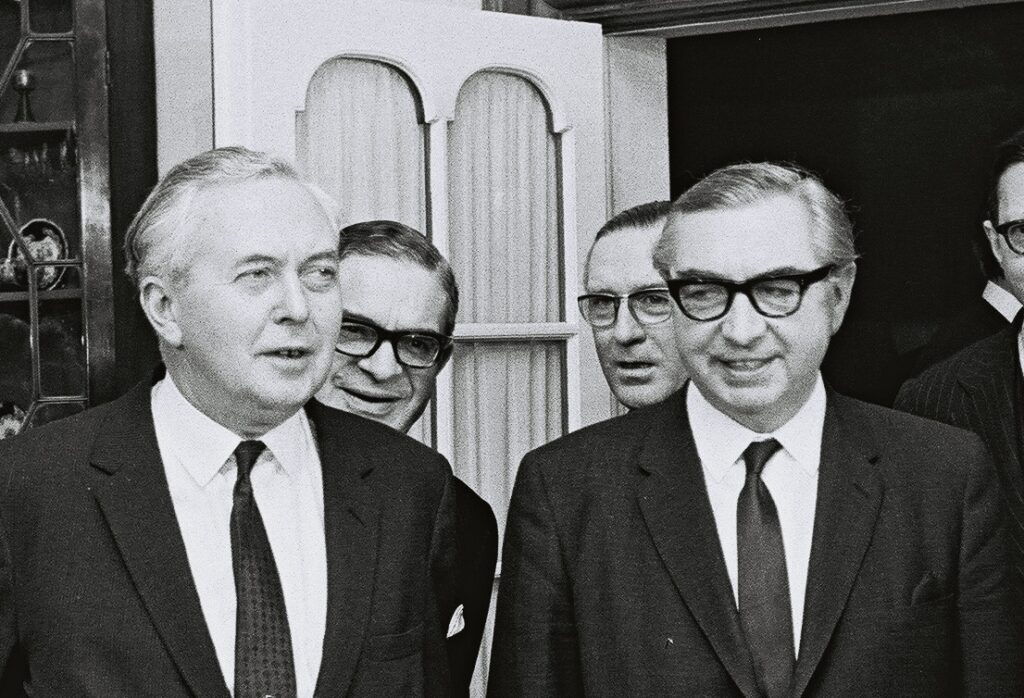
On 15 March 1968, George Brown, the talented and eccentric foreign secretary, resigned from Harold Wilson’s Labour government, bringing to an end one of the most turbulent careers in post-war politics. His departure was the culmination of a long-running and difficult relationship with the prime minister and a personal struggle with alcohol.
***
Wilson defeated Brown in the 1963 Labour leadership contest triggered by the death of Hugh Gaitskell.
At the time, Wilson was seen as a Bevanite figure on the left of the party. His success in the 1963 leadership contest was attributed to splits on the right of the party (between supporters of Brown and Jim Callaghan), and Brown’s own divisive campaign. The latter factor allowed Wilson to assume the mantle of unity candidate. Brown had gone into the contest as the favoured candidate of the Gaitskellites and frontrunner.
Leading Gaitskellite Tony Crosland famously described the selection between Brown and Wilson as akin to choosing “between a crook and a drunk.”
Wilson won the 1964 and 1966 general elections as Labour leader, the latter by a landslide margin.
Brown, Labour’s deputy leader since 1960, was appointed as foreign secretary in 1966. But his tenure was marred with a series of diplomatic incidents and spats.
In 1967, Brown launched a bitter attack on the son of newspaper proprietor Cecil King. The following year, he insulted the wife of the British ambassador to France, Sir Patrick Reilly, at a dinner party at the French embassy in London.
The immediate trigger for Brown’s resignation was a decision by Wilson to convene an emergency late-night meeting of the privy council to approve an emergency bank holiday. This would enable the government to close the London gold market to stem the losses being suffered by the British pound.
Brown, it was said, could not be located and so was not in attendance for the meeting.
However, the foreign secretary felt he had been improperly excluded and so confronted Wilson. He appeared heavily intoxicated. Brown ended the meeting by storming out of Downing Street; at this stage, it was unclear whether he had tendered his resignation.
On the evening of 15 March, Brown wrote to Wilson that “the events of last night” had “brought to a head a really serious issue which has, as you know, been troubling me for some time.”
He added: “It is, in short, the way this government is run and the manner in which we reach our decisions… For this reason I thought it better that we should part company much as, in every other respect, I shall regret it.”
Wilson responded that Downing Street had made “unsuccessful efforts” to establish contact with Brown ahead of the crunch meeting. The prime minister said a decision needed to be reached at the meeting with “great urgency if most serious consequences for the nation and the international community were to be averted.”
He added: “I am sorry that your feelings about what happened last night have made you decide that you cannot continue to hold office in the government. You have made a great contribution to the work of the government, and particularly in the conduct of Britain’s foreign policy and of foreign affairs in Europe.”
The prime minister, however, was still not entirely certain that Brown intended to resign and urged him to clear up any possible misinterpretation. This was far from the first time Brown had tried or threatened to resign. But upon receiving no further clarification, it was resolved that Brown had left the government.
***
In his resignation statement, delivered to the commons on 18 March, Brown hinted at his opposition to various “government decisions, and, even more, with the way in which they have been increasingly made and the considerations on which they were so often based.”
Brown argued that the seriousness of the financial situation made it essential that the principles of cabinet government be upheld. He warned of a tendency for power to pass “very easily pass not merely from cabinet to one or two ministers, but effectively to sources quite outside the political control altogether.”
The backbench Labour MP subsequently set out his rationale in resigning from the government.
He told the House: “It is open to anyone to challenge my judgment of the situation on Thursday night, when it was learned that the prime minister and two other ministers were already at the palace, or to feel that I exaggerated the dangers in it.
“But I am very conscious of past parallels in my own political lifetime, and felt strongly enough on the issue to gather some of my colleagues together and to protest then. When that protest was virtually brushed aside on the basis that what I had done was in itself irregular, I felt that the time had come to leave the government.”
He ridiculed the suggestion that his resignation represented the beginnings of a “left-wing revolt against the cabinet”.
Brown insisted that his aim was to encourage changes in the way government decisions were taken and communicated. “Just making what are called tough decisions on occasions, valid as they may be, is not enough”, the former foreign secretary declared.
“There must be a thread of continuity evident in all that is done.”
He concluded: “I believe that restoring the morale and the enthusiasm of those who elected this government with such high hopes in 1966 is a most vital and urgent task facing us.
“It has seemed increasingly to me over a period that we were ignoring the basic reasons for the decline, that we were misreading all the political signs and refusing to recognise that we ourselves were at least partly responsible for the mood of cynicism in the nation which, whatever our future policy decisions may be, is Britain’s greatest threat.”
***
Wilson’s turmoil over the resignation of his foreign secretary was later confirmed with the release of contemporary cabinet papers by the National Archive under the 30-year rule. The prime minister wrote a full 17 drafts of his reply to Brown’s letter, which hinted at his resignation.
The prime minister appointed Michael Stewart as Brown’s successor as foreign secretary.
Brown’s struggles with alcohol were an open secret in Westminster, famously leading the satirical magazine Private Eye to coin the phrase “tired and emotional” in a spoof diplomatic memo detailing a set of euphemisms to describe Brown’s state.
Brown never returned to high office. Upon his defeat at the 1970 general election, Brown was made a life peer – though he was never an active member of the House of Lords.
He left the Labour Party in March 1976.
In 1981, Baron George-Brown was one of the signatories to the Limehouse Declaration that precipitated the formation of the Social Democratic Party (SDP). George-Brown, who hyphenated his name upon his elevation to the peerage, announced that he had joined the splinter party four years later.
George-Brown died following a stroke on 2 June 1985 at the age of 70.

Politics.co.uk Newsletters
DAILY
Politics@Lunch
WEEKLY
Week in Review