Wes Streeting quits as health secretary and calls for Starmer to resign
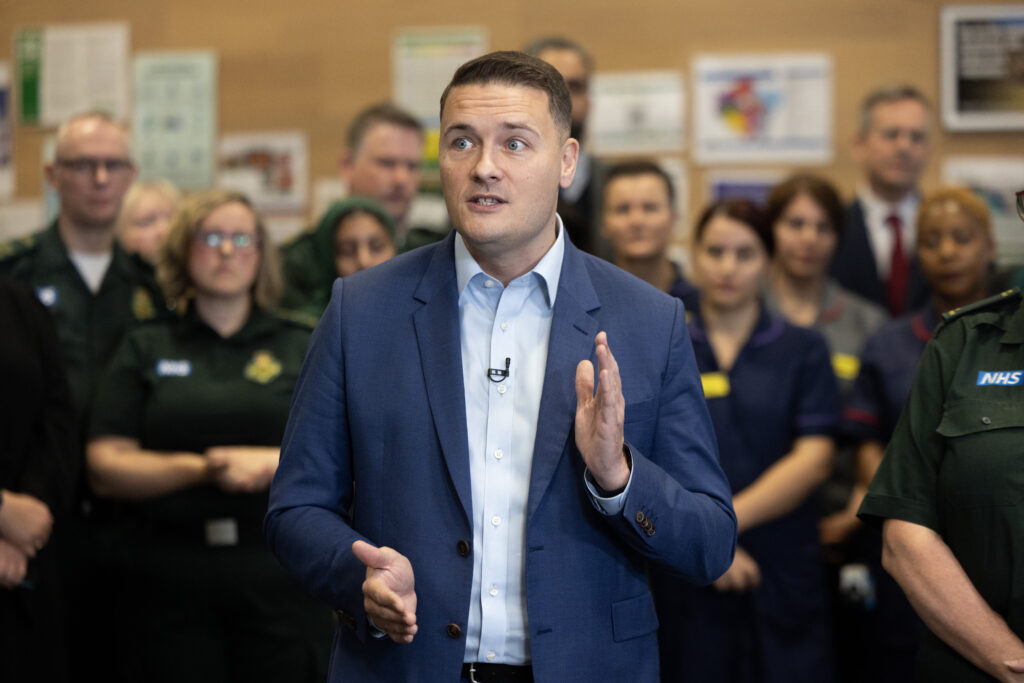
On 14 May 2026, Wes Streeting resigned as secretary of state for health and social care and declared he had lost confidence in the prime minister, Keir Starmer.
Streeting’s resignation followed days of political crisis in the wake of the May 2026 local elections and simultaneous elections to the devolved Scottish Parliament and Senedd Cymru.
***
In the 2026 Senedd elections, Welsh Labour suffered a historic defeat that ended 100 years of Labour control of Wales. The party was reduced to third place behind Plaid Cymru and Reform UK. Eluned Morgan, the incumbent first minister, became the first head of government to lose their seat in an election in British history.
In Scotland, Labour lost five seats as the Scottish National Party (SNP), led by John Swinney, was re-elected.
In the local elections across England, Labour lost control of 35 councils and nearly 1,500 councillors (approximately 60% of seats up for election). Under the BBC’s projected national vote share metric, Labour was estimated to have won just 17% of the vote.
These results, which were confirmed from 8 to 9 May, sparked an intense political crisis as Labour MPs lined up to call on Starmer to step down/set out a timetable for his departure. The coalition calling for Starmer to resign was symbolically broad, including rising stars from the 2024 intake (such as Chris Curtis, Gordon McKee and Yuan Yang), Blue Labour figures (Jonathan Brash, Jonathan Hinder and David Smith), and leading “soft left” MPs (Louise Haigh and Debbie Abrahams).
In total, over 90 MPs called for Starmer to step down as prime minister. This collective expression of disapproval over the direction of the government followed months of mounting pressure on the government over the Peter Mandelson vetting scandal.
On 10 May, Angela Rayner, the former deputy prime minister, issued a 1000-word statement criticising a “toxic culture of cronyism” at the top of the Labour Party. She called on the Labour Party to “live up to our name: we must be the party of working people” and for Starmer to “meet the moment and set out the change our country needs.”
Catherine West, a former Foreign Office minister, provided something of a lightning rod for Starmer’s critics. On 9 May, West announced a challenge to Starmer’s leadership, declaring that she would seek to gather the support of 81 Labour MPs – the threshold to trigger a contest under party rules. She called on the cabinet to “reorganise themselves” and put forward their “best communicator” to replace Starmer. West had been dismissed as a Foreign Office minister in September 2025 as part of the frontbench reshuffle that followed Rayner’s resignation as deputy prime minister.
Speaking to BBC News, West stated she was putting senior ministers “on notice”. West’s move, putting herself forward as a possible “stalking horse”, represented an attempt to smoke out a more prominent leadership rival to challenge Starmer.
However, West appeared to back down on 11 May, instead calling for Starmer “to set a timetable for the election of a new leader in September.” This was the rhetorical formulation preferred by allies of Andy Burnham, the mayor of Greater Manchester; they understood that a delayed departure would potentially allow Burnham to return to parliament and mount a leadership challenge.
On 11 May, Starmer delivered a set-piece speech and press conference in a bid to shore up his position. The event, billed as his final chance for Starmer to save his premiership, was officially presented as a warm-up for the king’s speech. The state opening of parliament was scheduled weeks in advance for 13 May; reports at the time suggested the timing was an attempt to deter possible leadership challengers.
In his speech, Starmer warned Labour was facing “very dangerous opponents” and described a “battle for the soul of our nation”. The speech, which was light on policy, did not succeed in improving Starmer’s standing.
Indeed, the prime minister subsequently suffered a series of resignations. After several parliamentary private secretaries (PPSs) left their posts, Miatta Fahnbulleh stood down as minister for devolution, faith and communities on 12 May. Fahnbulleh, the first serving minister to resign following the May elections, said the government had “not acted with the vision, pace and ambition that our mandate for change demands of us.”
Jess Phillips, Zubir Ahmed and Alex Davies-Jones also resigned as ministers on 12 May. Phillips and Ahmed, in particular, were viewed as close to Streeting. Ahmed, who left a junior post in the Department for Health and Social Care, accused Starmer of becoming the “inadvertent midwife of a fifth-term SNP government”. In her resignation letter, Phillips accused the prime minister of moving too slowly to tackle online harms and protect children.
Meanwhile, loyal Labour MPs organised a statement expressing support for the prime minister.
The statement, which received over 100 signatories, read: “Last week we had a devastatingly tough set of election results. It shows we have a hard job ahead to win back trust from the electorate.
“That job needs to start today – with all of us working together to deliver the change the country needs.
“We must focus on that. This is no time for a leadership contest.”
***
On 13 May, Streeting held talks with Starmer in 10 Downing Street. The health secretary was in the building for just 16 minutes before departing. Reports later indicated that Streeting, in the prime minister’s company, had privately stated his intention to resign and challenge Starmer for the Labour leadership.
Streeting, having delayed to avoid interrupting the state opening of parliament, formally submitted his resignation at 1:00 pm on 14 May.
In his letter of resignation, the outgoing health secretary described the 2026 local and devolved parliament elections as “unprecedented”. He said that the rise of nationalism in all corners of Britain represented “an existential threat to the future integrity of the United Kingdom”.
Streeting wrote: “Progressives across our country understand this threat and our responsibility to confront it, but they are increasingly losing faith that the Labour Party is capable of rising to our historic responsibility of defeating racism and offering hope that Britain’s best days lie ahead through social democracy.”
The leading Labour MP further accused Starmer of presiding over a period of “drift”.
He called on the prime minister to oversee a leadership contest and for a future election to be a “battle of ideas, not of personalities or petty factionalism.”
Notably, Streeting said a leadership contest should “be broad” and include the “best possible field of candidates.” This line represented a symbolic concession on the part of Streeting’s campaign that Andy Burnham would need to feature in a contest.
In his response to Streeting’s letter, Starmer said it was “incumbent on all of us to rise to what I see as a battle for the soul of our nation.”
He added: “I am truly sorry you will no longer be sat at the cabinet table helping to transform our National Health Service. But I have no doubt you will continue to play an important role in our party for many years to come. I hope we can work together to show that Labour in power can address the problems our opponents exploit, can install hope where they want despair, and can bring people together where they want division.”
On 16 May, Streeting confirmed he would stand in a future Labour leadership election. The comments came as part of an appearance at the annual Progress/Progressive Britain conference in London. Streeting was also highly critical of his party’s record since at least 2015.
He stated: “We haven’t had a debate in the Labour Party about who and what we’re for in more than a decade. The moral emergency of antisemitism in our party left little room for intellectual renewal or policy debate on the centre left.
“We then had a dishonest leadership contest, followed by an overcautiousness in opposition. Interesting policy ideas couldn’t be floated because we were too afraid of what the Tories might say, so we said nothing. Instead of a willingness to challenge ideas and kick the tyres, debate was viewed as division and shut down.”
Streeting went on to refer to the decision to leave the European Union in 2016 as “catastrophic”.
Streeting argued that Britain needs “a new special relationship with the EU, because Britain’s future lies with Europe, and one day, one day, back in the European Union.”
***
On 14 May, mere hours after Streeting’s resignation, Josh Simons, a former junior minister, announced that he would resign his Makerfield seat to enable Burnham to stand as a candidate and return to parliament. Simons stood down as a Cabinet Office minister in February 2026 after facing claims that Labour Together, the think tank he ran before entering parliament, commissioned a report that looked into journalists’ backgrounds.
In a statement setting out his decision to resign as an MP, Simons said: “It is my unwavering belief that nothing short of urgent, radical, courageous reform will make a difference. That must start with a change in leadership.
“Today, I am putting the people I represent and the country I love first and will be resigning as MP for Makerfield. I am standing aside so that Andy Burnham can return to his home, fight to re-enter parliament, and if elected, drive the change our country is crying out for.”
On 4 June, Burnham confirmed that he would seek to enter any future Labour leadership contest should he win the Makerfield by-election. The Greater Manchester mayor argued that “Wes Streeting seems to have launched a leadership contest, so if that is running I would seek to join it.”
Labour’s national executive committee (NEC) had previously blocked Burnham from standing in the February 2026 Gorton and Denton by-election. In her aforementioned 1000-word statement, Rayner criticised the decision to block Burnham from standing in the Gorton and Denton by-election as a “mistake.”
This time, ahead of the Makerfield by-election, the NEC put up no resistance and Burnham was confirmed as Labour’s candidate.
In the early hours of Friday 19 June, Burnham was declared as the winner of the Makerfield by-election. Burnham secured 24,927 votes (54.8%) and a significant majority of 9,231, while the Reform UK candidate, Robert Kenyon, finished in second place with 15,696 votes (34.5%). Burnham’s Makerfield victory ensured that he was now eligible to stand in a leadership contest to succeed Starmer.
Starmer spent the weekend of 20-21 June at Chequers, the prime minister’s country retreat, to mull his political future. In a statement on 22 June, Starmer confirmed his intention to resign.
In the hours that followed Starmer’s address, Burnham confirmed that he would be standing for the Labour leadership.
He said: “His decision marks the beginning of a transition and it is important that this process is conducted in an orderly and responsible way. I will put myself forward as part of this process…
“The Labour movement has always been at its strongest when it looks forward with confidence and purpose. This is what we will do from here and we will make sure this transition is a positive process of renewal for our party and our country.”
Almost immediately, Streeting endorsed Burnham and abandoned his own leadership bid. The former health secretary said he had spoken to Burnham “at length” in recent days.
In a post to social media, he stated: “We could spend the summer exaggerating small differences, or we can roll up our sleeves and help him to deliver the change our party and country needs. That is the choice I am making and I hope that everyone else will back Andy, too.”

Politics.co.uk Newsletters
DAILY
Politics@Lunch
WEEKLY
Week in Review