Rhun ap Iorwerth sworn in as first Plaid Cymru first minister of Wales
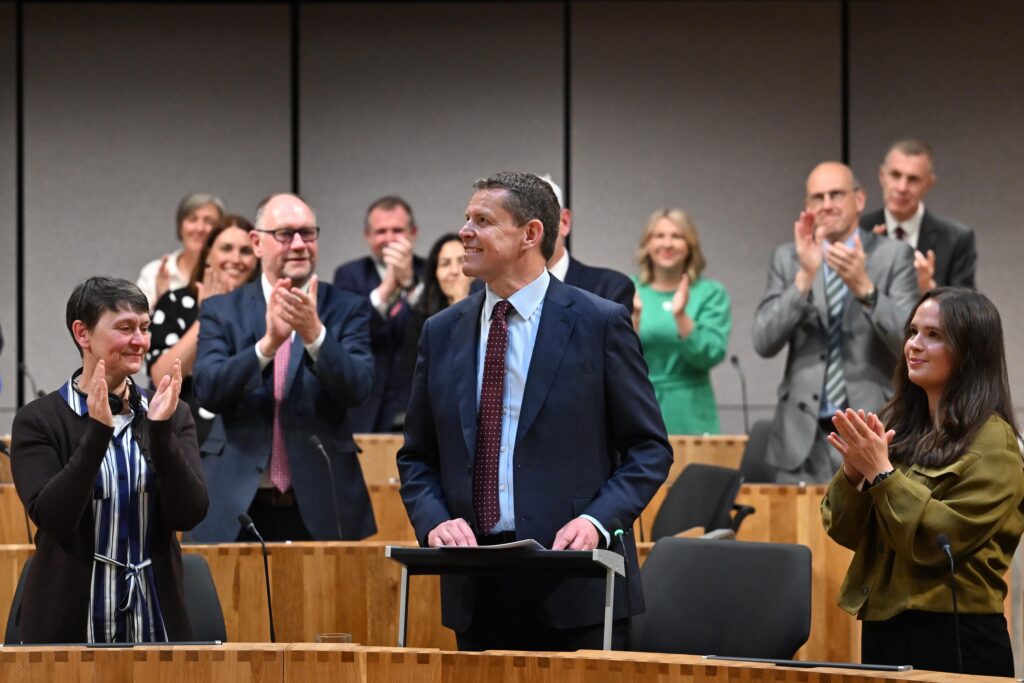
On 12 May 2026, Rhun ap Iorwerth was elected and sworn in as the new first minister of Wales. Ap Iorwerth’s confirmation formally ended 27 years of continuous Labour-led devolved governments. Labour politicians had led the Welsh executive/government since the founding of the National Assembly for Wales in 1999.
Ap Iorwerth was first elected as the MS (member of the Senedd) for Ynys Môn in a by-election in 2013. Before entering politics, he was a broadcast journalist and presenter for BBC Wales.
Ap Iorwerth’s elevation followed the 2026 Senedd elections on 7 May, in which Plaid Cymru secured 43 seats. Reform UK emerged as the official opposition with 34 seats, while Welsh Labour was reduced to just nine members.
Eluned Morgan, the incumbent first minister, lost her seat. She became the first head of government to lose their seat in an election in British history as Labour’s century-long electoral dominance in Wales was ended.
The results placed Plaid Cymru in a comfortable position to form a minority government.
The 2026 election was also the first held since a series of reforms came into force under Senedd Cymru (Members and Elections) Act 2024. This legislation increased the size of the chamber to 96 members and introduced a new closed party list system, replacing the previous additional member system (AMS).
In a party-list system – a pure form of proportional representation – voters choose a party rather than a candidate. As such, each party presented a list of candidates, and seats were allocated to each party in direct proportion to their share of the vote in a multi-member constituency or region.
The Senedd Cymru (Members and Elections) Act 2024 also changed the length of the legislature’s fixed term from five to four years and increased the maximum number of Welsh Ministers from 12 to 17.
***
Plaid Cymru, a pro-Welsh independence party founded in 1925, had previously held prominent positions in the Welsh government/executive. Following the 2007 election, Plaid Cymru served as the junior partner in the “One Wales” coalition alongside Labour. Under the agreement, Plaid Cymru leader Ieuan Wyn Jones was made deputy first minister, serving under Labour’s Rhodri Morgan as first minister (and later Carwyn Jones). In total, three Plaid Cymru members sat in the cabinet as full ministers, including Jones, Elin Jones (rural affairs), and Rhodri Glyn Thomas (heritage).
From December 2021 until May 2024, the Welsh Labour government operated with support from Plaid Cymru through a formal “co-operation agreement”. Unlike a formal coalition, Plaid Cymru remained in opposition and did not take up ministerial seats. Instead, the parties worked together on 46 specific policy areas, including free school meals and Senedd reform. Plaid appointed special advisers to serve in the offices of the Welsh government.
At the time, Plaid Cymru leader Adam Price said his party was “transforming itself from a traditional opposition party in the Westminster sense to something new and refreshingly different, a co-opposition party, co-operating where possible, while continuing to oppose, and to scrutinise and criticise where necessary”.
Price resigned as Plaid Cymru leader on 10 May 2023 following the publication of a report entitled Prosiect Pawb, which found a culture of harassment, bullying and misogyny within the party. Rhun ap Iorwerth, who served as Plaid Cymru’s deputy leader from 2018 to 2023, vowed to make the organisation a “welcoming party where everyone feels safe”.
Rhun ap Iorwerth, who had challenged the incumbent leader Leanne Wood (Price’s predecessor) in a 2018 contest, stood unopposed in the 2023 election.
In May 2024, Plaid Cymru withdrew from its co-operation agreement with Welsh Labour. Ap Iorwerth said the decision was related to controversies surrounding the new first minister, Vaughan Gething, and what he called “a significant lack of judgement.” Gething ultimately resigned as first minister in July 2024, only four months after taking the job, after questions arose over a £200,000 campaign donation from a businessman convicted of environmental offences.
Gething, who denied any wrongdoing, was succeeded by Eluned Morgan.
Some months later in the 2025 Caerphilly by-election, Plaid Cymru emerged as victorious. Lindsay Whittle, the Plaid Cymru candidate, was elected to the Senedd with 15,961 votes (47.4%) – a majority of 3,848 over the Reform UK candidate in second place. Labour was reduced to a poor third with just 11.0% of the vote.
In his foreword to the Plaid Cymru manifesto for the 2026 Senedd Cymru election, Ap Iorwerth described the contest as the “most important since the dawn of devolution.”
He stated: “I am proud to present this Plaid Cymru manifesto, our plan for a modern, confident Wales – a Wales where all our people and communities can contribute to and share in our nation’s success.
“Plaid Cymru stands ready to form a new Welsh government with energy and a real determination to get to grips with the issues that matter to you. And we are clear on the most immediate priorities.”
***
In the event, Plaid Cymru won 444,665 votes (35.4%), which translated into 43 seats. Reform UK won 29.3% of the vote and 34 seats. The Conservative Party lost nine seats, securing seven, and the Green Party won a place in the legislature (two seats) for the first time. The Liberal Democrats retained their single seat.
Labour’s defeat amounted to a catastrophe. The party lost 21 seats, winning just nine. Morgan was not among those returned to the legislature.
Responding to her defeat, Morgan said it has been a great honour “to serve as first minister of Wales and to represent the people of Mid and West Wales in the Senedd.”
She added: “To the new Welsh Government, I send my very best wishes. Whatever our political differences, I believe we all want the same thing at heart: a fairer, stronger and more confident Wales.”
Labour’s defeat sent shockwaves through the British politics system. Over the following days, over 90 MPs called for the prime minister, Keir Starmer, to step down. The immediate backlash culminated in the resignation of Wes Streeting as health secretary. In his letter of resignation, Streeting described the elections held on 7 May 2026 as “unprecedented”.
Alongside the Senedd election, Labour had suffered losses in the simultaneous Scottish Parliament elections and local elections in England. Streeting said that the rise of nationalism in all corners of Britain represented “an existential threat to the future integrity of the United Kingdom”.
***
Ap Iorwerth was nominated as the new first minister of Wales on 12 May in a historic roll call vote. He received the support of 44 MSs (42 from Plaid Cymru and two from the Green Party). Dan Thomas, the Welsh leader of Reform UK, received 34 votes, and Darren Millar of the Conservatives received seven.
The Labour members and the sole Liberal Democrat abstained. Ap Iorwerth therefore received a majority of the votes cast.
After the vote, the newly elected presiding officer (Llywydd), Labour MS Huw Irranca-Davies, recommended that King Charles III appoint Ap Iorwerth as first minister.
Ap Iorwerth was subsequently sworn in by high court judge Justice Mary Stacey as part of a formal ceremony in front of his family.
In his speech following the Senedd vote, Ap Iorwerth said it was the “greatest privilege of my life to be elected first minister of the nation that means so much to me.” He paid tribute to his predecessor, Morgan, for her “resilience and determination”.
Ap Iorwerth quipped that he would soon learn whether asking questions “was, in fact, much more fun than answering them.”
The new first minister added: “Something has stirred in the soul of Wales – a new confidence, a new hope, a new, broader horizon, never to be narrowed again by the naysayers with other priorities in other places.
“From this historic moment onwards, every person in every part of our nation can know that the government of Wales is their government. And they will know that their government does not and will not impose on itself, or on our citizens, any limits on what our nation can achieve.”
Thomas, the Reform UK leader, responded that his party would act as a “robust opposition”, vowing to “break up the cosy consensus that has presided over 27 years of managed decline in this country.”
He stated: “I would like to remind Plaid Cymru that this chamber has a pro-union majority, and Reform will work with all pro-union parties to block taxpayers’ money being spent on an independence commission.
“The future of a prosperous Wales lies within a successful United Kingdom, and Reform will ensure that that union prevails.”
Ken Skates, the interim leader of Welsh Labour, compared himself and his surviving colleagues to the Lord of the Rings.
Skates stated: “We may only be a group of nine now, but above all we are a fellowship, and, let’s remember, in The Fellowship of the Ring it was just nine warriors who overcame enormous odds to bring down an empire, guided by their very own Gandalf, who will now guide us and protect our democracy with his shiny new mace.”
In referring to “Gandalf”, Skates was paying tribute to Irranca-Davies.
***
Ap Iorwerth, having confirmed his intention to lead a minority administration, set about appointing ministers to fill his new minority government.
On 13 May, Sioned Williams was given the post of deputy first minister and cabinet minister for social justice and equality. Adam Price, the Plaid Cymru leader from 2018 to 2023, was appointed as cabinet minister for connectivity and energy.
Ap Iorwerth said his cabinet would “bring new energy, new ideas and a new direction to the way our nation is led.”
He added: “Our principles will be our guide as we seek practical solutions to the issues faced by communities the length and breadth of our country – and we will pursue our missions with the energy and urgency they demand.
“Our pledge is simple – to repay people’s trust in us as quickly as we can, bringing the nation together. A new era of leadership starts today.”

Politics.co.uk Newsletters
DAILY
Politics@Lunch
WEEKLY
Week in Review