Andy Burnham wins Makerfield by-election to seal parliamentary return
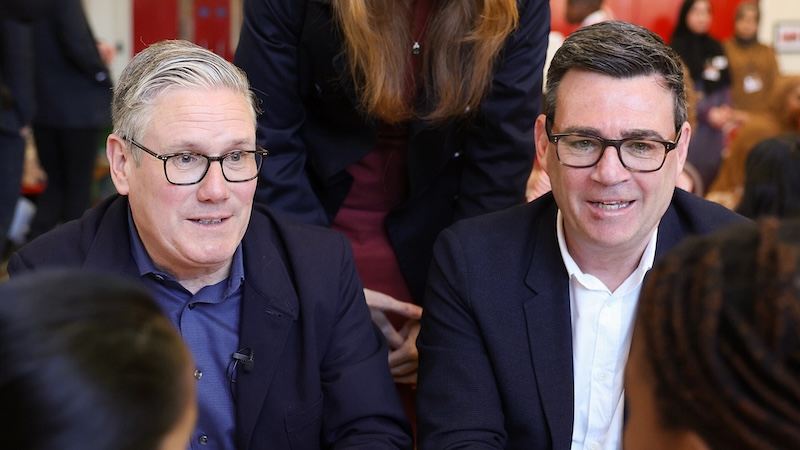
Andy Burnham stormed to victory in the Makerfield by-election held on 18 June 2026, sealing a parliamentary return after months of speculation over his political future.
Burnham secured 24,927 votes (54.8%) and a significant majority of 9,231. The Reform UK candidate, Robert Kenyon, finished in second place with 15,696 votes (34.5%), while Rebecca Shepherd of Restore Britain received 3,111 votes (6.8%).
Burnham’s victory brought to a close one of the most politically consequential by-elections in recent memory. The leading Labour figure, who previously stood in the 2010 and 2015 leadership contests, was widely understood to be positioning himself as a challenger to Keir Starmer.
Burnham previously represented the constituency of Leigh from 2001 to 2017, resigning his seat upon his election as mayor of Greater Manchester. He held cabinet roles during Gordon Brown’s tenure as prime minister including as secretary of state for health (2009-2010) and secretary of state for culture, media and sport (2008-2009).
The Starmer government’s woes over the winter fuel payment cut, welfare bill rebellion and Peter Mandelson vetting debacle sparked speculation that Burnham could mount a parliamentary comeback.
In early 2026, Burnham sought the Labour selection for the Gorton and Denton by-election, which was triggered by the resignation of former minister Andrew Gwynne. However, Labour’s national executive committee (NEC) voted 8-1 to block Burnham’s candidacy; only the deputy Labour leader and Burnham ally, Lucy Powell, voted in his favour. Burnham’s application had been publicly supported by senior Labour figures including Powell, Angela Rayner, Ed Miliband and Sadiq Khan.
At the time, a Labour spokesperson said: “Andy Burnham is doing a great job as mayor of Greater Manchester. We believe it is in the best interests of the party to avoid an unnecessary mayoral election, which would use substantial amounts of taxpayers’ money and resources that are better spent tackling the cost of living crisis.”
The decision to block Burnham was a boost for the Green campaign, spearheaded by Zack Polanski, resulting in the party’s first-ever victory in a parliamentary by-election.
***
The Makerfield by-election was triggered by the resignation of Josh Simons, a former junior minister.
Simons served as director of Labour Together from 2022 to 2024. The influential think tank was instrumental in Starmer’s rise to power, and Simons himself served as a minister under Starmer from September 2025 to February 2026. He resigned as minister in February 2026 after facing claims that Labour Together had commissioned a report that looked into journalists’ backgrounds.
In a May 2026 statement, Simons announced he would be standing down from parliament and called for “urgent, radical, courageous reform”.
He added: “Today, I am putting the people I represent and the country I love first and will be resigning as MP for Makerfield. I am standing aside so that Andy Burnham can return to his home, fight to re-enter parliament, and if elected, drive the change our country is crying out for.”
The sensational statement followed the 2026 local elections and devolved elections to the Scottish Parliament and Senedd Cymru.
These results of the elections, which were confirmed from 8 to 9 May, sparked an intense political crisis as Labour MPs lined up to call on Starmer to step down/set out a timetable for his departure. In total, over 90 MPs called for Starmer to resign as prime minister. The crisis appeared to culminate in the resignation of Wes Streeting as secretary of state for health and social care on 14 May. In his resignation letter, Streeting declared that he had lost confidence in Starmer as prime minister and called for a future leadership contest to include the “best possible field of candidates.
Simons announced his decision to stand down as an MP mere hours after Streeting’s resignation. The Labour NEC did not seek to block Burnham’s candidacy after the May elections sparked considerable criticism of its conduct during the Gorton and Denton campaign.
***
The Makerfield by-election took on the character of a prime ministerial primary. Campaigning under the slogan “Andy – For Us”, Burnham vowed to “change Labour” and win back the voters the party had lost. This rhetoric was interpreted as a direct challenge to Starmer.
The Burnham campaign conducted a shrewd and disciplined campaign – balancing a focus on local concerns with nods to the national mood, while subtly signalling his wider ambitions. In one social media video, Burnham revealed his “by-election playlist”, which included tracks such as Manchester Orchestra’s The Silence, Johnny Cash’s cover of Hurt and Joan Baez’s Farewell, Angelina.
On 4 June, during a BBC Question Time special, Burnham confirmed that he would seek to enter any future Labour leadership contest should he win the Makerfield by-election. He argued that “Wes Streeting seems to have launched a leadership contest, so if that is running I would seek to join it.”
Burnham stated: “I can’t do anything unless I’m lucky enough to get the support of people here.
“But if I get your support, I would seek to represent you at the highest possible level and give this constituency maximum power and influence.”
Burnham’s campaign also benefited from divisions and blunders on both the right and left.
In the early stages of the campaign, it was anticipated that Burnham would face a strong challenge from Reform UK, the party led by Nigel Farage. Reform polled 12,803 votes (31.8%) in Makerfield at the time of the 2024 general election – placing a strong second. Simons’ 5,399-vote majority was the fifth lowest of the 27 Greater Manchester constituencies in 2024. Moreover, in the May 2026 local elections, Reform secured 24 out of the 25 seats up for grabs on Wigan Borough Council.
After Simon’s resignation, Reform re-selected its 2024 candidate, local plumber and councillor Robert Kenyon.
Reform’s campaign soon descended into disarray, however, following the discovery of Kenyon’s past social media posts, which included lewd comments about Carol Vorderman, Covid-19 conspiracies and an assertion that Russia was “within their rights” to annex Crimea.
Kenyon responded to the reports in an interview with the BBC at the start of June. The Reform candidate said he had “not made sexual remarks about Carol Vorderman”, but had responded to someone else’s post with a “crass joke”.
Reform also faced a challenge on its right flank from Restore Britain, the party led by former Reform MP Rupert Lowe.
Originally launched as a pressure group and political movement on 30 June 2025, Restore Britain (or Restore) rose to prominence on social media, owing, in part, to the endorsement of tech trillionaire Elon Musk.
Restore Britain fielded Rebecca Shepherd, a 53-year-old local businesswoman, as its candidate. During the by-election campaign, Musk shared a social media post from Lowe with the caption: “Restore Britain”. Both Labour and Reform activists noted an uptick in support for Restore on the doorstep as the campaign progressed.
Meanwhile, the Green Party executed a full retreat after its initial candidate, Chris Kennedy, withdrew from the contest citing “personal and family reasons”. Kennedy later apologised for sharing social media posts which described an attack on ambulances run by a Jewish charity as a “false flag”.
Caroline Lucas, the former Green leader, went as far as to urge her party to withdraw from the contest to avoid splitting the progressive vote. Lucas, the first Green MP, pointed to Burnham’s support for electoral reform and proportional representation (PR).
The Green candidate, Sarah Elizabeth Wakefield, ultimately placed fifth with only 308 votes (0.7%).
***
Burnham’s landslide victory represented a considerable setback for Reform UK.
Responding to the result, Farage blamed Reform’s defeat on a desire among voters to defenestrate Keir Starmer. He also issued a plea for Restore voters to back Reform instead, as the main “challenger party to the left”.
In a video posted to social media, Farage said: “In many ways, he’s a popular local mayor, just as Boris Johnson was a popular mayor in London just a few years ago. But what really happened here is it was ‘vote Burnham, get Starmer out’.”
He added: “There’s a couple of thousand voters there who would normally have gone out and voted Reform, that voted Restore. And I would say directly to them, what do you want?
“We are the challenger party to the left in this country. And I would urge you to think again, I really, really would.”
Burnham’s victory also overshadowed two other by-elections held on 18 June.
At the 2026 Arbroath and Broughty Ferry by-election, Scottish National Party (SNP) candidate Lara Bird received 9,802 votes (41.1%). The Conservative candidate, Jack Cruickshanks, came second with 4,524 votes (19.4%). Bird was elected with a majority of 5,178.
The by-election was triggered by the resignation of the SNP incumbent, Stephen Gethins, following his election to the Scottish Parliament. Bird therefore retained the seat for the SNP.
In the 2026 Aberdeen South by-election, Conservative candidate Douglas Lumsden received 14,308 votes (49.5%). Richard Thomson, the SNP candidate, placed second with 8,258 votes (28.6%).
This by-election was triggered by the resignation of Stephen Flynn, the leader of the SNP at Westminster from 2022 to 2026, following his election to the Scottish Parliament.
Lumsden’s victory was significant for the Scottish Conservatives, marking their first gain in a Scottish by-election since 1967.
Kemi Badenoch, the leader of the Conservatives, responded: “The Makerfield by-election was about one man’s job.
“The Aberdeen South by-election was about thousands of jobs all over the country but especially in the oil and gas sector.”
Scottish Conservative leader Russell Findlay described the result as a “sensational victory”.
***
The Makerfield by-election moved Labour’s leadership crisis into a new phase. It ensured that Burnham was now eligible to stand in a leadership contest to succeed Starmer.
Events moved quickly.
Starmer spent the weekend of 20-21 June at Chequers, the prime minister’s country retreat, to mull his political future. In a statement on 22 June, Starmer confirmed his intention to resign.
Speaking on the steps of Downing Street, Starmer said that he had inherited a Labour Party that was “politically, financially and morally bankrupt” upon his election as leader in 2020. He described entering office as prime minister following the 2024 general election as “the proudest moment of my life.”
In the hours that followed Starmer’s address, Burnham confirmed that he would be standing for the Labour leadership.
He said: “His decision marks the beginning of a transition and it is important that this process is conducted in an orderly and responsible way. I will put myself forward as part of this process…
“The Labour movement has always been at its strongest when it looks forward with confidence and purpose. This is what we will do from here and we will make sure this transition is a positive process of renewal for our party and our country.”
Almost immediately, Streeting endorsed Burnham and abandoned his own leadership bid. The former health secretary said he had spoken to Burnham “at length” in recent days.
In a post to social media, he stated: “We could spend the summer exaggerating small differences, or we can roll up our sleeves and help him to deliver the change our party and country needs. That is the choice I am making and I hope that everyone else will back Andy, too.”

Politics.co.uk Newsletters
DAILY
Politics@Lunch
WEEKLY
Week in Review
