Major caught on tape calling eurosceptic ministers ‘bastards’
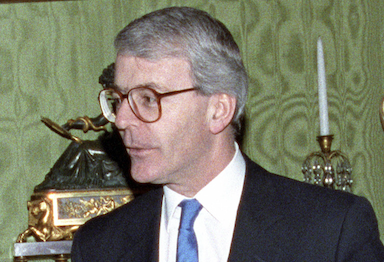
On 23 July 1993, unaware that microphones were still live after a television interview, prime minister John Major referred to three eurosceptic cabinet colleagues as “bastards”.
The comment was delivered after Major survived a formal vote of confidence in his government – at the peak of the Conservative furore over the Maastricht Treaty.
***
The Maastricht Treaty, which entailed a significant deepening of European integration, badly divided the Conservative Party during Major’s tenure as leader – triggering rolling rebellions from a determined group of eurosceptic backbenchers (the “Maastricht rebels” or “euro-rebels”). Major’s majority stood at around 20 after the 1992 general election – meaning internal party discipline was crucial to the proper function of government.
The passage of the Maastricht Treaty through parliament began on 21 May 1992 with the second reading of the European Communities (Amendment) Bill.
In the end, Major was only able to secure parliamentary approval for the Maastricht Treaty by linking it to a formal vote of confidence in the government and threatening an early general election. “The boil must be lanced, and it must be lanced today”, Major told MPs on the morning of 23 July 1993.
The prime minister stated: “At the conclusion of this debate, either the government will have won the vote of confidence and we can proceed with our policy… or we shall have lost and I shall seek a dissolution of parliament.”
John Smith, the Labour leader of the opposition, said Major had been “backed against the wall and forced, in order to survive, to threaten his own party with electoral suicide.”
Major survived the vote of confidence by 339 to 299.
In the wake of the debate, Major subjected himself to a series of broadcast media interviews.
***
Following his interview with ITN’s political editor, Michael Brunson, Major jokingly questioned “why such a complete wimp like me keeps winning everything”.
Brunson remarked: “You said precisely that [in the interview]… it’s a fair point. The trouble is that people are not perceiving you as winning.”
Major responded: “Oh, I know… why not?”
Brunson said: “Because rotten S-O-Ds like me, I suppose, don’t tell the message.”
Major replied: “No. I wasn’t going to say that – well partly that, yes, partly because of S-H-one-Ts like you, yes, that’s perfectly right.”
He added: “But also because those people who are opposing our European policy have said the way to oppose the government on European policy is to attack me personally. The Labour Party started before the last election. It has been picked up and it is just one of these fashionable things that slips into the parliamentary system and it is an easy way to proceed.”
Brunson suggested Major had been “overshadowed” by the Maastricht controversies and sleaze scandals.
Major said: “Even as an ex-whip I can’t stop people sleeping with other people if they ought not, and various things like that.”
The prime minister maintained that the “real problem” was the size of his majority.
He stated: “Don’t overlook that I could have done all these clever and decisive things that people wanted me to do and I would have split the Conservative Party into smithereens. And you would have said, ‘Aren’t you a ham-fisted leader – you’ve broken up the Conservative Party?’
“Most people in the cabinet, if you ask them sensibly, would tell you that. Don’t underestimate the bitterness of European policy until it is settled – it is settled now.”
Brunson then raised the possibility that three cabinet ministers would have resigned if Major had charted a more authoritative course. He was widely understood to be referring to Michael Howard, the home secretary; Peter Lilley, the social security secretary; and Michael Portillo, the chief secretary to the Treasury.
Brunson suggested that having the three leave cabinet would actually benefit the prime minister’s standing.
Major responded: “We all know which three that is… Just think it through from my perspective. You are the prime minister, with a majority of 18, a party that is still harking back to a golden age that never was, and is now invented.
“You have three rightwing members of the cabinet who actually resign. What happens in the parliamentary party?”
Brunson argued the prime minister could simply appoint three loyal MPs as their replacements.
Major replied: “I could bring in other people. But where do you think most of this poison is coming from? From the dispossessed and the never-possessed. You can think of ex-ministers who are going around causing all sorts of trouble.
“We don’t want another three more of the bastards out there. What’s Lyndon Johnson’s maxim?”
The “maxim” comment was a reference to FBI director J. Edgar Hoover, whom US president Lyndon Johnson declined to sack on the basis that “it’s probably better to have him inside the tent p****** out than outside pissing in”.
***
The remarks were not broadcast as part of the ITN package. But the line was still being monitored by BBC technical staff, who were waiting to record their own interview with the prime minister. And the comments found their way into the press.
After his 1993 “hot mic” moment, the term “bastards” description became a political shorthand for the eurosceptic rebels who continued to plague Major’s government. The exchange also reflected Major’s fear of creating a right-wing standard bearer, exposing his weak position in his own party.
However, Major’s position became so intolerable that, in June 1995, he resigned as leader of the Conservative Party, triggering an immediate leadership contest. Speaking in the garden of 10 Downing Street, Major said his patience had been exhausted with the constant division and speculation surrounding his leadership.
Tory MPs ultimately backed Major over John Redwood, a eurosceptic challenger, but the so-called “put up or shut up” exercise failed to address the Conservative Party’s deep ideological wounds.
Other potential challengers, including Portillo and Michael Heseltine, chose not to stand. Both backed Major. It was speculated that a second ballot would prompt Major’s resignation and the entrance of further candidates, such as Portillo, into the race. This was the pattern Thatcher’s defenestration followed in November 1990.
***
On 1 May 1997, the Labour Party, led by Tony Blair, won a landslide general election victory, ending 18 years of Conservative rule. The result was the most decisive for any party since 1945, with Labour securing a House of Commons majority of 179 seats.
Blair’s party won 418 seats, its highest ever total, while the Conservatives were reduced to just 165 seats – their worst result since 1906. The landslide represented a swing of 10.3% from the Conservative to Labour, and saw a record 120 women voted in as MPs, up from 60 (102 of which were Labour MPs).
As expected, Major responded to the seismic defeat by resigning as Tory leader. “When the curtain falls it’s time to get off the stage and that is what I propose to do”, said.
A whole chapter of Major’s memoirs, published in 1999, is entitled ‘The “Bastards”’. Teresa Gorman, a leading figure in the Maastricht rebellion, called her autobiography The Bastards.
In 2013, Major attempted to make light of the interview, conducted some two decades previously, quipping that his only excuse was that the comment “was true”.
He said: “Calling three of my colleagues, or a number of my colleagues, ‘bastards’ was absolutely unforgivable. My only excuse is that it was true.”

Politics.co.uk Newsletters
DAILY
Politics@Lunch
WEEKLY
Week in Review