Theresa May denounces ‘citizens of the world’ in conference speech
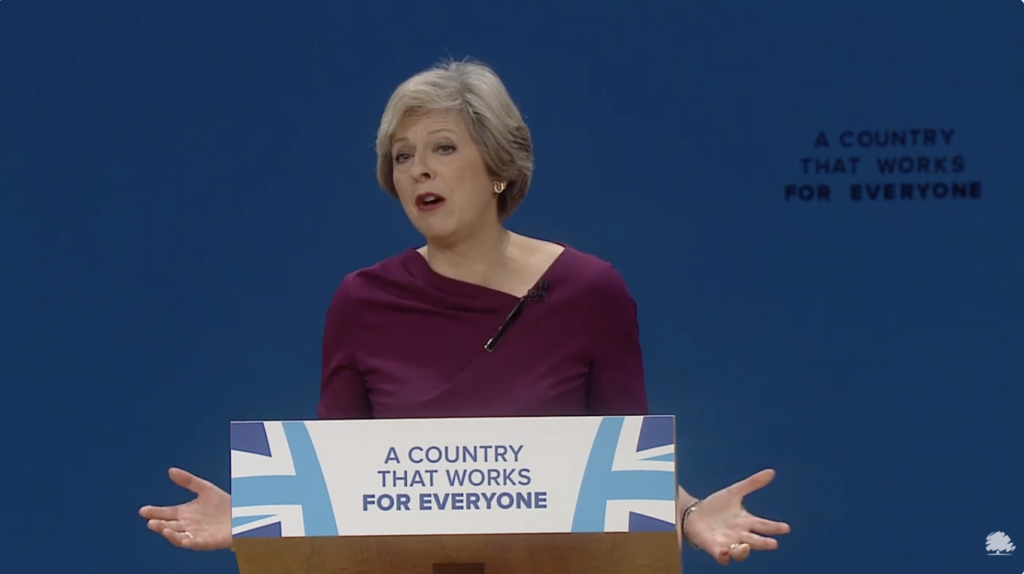
On 5 October 2016, the prime minister, Theresa May, delivered her first keynote conference speech as Conservative Party leader. The post-Brexit address, which criticised a perceived global elite, is remembered for May’s declaration: “If you believe you’re a citizen of the world, you’re a citizen of nowhere.”
The remark reflected a broader political strategy to redefine British conservatism in the post-Brexit era as critical of liberal internationalism. It was widely interpreted as a pitch to voters on the right of British politics – including those traditionally to the right of the Conservative Party.
***
Addressing delegates, May argued that “too many people in positions of power behave as though they have more in common with international elites than with the people down the road.”
She stated: “But if you believe you’re a citizen of the world, you’re a citizen of nowhere. You don’t understand what the very word ‘citizenship’ means.”
In her speech, May referred to the 2016 referendum on Britain’s membership of the European Union (EU) as a “quiet revolution”.
The referendum, she argued, was “about something broader” than the EU.
She told Tory delegates: “It was about a sense – deep, profound and let’s face it often justified – that many people have today that the world works well for a privileged few, but not for them.”
May, who emerged as PM in the wake of the 2016 referendum, pledged “to put the power of government squarely at the service of ordinary working-class people.”
Theresa May becomes Conservative leader after Leadsom withdraws
She added: “Because too often that isn’t how it works today. Just listen to the way a lot of politicians and commentators talk about the public.
“They find your patriotism distasteful, your concerns about immigration parochial, your views about crime illiberal, your attachment to your job security inconvenient. They find the fact that more than seventeen million voters decided to leave the European Union simply bewildering.
“Because if you’re well off and comfortable, Britain is a different country and these concerns are not your concerns. It’s easy to dismiss them – easy to say that all you want from government is for it to get out of the way.”
May called for the rejection of “the ideological templates provided by the socialist left and the libertarian right and to embrace a new centre ground in which government steps up – and not back – to act on behalf of us all.”
The “citizen of nowhere” phrase sparked a marked and enduring political backlash.
The leading Liberal Democrat, Vince Cable, was later criticised for comparing the speech’s sentiment to language used in Adolf Hitler’s Mein Kampf.
“It could’ve been taken out of Mein Kampf. I think that’s where it came from, wasn’t it? ‘Rootless cosmopolitans’?”, Cable told the New Statesman in July 2017. “It was out of character for her.”
Cable later admitted that he had referred to the wrong murderous dictator: “I got my literary reference wrong – I think it was Stalin who talked about ‘rootless cosmopolitans’”, he clarified.
***
The speech aimed to stake out a new centre-ground in British politics in the wake of the 2016 Brexit referendum, with arguments deliberately targeted at a perceived pro-‘Remain’, liberal establishment. However, the populist speech also adopted positions more traditionally associated with the political left.
In fact, May’s “citizens of nowhere” line marked the rhetorical crescendo of a passage that criticised wealth-hoarding, millionaire tax dodgers.
The passage read: “Yet within our society today, we see division and unfairness all around. Between a more prosperous older generation and a struggling younger generation. Between the wealth of London and the rest of the country.
“But perhaps most of all, between the rich, the successful and the powerful – and their fellow citizens. Now don’t get me wrong. We applaud success. We want people to get on. But we also value something else: the spirit of citizenship.
“That spirit that means you respect the bonds and obligations that make our society work. That means a commitment to the men and women who live around you, who work for you, who buy the goods and services you sell.”
“That spirit that means recognising the social contract that says you train up local young people before you take on cheap labour from overseas. That spirit that means you do as others do, and pay your fair share of tax.
“But today, too many people in positions of power behave as though they have more in common with international elites than with the people down the road, the people they employ, the people they pass in the street.
“But if you believe you’re a citizen of the world, you’re a citizen of nowhere. You don’t understand what the very word ‘citizenship’ means.”
She added: “So if you’re a boss who earns a fortune but doesn’t look after your staff, an international company that treats tax laws as an optional extra, a household name that refuses to work with the authorities even to fight terrorism, a director who takes out massive dividends while knowing that the company pension is about to go bust – I’m putting you on warning.
“This can’t go on anymore.”
The speech, nonetheless, was widely interpreted as an ideologically charged commentary on the immigrant experience.
***
On 15 January 2019, May’s Brexit withdrawal agreement suffered a catastrophic defeat in the House of Commons – the first of three ill-fated “meaningful votes”. The government’s motion was rejected by 432 votes to 202 (a majority of 230).
This marked the largest defeat for a sitting government in modern parliamentary history.
May resigned as prime minister on 24 May 2019, shortly before the results of the recent European parliament election were announced.
Theresa May’s Brexit deal defeated in historic commons vote

Politics.co.uk Newsletters
DAILY
Politics@Lunch
WEEKLY
Week in Review
