Boris Johnson becomes prime minister after winning Tory leadership
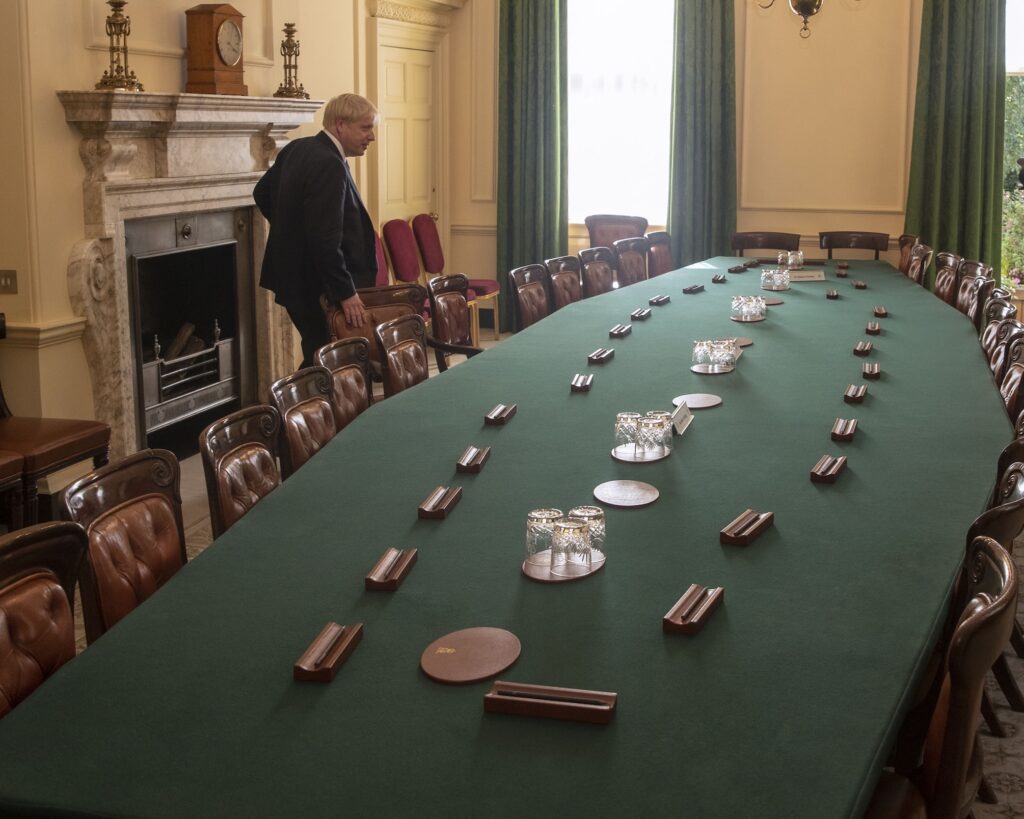
On 24 July 2019, Boris Johnson became prime minister of the United Kingdom, following his decisive victory in the Conservative Party leadership contest triggered by Theresa May’s resignation.
May announced her resignation on 24 May, having failed to convince MPs to back her withdrawal agreement in three separate “meaningful votes”.
The ensuing contest, which formally began on 10 June, saw 10 candidates compete for the Conservative leadership. Johnson, whose opposition to May’s Brexit strategy led to his resignation as foreign secretary in 2018, entered the race as the clear frontrunner – promising to deliver Brexit by the latest deadline of 31 October “do or die” and “no ifs no buts”.
The Brexit withdrawal date had previously been scheduled for 29 March 2019 – before two successive extensions (of Article 50) to 12 April and then 31 October.
***
In successive rounds of voting, Johnson consistently secured the largest share of support, eliminating rivals including Michael Gove, Sajid Javid, Rory Stewart and Dominic Raab. Johnson won 160 votes in the fifth and final ballot of MPs – leaving him to face his successor as foreign secretary, Jeremy Hunt, in the all-important vote among the wider party membership.
The result, announced on 23 July, confirmed Johnson’s victory. He won 92,153 votes (66.4%) to Hunt’s 46,656 (33.6%).
The following day, 24 July, May formally tendered her resignation to the queen. Johnson visited Buckingham Palace shortly afterwards, and was invited by Her Majesty to form a government.
Upon arriving in Downing Street, Johnson delivered his first speech as prime minister. He paid tribute to May’s “fortitude and patience” as well as her “deep sense of public service”.
Turning to the political battles ahead, the new prime minister condemned the “doubters, the doomsters, the gloomsters” who questioned his ability to deliver Brexit.
He said: “We are going to fulfil the repeated promises of parliament to the people and come out of the EU on 31 October – no ifs or buts.
“And we will do a new deal, a better deal that will maximise the opportunities of Brexit while allowing us to develop a new and exciting partnership with the rest of Europe based on free trade and mutual support.”
***
On 28 August, the leader of the House of Commons, Jacob Rees-Mogg, convened a meeting of privy councillors which advised Queen Elizabeth II to prorogue parliament. The approach was denounced by critics, including those within the Conservative Party, as an anti-democratic, unconstitutional ploy to bypass MPs – at a time when the parliamentary arithmetic was finely balanced.
Prorogation in order to secure a “no-deal” Brexit – the default legal position under EU law’s Article 50 process – had been a point of debate in the 2019 Tory leadership contest. However, a critical mass of UK parliamentarians were bitterly opposed to a no-deal Brexit scenario, and on 3 September, a cross-party alliance led by the Conservative backbencher Sir Oliver Letwin successfully passed a motion by 328 votes to 301 to seize control of the commons order paper.
It allowed for the introduction of a bill to block a no-deal exit.
This act of rebellion provoked a ruthless response from the government. On the evening of 3 September, the Conservative whip was withdrawn from all 21 Tory MPs who had voted against the government. This included former chancellors Philip Hammond and Kenneth Clarke, and Nicholas Soames, Winston Churchill’s grandson.
This purge effectively cost the prime minister his working majority.
In the end, Johnson was forced to seek a further extension to the Brexit deadline on 31 October – in accordance with the European Union (Withdrawal) (No. 2) Act 2019 or “Benn Act”. The legislation imposed a legal duty on the prime minister to send a specific, pre-written letter to the European Council requesting an Article 50 extension until 31 January 2020 in the event that a withdrawal deal had not been approved by 19 October.
On 24 September, the supreme court unanimously ruled the prorogation unlawful and “void and of no effect.”
On 29 October, after further parliamentary wrangling, MPs agreed to Johnson’s request to hold a general for 12 December.
The Conservative Party won a landslide victory in the general election held on 12 December 2019, securing 365 seats and a parliamentary majority of 80. It marked the party’s best result since 1987 and the highest share of the popular vote (43.6%) for any party since 1979.
At 11:00 pm GMT on 31 January 2020, the United Kingdom formally left the European Union, ending 47 years of membership.

Politics.co.uk Newsletters
DAILY
Politics@Lunch
WEEKLY
Week in Review
