Brexit Party storms to victory in last European Parliament elections
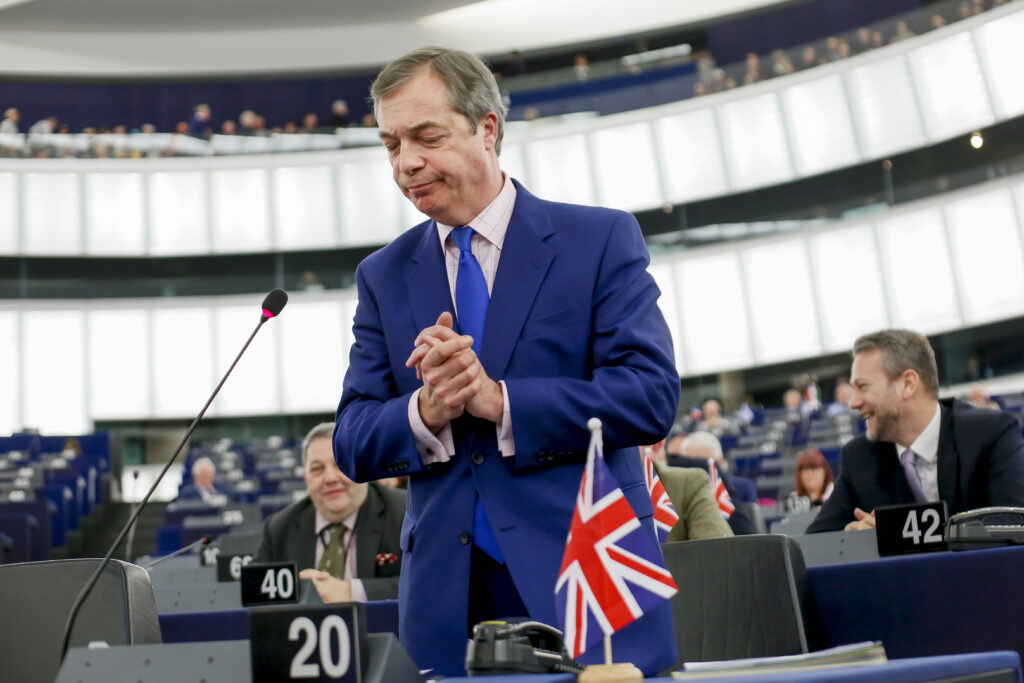
On 23 May 2019, the United Kingdom took part in European Parliament elections – elections that the government had not expected nor wanted to fight. The contest, held almost three years after the Brexit referendum, was dominated by the UK’s stalled departure from the European Union (EU) and resulted in a seismic victory for Nigel Farage’s newly formed Brexit Party.
It marked the UK’s final participation in a European Parliament election before leaving the EU on 31 January 2020. Brexit was the campaign’s central, defining issue.
***
The election took place after the prime minister, Theresa May, was forced to request a further extension to the Article 50 Brexit negotiating period. On 12 March. MPs rejected May’s Brexit deal by 391 votes to 242 in a second so-called “meaningful vote”. Mere days later on 29 March, May’s withdrawal agreement was rejected for a third time by 244 votes to 286.
As a result, the prime minister announced she would seek a further extension to the Article 50 process.
The UK and EU ultimately agreed to extend Article 50 until 31 October 2019.
The government only confirmed that the UK would be participating in the elections on 7 May, effectively conceding that it would not be possible to ratify its withdrawal agreement before polling day. At the time, May was facing significant pressure to resign as prime minister to make way for a Conservative leadership election.
Farage officially launched the Brexit Party on 12 April, unveiling an “impressive list” of 70 candidates for the upcoming elections.
The Brexit Party slate included Richard Tice, as well as Annunziata Rees-Mogg, the sister of Conservative MP Jacob Rees-Mogg; Paul Nuttall, the former Ukip leader; Ann Widdecombe, the former Conservative MP and minister; Rupert Lowe, the former chairman of Southampton Football Club; Ben Habib, a British-Pakistani businessman; Nathan Gill, the former leader of Ukip in Wales; and Martin Daubney, the former editor of the men’s lifestyle magazine Loaded.
The party campaigned in favour of a “no-deal” Brexit.
***
The results, declared on 26 May, exposed a deep public backlash against the two main parties.
The Brexit Party, which was only incorporated with Companies House on 23 November 2018, topped the poll with 31.6% of the vote, securing 29 seats and becoming the largest single party in the European parliament. In the wake of the results, Farage vowed to stand Brexit Party candidates at a future general election.
The Conservatives suffered their worst national election result since the 1832 Great Reform Act, finishing in fifth place with just 9.1% of the vote and four MEPs (down 15). The Labour Party also performed poorly, coming third with 14.1% and 10 seats (down 10). Its ambiguous Brexit position failed to satisfy either ‘Leave’ or ‘Remain’ voters.
The collective share for Labour and the Conservative Party (23%) was well below their previous post-war low of 43.5% in 2009. Turnout was 37.2% – up from 35.6% in 2014.
Meanwhile, parties with a clear pro-Remain stance performed strongly.
The Liberal Democrats surged into second place with 20.3% of the vote and 16 seats (up 15), while the Green Party also had its best-ever national result, taking 12.1% and seven seats (up four).
The exception to this rule was Change UK – the new pro-Remain party which emerged from the “Independent Group” of ex-Labour and Tory MPs.
Change UK stood a full slate of candidates, including two former Conservative MEPs, Julie Girling and Richard Ashworth; Rachel Johnson, sister of Boris; former BBC journalist Gavin Esler; former deputy prime minister of Poland Jacek Rostowski; and ex-Conservative MPs Stephen Dorrell and Neil Carmichael.
But the party effectively imploded during the campaign. On 18 May, Rachel Johnson told the Times that she was “the rat that jumps on the sinking ship. And now I’m jumping on another sinking ship with Change UK.” She also described Change UK as a “terrible name” and accused its leadership of wanting to “focus-group everything”.
Heidi Allen, the party’s interim leader, threatened to quit over an internal row over whether to endorse voting tactically for the Liberal Democrats. It came after Change UK’s lead candidate in Scotland, David Macdonald, endorsed the Liberal Democrats.
Change UK ultimately won no seats and just 3.3% of the vote. A subsequent meeting in June resulted in the resignation of six of the party’s MPs, including interim leader Heidi Allen and Chuka Umunna. Umunna announced he intended to join the Liberal Democrats on 13 June, arguing that “there isn’t room for more than one centre-ground option, particularly under the first past the post in UK politics.”
***
The campaign was characterised by unlikely endorsements.
Michael Heseltine, the Conservative former deputy prime minister, stated he would vote for the Liberal Democrats due to its anti-Brexit position. Alistair Campbell, formerly director of communications in Tony Blair’s No 10, later revealed he had voted for the Liberal Democrats. This resulted in his expulsion from the Labour Party.
Nevertheless, the results helped prompt prominent Labour figures, including deputy leader Tom Watson and shadow foreign secretary Emily Thornberry, to openly support the adoption of a “second referendum” policy. By the end of May, Labour leader Jeremy Corbyn had endorsed this stance as his party’s official position.
On 24 May, between polling day and the declaration of results, Theresa May announced her intention to resign as prime minister. She was succeeded by Boris Johnson as Conservative leader and prime minister in July.
Vince Cable also stood down as leader of the Liberal Democrats. Cable, who had previously indicated his intention to resign after the elections, was succeeded by Jo Swinson on 22 July.
Swinson, Johnson, Farage and Corbyn led their parties into the 2019 general election.
However, on 11 November – some weeks into the general election campaign – Farage announced that the Brexit Party would stand down its candidates in the 317 constituencies won by the Conservatives at the 2017 general election. The decision came amid fears that Farage’s party could split the pro-Brexit vote.
The Conservative Party ultimately secured 365 seats and a parliamentary majority of 80. It marked the party’s best result since 1987 and the highest share of the popular vote (43.6%) for any party since 1979.
Reacting to the general election result, a Conservative majority of 80 seats, Farage said: “This victory for Boris was hugely helped by us and is far better than the Marxist Corbyn and a second referendum.”

Politics.co.uk Newsletters
DAILY
Politics@Lunch
WEEKLY
Week in Review