Seven Labour MPs quit party to form Independent Group
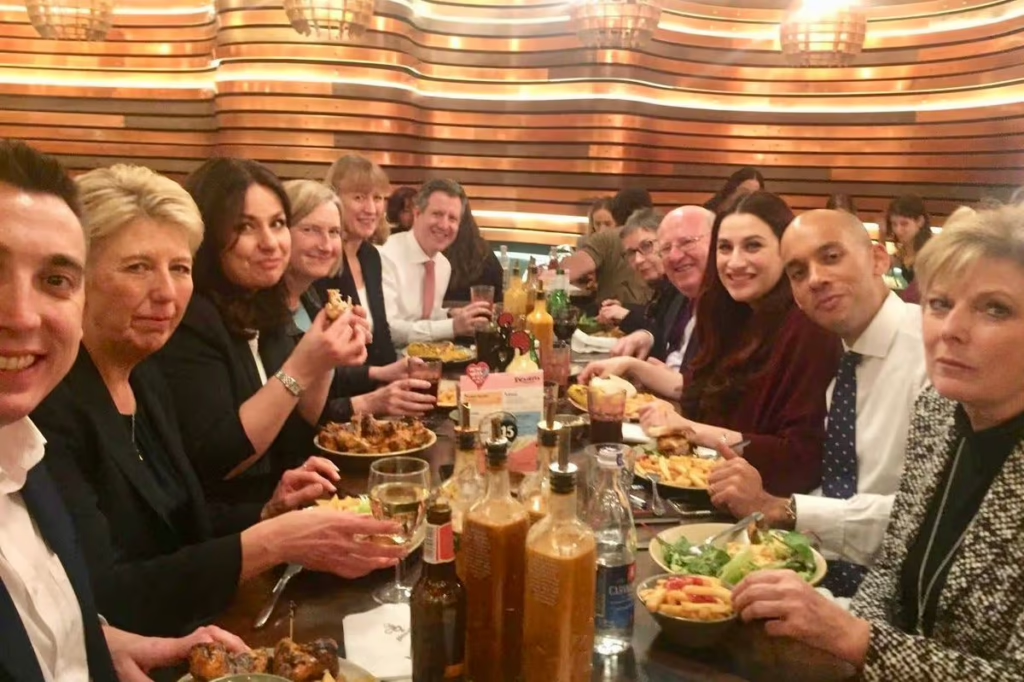
On 18 February 2019, seven Labour MPs resigned from the party to form a new parliamentary bloc called The Independent Group, citing Jeremy Corbyn’s leadership, the party’s handling of antisemitism allegations and its position on Brexit.
The coordinated move was the most significant schism suffered by the Labour party since the formation of the Social Democratic Party (SDP) in 1981.
The MPs – Chuka Umunna, Luciana Berger, Chris Leslie, Angela Smith, Gavin Shuker, Mike Gapes and Ann Coffey – announced their decision at a press conference.
Leslie, Shuker and Smith had previously been the subject of successful “no-confidence” motions brought by their constituency Labour parties (CLPs).
***
Leslie, in his press conference contribution, argued that the Labour party had been “hijacked by the machine politics of the hard left”.
Gapes said he was “furious that the Labour leadership is complicit in facilitating Brexit”.
Umunna rejected comparisons with the SDP and said there would be “no merger” with the Liberal Democrats.
Shuker said the Labour Party was “riddled with antisemitism” and “perfectly content” to enable Brexit.
Berger described her departure as a “very difficult, painful but necessary decision”.
Berger addressed the commons on 20 February during a debate on antisemitism. The former Labour MP said she had come to the “sickening conclusion” that the party was “institutionally antisemitic in its processes, its attitudes and its behaviour.”
Berger added: “We ignore this at our peril.”
The Independent Group’s launch statement described its commitment to “evidence-based” policy-making that was “not led by ideology, taking a long-term perspective to the challenges of the 21st century in the national interest, rather than locked in the old politics of the 20th century in the parties’ interests.”
The group expressed support for a “mixed social market economy” and investment in public services.
The MPs accused Labour of abandoning “progressive values” in favour of policies that would “weaken our national security” and “destabilise the British economy in pursuit of ideological objectives”.
They said that Corbyn had failed to “take a lead in addressing the challenge of Brexit and to provide a strong and coherent alternative to the Conservatives’ approach”.
The statement concluded: “To fix our broken politics, we are clear that we want to develop a different approach. We recognise that every member of our group has the right to be heard and a duty to lead. We commit to support each other and treat each other with respect.”
***
It was later reported that Ian Murray, then Labour’s only MP in Scotland, withdrew from the Independent Group launch at the last minute. Murray, who resigned as shadow secretary of state for Scotland after the Brexit referendum, is said to have had a resignation speech prepared.
Corbyn responded that he was “disappointed that these MPs have felt unable to continue to work together for the Labour policies that inspired millions at the last election and saw us increase our vote by the largest share since 1945”.
He added: “The Conservative government is bungling Brexit, while Labour has set out a unifying and credible alternative plan. When millions are facing the misery of Universal Credit, rising crime, homelessness and poverty, now more than ever is the time to bring people together to build a better future for us all.”
The Labour deputy leader, Tom Watson, issued a statement of his own, saying he felt “deep sadness” at the resignation of his former colleagues. “There are those who are already celebrating the departure of colleagues with whom they disagree”, he said.
“The hard left can be too easily tempted into the language of heresy and treachery. Betrayal narratives and shouting insults at the departed might make some feel better briefly but it does nothing to address the reasons that good colleagues might want to leave.”
On the day the Independent Group formed, Angela Smith appeared to discuss the splinter on BBC One‘s Politics Live programme. Smith later apologised for having “misspoke” after she appeared to refer to people from black, Asian and minority ethnic backgrounds as having a “funny tinge”.
https://x.com/angelasmithxmp/status/1097518807357288448
On 19 February, Labour MP Joan Ryan made the “terribly difficult decision” to join her former colleagues in resigning from the party. She argued that the “Labour Party under Jeremy Corbyn has become infected with the scourge of anti-Jewish racism.”
Ryan, who joined the Independent Group, also stated that Corbyn and the “Stalinist clique that surrounds him” had failed to effectively oppose the government’s Brexit strategy.
On 20 February, three pro-European Conservative MPs, Anna Soubry, Heidi Allen and Sarah Wollaston, joined the breakaway Independent Group. Soubry criticised the government for being “in the grip” of the Democratic Unionist Party (DUP) and the European Research Group (ERG) of hardline Conservative eurosceptics.
In a press conference, Soubry stated: “The battle is over, the other side has won.
“The right wing, the hard-line anti-EU awkward squad that have destroyed every leader for the last 40 years are now running the Conservative Party from top to toe. They are the Conservative Party.”
The prime minister, Theresa May, responded that she was “saddened”, but her party would “always offer… decent, moderate and patriotic politics”.
***
In his capacity as Labour deputy leader, Watson formed the Future Britain Group, a parliamentary caucus intended to provide a voice for the party’s social democratic and centre-left traditions, on 8 March. Watson’s initiative was widely seen as a direct response to the Independent Group defections – that is, an attempt to create a political home for disillusioned ‘moderate’ MPs and prevent further schisms.
In an invitation sent to Labour MPs, Watson said: “I believe the time is right to restate our social democratic values once again in order to address the challenges our country faces. Life after Brexit and Britain’s relationship with the world, automation, the housing crisis, inequality, climate change and more.”
Watson addressed an inaugural meeting of the group on 11 March. He argued that the group was not a faction and that it could “pull the PLP [parliamentary Labour Party] together at a time when our country needs a united Labour Party with all shades of red represented.”
Watson added: “The last few weeks have been very difficult and upsetting. The departure of good people, in particular friends like Luciana and Ian Austin, was for me a personal wake up call to step up and do more.”
He called for the restoration of “pluralism and tolerance”, arguing that Labour had only ever been elected to government “when the pluralism of our different traditions has been respected.”
Watson said: “Jeremy, to his credit, kept the voice of his tradition alive through the [Socialist] Campaign Group during the New Labour years. So he understands the need for those from the social democratic and democratic socialist traditions to give ourselves the strongest voice we can.
“I feel, and I suspect that many colleagues in this room feel, that the voice of the social democratic and democratic socialist traditions hasn’t been strong enough in recent times. It is to defend those traditions that I’ve invited you here. Not just because it’s critical for the future of the Labour party. But because these traditions are critical to the future of the nation.”
The group joined a shifting cast of Labour factions, including the soft-left Tribune group and the Socialist Campaign Group (SCG).
Notable supporters of the group included former Labour leader Neil Kinnock, former deputy leader John Prescott, Peter Mandelson, Yvette Cooper, Lord David Blunkett, Pat McFadden, and Hilary Benn.
Mandelson described the group as a “coming together of the TB-GBs” – a reference to the long-standing divisions between those loyal to Tony Blair (TB) and those loyal to Gordon Brown (GB) during the New Labour years.
In total, the Future Britain Group is said to have secured the support of over 150 MPs and peers.
Darren Jones, considered a rising star on the Labour right, served as the group’s convenor. Speaking to BBC News, Jones insisted that the grouping was “not a faction”, but “the coming together of previous factions into the mainstream of the Labour Party”.
He added: “If I was going to break away, I would have broken away with The Independent Group. I am staying in the Labour Party. There is a place in the Labour Party for me too.
“I am not a Marxist, I am a social democrat. And I want to contribute on that basis, and this group seems like a good way to do that.”
Despite such assurances, however, the move was interpreted by most commentators as the creation of an organised power base for the party’s moderate wing, which felt increasingly marginalised, and a means of asserting pressure on Corbyn’s leadership.
***
The defeat of Theresa May’s Brexit deal across two “meaningful votes” in March precipitated the extension of the Article 50 period (Brexit negotiating period) until 31 October 2019. This meant the UK would fight the European Parliament elections.
At around this time, the Independent Group applied to the Electoral Commission to register as a political party – under the name “Change UK – The Independent Group” – so they could stand at the upcoming elections.
Heidi Allen was appointed as the group’s interim leader.
Change UK’s registration was officially confirmed on 16 April. At the time, the party was polling between 4% and 7%. The registration came as two former Conservative MEPs, Julie Girling and Richard Ashworth, announced they had joined the party.
The Change UK name was challenged by the petitions site Change.org. Soubry accidentally referred to the party as Change.org in a commons speech.
Soubry said: “I have left the Conservative Party along with two others… I think we will see the break-up of the two parties, and I am delighted today that the group that I have joined with former Labour members has today formed itself into a new political party that will change the face and direction of British politics. That is why we call ourselves Change.org.”
In a statement, Change.org said: “It’s said that imitation is a form of flattery. But the movement we’ve built in the UK to win campaigns for ordinary people is ours – all 17 million of us”.
Change UK’s candidates for the European Parliament elections included Girling, Ashworth, Rachel Johnson (sister of Boris), former BBC journalist Gavin Esler, former deputy prime minister of Poland Jacek Rostowski, and ex-Conservative MPs Stephen Dorrell and Neil Carmichael.
During the European Parliament campaign, Rachel Johnson told the Times that she was “the rat that jumps on the sinking ship. And now I’m jumping on another sinking ship with Change UK.”
Johnson also described Change UK as a “terrible name” and accused its leadership of wanting to “focus-group everything”.
Allen, the party’s leader, threatened to quit over an internal row over whether to endorse voting tactically for the Liberal Democrats in the EU elections. “Had it been left to me, I would have absolutely advised tactical voting”, Allen told Channel 4 News.
Asked whether she had threatened to resign, Allen responded: “Yes. I did.”
It came after Change UK’s lead candidate in Scotland, David Macdonald, endorsed the Liberal Democrats.
***
Change UK ultimately won no seats in the European Parliament on 3.3% of the vote.
A subsequent meeting in June resulted in the resignation of six of the party’s MPs, namely Allen, Umunna, Shuker, Berger, Wollaston and Smith.
The five other MPs remained in the party and Soubry emerged as leader. Soubry said she was “deeply disappointed” that the six MPs had left. At around this time, following the party’s dispute with Change.org, it applied to the Electoral Commission to change its name to The Independent Group for Change.
A Financial Times report, published on 4 June, referenced “longstanding” tensions between Umunna and Leslie over strategy. This tension was initially managed by the appointment of Allen as interim leader.
On 13 June, Umunna joined the Liberal Democrats, arguing that “there isn’t room for more than one centre-ground option, particularly under the first past the post in UK politics.”
Berger, Shuker, Smith and Allen along with John Woodcock, another former Labour MP, formed a group called the Independents.
Wollaston joined the Liberal Democrats in August. Berger and Smith joined the party in September. Allen followed in October.
In the 2019 general election, Soubry, Gapes and Leslie stood as the Independent Group for Change candidates in their respective constituencies.
Coffey and Ryan, who remained in the Independent Group for Change, did not stand for re-election. Allen also did not stand in the election.
Shuker stood as an independent candidate. Meanwhile, Umunna, Berger, Wollaston and Smith stood as Liberal Democrats.
None of the original Independent Group MPs were returned to parliament.
Change UK was formally deregistered by the Electoral Commission on 23 July 2020.

Politics.co.uk Newsletters
DAILY
Politics@Lunch
WEEKLY
Week in Review