MPs vote to reject a ‘no-deal’ Brexit as cabinet ministers abstain
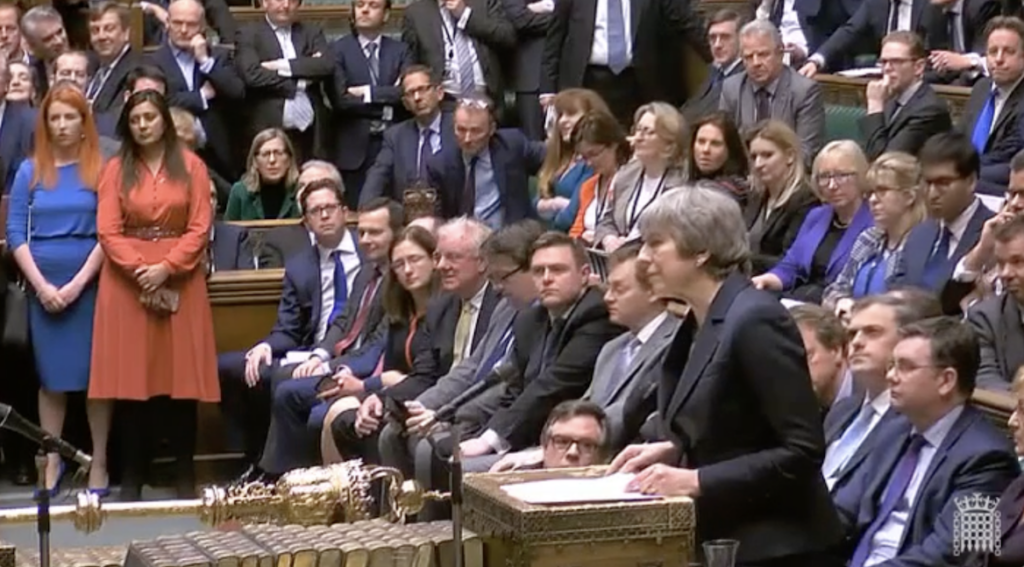
On 13 March 2019, the House of Commons voted decisively to reject the prospect of the United Kingdom leaving the European Union (EU) without a withdrawal agreement on “no-deal” terms.
The vote came after Theresa May, the prime minister, suffered a second overwhelming defeat on her Brexit deal. In this second “meaningful vote”, May’s deal was rejected by 391 votes to 242 – a crushing majority of 149.
The prime minister, addressing MPs with a hoarse voice on 12 March, said she “profoundly” regretted the decision.
In response, May pledged to introduce a motion to test whether the House supported leaving the EU without a deal on 29 March deadline, the default legal position. The prime minister said she had “struggled” over whether to support no-deal, telling MPs that the best way to leave the EU was “in an orderly way with a deal”.
She added: “If the House votes to leave without a deal on 29 March, it will be the policy of the government to implement that decision. If the House declines to approve leaving without a deal on 29 March, the government will, following that vote, bring forward a motion on Thursday on whether parliament wants to seek an extension to Article 50.”
May declared that the division would be a “free vote”, meaning the government would not take a position and allow ministers to vote with their conscience.
***
The evening of 13 March saw two crucial divisions.
First, MPs narrowly backed an amendment to the government’s motion, tabled by a cross-party group led by Conservative MP Caroline Spelman and Labour MP Jack Dromey, which ruled out a no-deal exit under any circumstances. While Spelman and Dromey opted not to move the amendment, another of its cross-party supporters, Labour MP Yvette Cooper, did.
The amendment passed by 312 votes to 308 – a majority of just four.
May had put forward a carefully worded motion. The final sentence stated that “leaving without a deal remains the default in UK and EU law unless this house and the EU ratify an agreement”. The amendment struck out this phrase.
The amended motion was worded as follows: “That this House rejects the United Kingdom leaving the European Union without a withdrawal agreement and a framework for the future relationship.”
Addressing the House during the debate, the Brexit-supporting environment secretary, Michael Gove, praised May for her “full-hearted desire to do what is right for our country”.
He added: “Throughout this process she has shown fortitude, tenacity, thoughtfulness, diligence and, above all, an unselfish and unstinting patriotism.
“I think it only appropriate that in all parts of the House, whatever political differences we have, we recognise that the prime minister always, always puts country first, and that we are fortunate to have her in that position.”
The government instructed its MPs to vote against Spelman and Dromey’s amendment.
After its passage, in chaotic scenes, the government rescinded its original promise of a free vote, whipping its MPs to vote against the motion as amended. The amended motion ultimately passed by 321 votes to 278 – a majority of 43.
It soon emerged that cabinet ministers, including work and pensions secretary Amber Rudd and justice secretary David Gauke, had abstained on this final vote. In total, four pro-Remain members of the cabinet and eight middle-ranking ministers abstained.
Greg Clark, the business secretary, defended his decision to abstain.
Clark stated: “It has been completely consistent with government policy to date that we should not leave on 29 March without a deal. And what we now have tomorrow is the ability to carry that forward. We acted completely in accordance with long-standing government policy.”
Downing Street ultimately took no action against the ministerial abstainers, which was criticised by some Brexiteers.
Junior pensions minister Sarah Newton, meanwhile, resigned having voted against the government. Newton became the 15th member of the government to resign over Brexit.
Also among the rebels were senior Conservative MPs Kenneth Clarke, Justine Greening, Sir Nicholas Soames, Dominic Grieve, Oliver Letwin and Ed Vaizey. In total, 17 Conservative MPs supported the amended motion.
***
Despite the clear parliamentary majority against a no-deal exit, the government was at pains to stress that the votes were not legally binding and did not alter the fact that leaving without an agreement remained the default legal outcome on the scheduled departure date of 29 March.
May put this point in a short statement, delivered on a point of order, after the amended motion was approved by the commons.
The prime minister stated: “The legal default in UK and EU law remains that the UK will leave the EU without a deal unless something else is agreed. The onus is now on every one of us in this House to find out what that is.
“The options before us are the same as they always have been: we could leave with the deal that this government have negotiated over the past two years; we could leave with the deal that we have negotiated but subject to a second referendum, but that would risk no Brexit at all, damaging the fragile trust between the British public and the members of this House; we could seek to negotiate a different deal, but the EU has been clear that the deal on the table is indeed the only deal available.”
May confirmed that, given the House’s position on “no-deal”, she would bring forward a motion to test whether MPs supported an extension to Article 50.
The prime minister also warned that a long extension – the likely consequence of a failure to pass a deal over the coming weeks – would result in Britain contesting the European Parliament elections in May.
On 14 March, MPs voted to delay Brexit by 413 votes to 202 – a majority of 211.
An extension to the Article 50 period was granted on 21 March until either 22 May, subject to MPs approving the Withdrawal Agreement, or failing that until 12 April.
A third meaningful vote on May’s deal was rejected by 344 votes to 286 on 29 March.
May’s government subsequently sent a letter to Donald Tusk, the president of the European Council, asking for a further extension. The UK and EU ultimately agreed to extend Article 50 until 31 October 2019.
This development meant the UK would fight the upcoming European Parliament elections.

Politics.co.uk Newsletters
DAILY
Politics@Lunch
WEEKLY
Week in Review
