Queen Caroline’s ‘trial’ begins in House of Lords
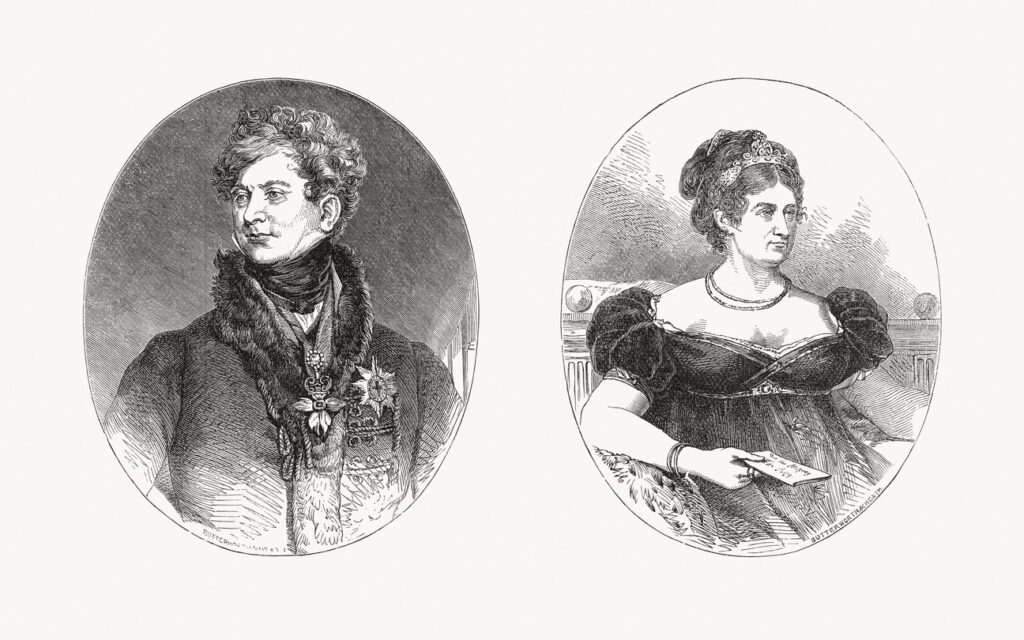
On 17 August 1820, the House of Lords commenced proceedings on the Pains and Penalties Bill, effectively putting Queen Caroline, the estranged wife of King George IV, on public trial. George IV had ascended the throne earlier that year and was determined to prevent Caroline, whom he had long since grown to detest, from being crowned Queen.
George had reluctantly married his first cousin, Princess Caroline of Brunswick, in 1795. The marriage was disastrous from the outset
In fact, George was already married. But the Prince of Wales’ secret union with Maria Fitzherbert was considered unlawful, as it had not been endorsed by King George III under the Royal Marriages Act of 1772.
In a letter dated 30 April 1796, George wrote to Caroline outlining the terms of their separation. “Our inclinations are not in our power”, he said, “nor should either of us be held answerable to the other, because nature has not made us suitable to each other”.
He added: “I shall now finally close this disagreeable correspondence, trusting, that, as we have completely explained ourselves to each other, the rest of our lives will be passed in uninterrupted tranquillity.”
Upon George IV’s accession, Caroline returned to England having spent years living abroad. She had arrived to claim her rights as queen. George’s tranquility, suddenly, was interrupted.
***
George responded by sending two tranches of evidence, sealed in separate green bags, to the House of Commons and House of Lords. The bags, George said in a message to parliament, regarded “the conduct of her majesty since her departure from this kingdom”.
The royal missive, presented to the commons by Lord Castlereagh, added: “The king has felt the most anxious desire to avert the necessity of disclosures and discussions which must be as painful to his people as they can be to himself; but the step now taken by the queen leaves him no alternative.
“The king has the fullest confidence that, in consequence of this communication, the House of Commons will adopt that course of proceeding, which the justice of the case, and the honour and dignity of his majesty’s crown may require.”
Henry Brougham, Caroline’s chief attorney and Whig MP, demanded a “full, fair, open investigation”.
A committee of peers examined George’s evidence, and recommended that parliament proceed with legislation. As such, the prime minister, Lord Liverpool, introduced a Bill of Pains and Penalties, officially entitled: “An Act to deprive Her Majesty Caroline Amelia Elizabeth of the title, prerogatives, rights, privileges, and exemptions of Queen Consort of this realm, and to dissolve the marriage between his majesty and the said Caroline Amelia Elizabeth”.
Peers would vote on whether the text of the bill was a correct account of events. The proceedings therefore made for an unofficial public trial of Caroline.
The bill accused Caroline of “a most unbecoming and degrading intimacy” with her Italian courtier, Bartolomeo Pergami, “a foreigner of low station”.
It said the queen had “conducted herself towards the said Bartolomo Pergami… with indecent and offensive familiarity and freedom, and carried on a licentious, disgraceful, and adulterous intercourse”.
The proceedings began on 17 August in a packed House of Lords. Over the following weeks and months, lurid evidence, often from Italian servants and couriers, was presented by the King’s lawyers and fiercely contested by Caroline’s defence team.
‘The Queen Caroline Affair’ became a national spectacle. The ‘trial’ was reported in minute detail by the press, which produced in countless popular prints and satires.
Huge crowds gathered daily outside parliament to cheer Caroline and jeer the King and his ministers. Petitions supporting the queen flooded in. The government’s case began to crumble.
***
In his speech on the first day of the trial, Brougham questioned “whether adultery is to be considered only a crime in woman”.
He asked “whether the crown can be dishonoured, the fame of the country tarnished, and the morals of the people put in jeopardy, if an adulterous intercourse… shall be proved against a lady, when that which I venture to call adultery, because the exalted individual himself has confessed it to be so, has actually been committed by a prince.”
Brougham feigned the “utmost pain” in making that statement. But said it was “wrung from me by hard compulsion” – his sense of duty to his client.
On 3 October, opening the case for the defence, Brougham threatened to disclose evidence of George IV’s affairs and his secret marriage to Fitzherbert, a Catholic. Urged to hold back for sake on the monarchy’s stability, Brougham said his duty was to “go on reckless of the consequences”.
In his famous speech, Brougham told the Lords “that an advocate, by the sacred duty of his connection with his client, knows, in the discharge of that office, but one person in the world, that client and none other.
“To save that client by all expedient means—to protect that client at all hazards and costs to all others, and among others to himself—is the highest and most unquestioned of his duties; and he must not regard the alarm, the suffering, the torment, the destruction, which he may bring upon any other; nay, separating even the duties of a patriot from those of an advocate, he must go on reckless of the consequences, if his late it should unhappily be, to involve his country in confusion for his client.”
Brougham framed the trial as the culmination of decades-long, vindictive plot by the new king.
On 4 October, Brougham presented the contents of George’s 30 April 1796 letter to the Lords. Such correspondence, he argued, exposed the king’s hypocrisy: he suggested that, having demanded they pursue separate lives “not answerable to the other”, George had forfeited any right to act as a wronged husband.
***
On 10 November, the bill narrowly secured its third reading in the Lords by a majority of just nine votes.
But Lord Liverpool, fearing further public disorder, said he “could not be ignorant of the state of public feeling with regard to this measure” and announced that the government would withdraw the bill.
Liverpool’s reference to “the state of public feeling” was significant; Caroline had won a major victory in the court of public opinion. During the course of the trial, she became a symbol of defiance against an unpopular monarch and government.
Remarkably, this trial pitting two ostensible royals against each other tapped into wider radical sentiment and public discontent. As parliament considered the future of the monarchy, the people intervened. George IV was roundly ridiculed by radical publications.
“The Queen Caroline Affair” reflected and shaped the radical energies animating Britain in the early 19th century.
Caroline retained her title, but was forcibly barred from George IV’s coronation. She died 19 days later on 7 August 1821.
She is buried in Brunswick, with her tomb bearing the inscription: “Here lies Caroline, the Injured Queen of England”.
Brougham, Caroline’s counsel, was later elevated to the House of Lords.
With the trial having vastly increased his profile, Brougham became a prominent advocate of liberal causes – including the abolition of the slave trade, free trade and parliamentary reform.
He served as Lord Chancellor from November 1830 to November 1834.

Politics.co.uk Newsletters
DAILY
Politics@Lunch
WEEKLY
Week in Review