Police foil Cato Street Conspiracy to assassinate the cabinet
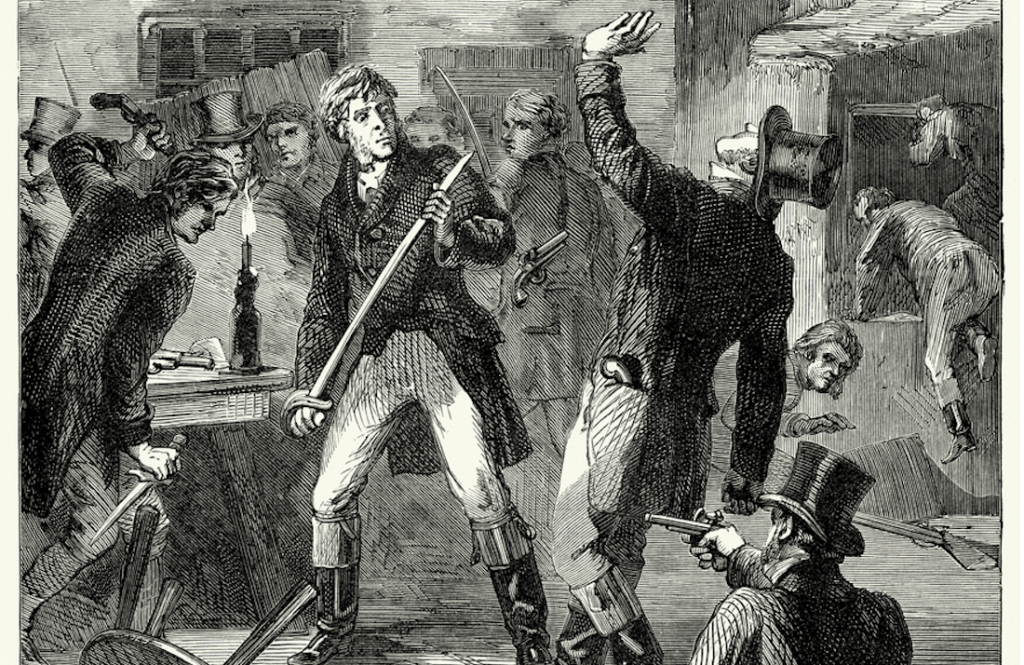
On 23 February 1820, a group of approximately 20 radical conspirators was intercepted by police in a hayloft on Cato Street, London, as they prepared to assassinate the entire British cabinet. The “Cato Street Conspiracy” was the culmination of a plot to kill the prime minister, Lord Liverpool, and the home secretary, Lord Sidmouth, during a fabricated dinner at the home of Lord Harrowby in Grosvenor Square.
The plot was conceived in the climate of economic deprivation and political repression that followed the Napoleonic Wars, the 1819 Peterloo Massacre and the enactment of the Six Acts. The conspirators themselves were members of the Spencean Society or Society of Spencean Philanthropists – named after Thomas Spence, a leading English radical who advocated for universal suffrage and an end to private property. Some of the conspirators, including Thistlewood, had been involved with the Spa Fields riots in 1816.
***
The conspiracy was catalysed by a false report, deliberately circulated by the government spy George Edwards and published in the New Times newspaper. The report, published on 22 February, announced that several cabinet ministers, including Liverpool and Sidmouth, would be attending a dinner at the home of Lord Harrowby in Grosvenor Square the following evening.
Arthur Thistlewood, the leader of the radical plot, gathered his co-conspirators and declared his intention to assassinate the entire British cabinet. It was Edwards, serving as Thistlewood’s second in command, who suggested that the group should capitalise on the opportunity seemingly presented by the fabricated dinner. Liaising with government ministers, Edwards even helped procure the arms and resources needed to make the conspiracy appear possible.
The conspirators, numbering around 20, settled on their plan: they would storm Lord Harrowby’s home and kill the ministers, before seizing the Bank of England and the Tower of London. The group would then establish a “Committee of Public Safety” to govern a new British republic.
It was believed that such action would trigger an uprising against the government.
As part of this strategy, the group prepared a proclamation urging soldiers to mutiny and side with the people in the form of the revolutionary provisional government.
One reputed draft declared: “Brave soldiers, the tyrants are no more. Make common cause with the people. Think of your fathers, mothers and friends! Be just to the miseries they have long endured! Be just to yourselves! Be brave and be free!!!
“Join the people; to be the freest nation on earth, then you will be the most prosperous and happy. Wait for instructions from the provisional government. It is engaged in preparing measures to reward you.”
The proclamation, including instructions on how to deliver it, was signed “G E”.
On 23 February, acting on Edwards’ intelligence, police stormed a hayloft located on Cato Street where the conspirators were gathering their weapons. In the ensuing fight, one police officer, Richard Smithers, was killed and 13 members of the group were arrested.
Five of the ringleaders, Thistlewood, James Ings, Richard Tidd, William Davidson and John Brunt, were later found guilty of high treason and, on 1 May, publicly hanged and decapitated. Five others, John Harrison, James Wilson, Richard Bradburn, John Strange and Charles Copper, were transported to Australia.
On 28 April, in his final speech before his sentencing, Thistlewood told the court: “I am asked… what I have to say that judgment of death should not be passed upon me according to law. This to me is mockery – for were the reasons I could offer incontrovertible, and were they enforced even by the eloquence of a Cicero, still would the vengeance of my Lords Castlereagh and Sidmouth be satiated only in the purple stream which circulates…
“High treason was committed against the people at Manchester [Peterloo], but justice was closed against the mutilated, the maimed, and the friends of those, who were upon that occasion indiscriminately massacred…
“Albion [Britain] is still in chains of slavery. I quit it without regret. I shall be consigned to the grave, and my body will be immured beneath the soil whereon I first drew breath.
“My only sorrow is that that soil should be a theatre for slaves, for cowards and for despots. My motives, I doubt not, will hereafter be justly appreciated.”
Davidson defended himself by invoking Magna Carta and what he described as an “ancient custom to resist tyranny”.
He declared: “Would you not rather govern a country of spirited men, than cowards? I can die but once in this world, and the only regret left is, that I have a large family of small children, and when I think of that, it unmans me.”
Edwards, meanwhile, was living in hiding on Guernsey. The government arranged for him to assume a new identity; Edwards, now known as George Parker, was subsequently relocated to South Africa.
***
On 2 May 1820, Matthew Wood, the former lord mayor of London, London alderman and MP for the City of London, raised the conduct of Edwards in a speech in the House of Commons. It came after supporters of the Spenceans submitted a request for Edwards’ arrest to Wood, in his capacity as a magistrate.
Wood, a supporter of reform, had previously been listed as a name that could serve on the so-called Committee of Public Safety.
Wood argued that Edwards was not just a reporter of crime but the “sole promoter of the treasonable conspiracy” who recruited “all the desperate characters whom he could find”.
Henry Brougham, one of the era’s leading legal minds, argued that while the “necessity for the employment of spies was lamentable”, it was no different from “the employment of the executioner of the law.”
He argued that “no man was entitled to blame government for employing the odious informer who was not prepared to blame them equally for employing the odious executioner.”
Brougham asserted that a government would be “highly culpable if they neglected” to watch men like Thistlewood.
However, he maintained that while characters like Thistlewood “rendered the employment of spies necessary”, they simultaneously “rendered the employment of instigators to crime equally unnecessary.” He concluded that if Edwards went “beyond his commission as an informer” and “employed himself as an instigator… justice would not be satisfied unless he was brought to trial for such new and serious offence”.
Radical MP Joseph Hume said he strongly suspected “that the existence of the plot was known to many persons before the time of its public detection.”
Future prime minister George Canning defended the need for governments to “defeat by the prostitution of wicked men, the plots of men as wicked.”
Wood returned to the commons on 9 May and moved for the creation of a select committee to “examine evidence touching the, criminal conduct and proceedings of George Edwards and his associates for the last, two years, and especially his connection with the parties forming the plot lately discovered in Cato Street.”
Addressing the House, Wood described a separate scheme, purportedly planned by Edwards, to massacre MPs in the House of Commons. He detailed a plot where “iron cases shaped like books” would be filled with gun-barrels, plugged with lead and packed with gunpowder. According to Wood, these disguised explosives would be thrown from the gallery when the chamber was full.
Wood emphasised Edwards’ suspicious transformation from a “destitute” seller of plaster busts to a man of “great affluence”. The MP said he had evidence that Edwards was the “sole promoter and instigator” of the Cato Street conspiracy.
Sir Francis Burdett, a prominent reformer, questioned whether the employment of “reptiles” like Edwards was a legitimate instrument of government.
He questioned: “Where did we find those reptiles thrive, and where had they been approved as fair supporters of a government? Was it during the freedom of the Roman commonwealth? Were they employed under a Trajan, or an Aurelius; or under the tyranny of such monsters as Domitian, and Nero, and Caligula?
“Then they were employed; but now they were employed and justified.”
Canning argued that it was “glorious absurdity” to suggest that “plots might best be discovered by throwing aside every person connected with, or who knew any thing at all about them.”
Burdett accused Canning of being “drunk with insolence”.
The attorney general, Robert Gifford, argued that Thistlewood was a hardened traitor who “gloried” in the plot.
Wood’s motion was negatived (defeated) without need for a division.

Politics.co.uk Newsletters
DAILY
Politics@Lunch
WEEKLY
Week in Review