Prime minister Spencer Perceval assassinated in House of Commons lobby
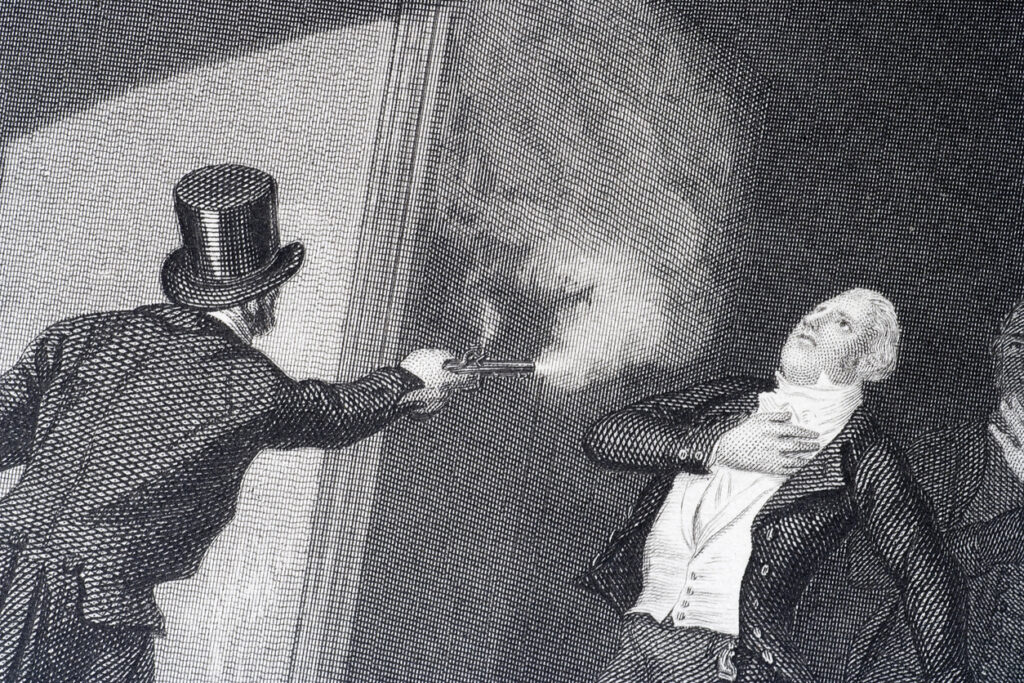
Prime minister Spencer Perceval was assassinated on 11 May 1812, when he was shot in the lobby of the House of Commons. The attack, which took place at around 5:15 pm, was carried out by John Bellingham, a Liverpool merchant who held a long-standing grievance against the government.
Perceval was not a popular prime minister, and his assassination came at a time of war abroad (against Napoleonic France) and domestic political upheaval. He was on his way to attend an inquiry into a much-criticised wartime economic policy, when Bellingham stepped forward, drew a pistol, and shot him at point-blank range in the chest.
Perceval remains the sole British prime minister to have been assassinated.
***
Bellingham’s motive was not linked to a personal vendetta – as opposed to a wider political plot. He was a bankrupt merchant trader who believed the government had failed to intervene after he was imprisoned in Archangel, Russia, over a commercial dispute. Bellingham was accused of a debt amounting to 4,890 roubles. He protested his innocence and sought assistance from the British authorities, to no avail.
Upon returning to the UK in December 1809, having served a total of six years in Russian prisons, Bellingham proved unable to secure compensation from the UK government. He is said to have written to a series of senior government ministers, including Perceval, and frequented parliament to lobby ministers.
After being shot, the prime minister staggered forward, uttered words recorded variously as “I am murdered” or “Oh my God”, and fell to the floor.
Bellingham made no attempt to escape. He answered the call to identify the culprit, stating: “I am the unfortunate man; my name is Bellingham; it is a private injury; I know what I have done; it was a denial of justice on the part of the government.”
Questioned why he had committed the act, Bellingham responded: “Want of redress, and denial of justice.”
Troops were called to escort Bellingham from Westminster to Newgate prison out of fear sympathetic crowds would intervene and enable his escape.
The assassination caused initial panic and fears of a popular uprising, but it was soon established that Bellingham had acted alone. He was put on trial just four days later at the Old Bailey, where he was found guilty of murder.
During his trial, Bellingham attempted to explain his actions. He told the court that he had been driven to desperation after what he believed was a prolonged refusal of justice by the British government.
He declared: “Finding myself thus bereft of all hopes of redress, my affairs ruined by my long imprisonment in Russia through the fault of the British minister, my property all dispersed for want of my own attention, my family driven into tribulation and want, my wife and child claiming support which I was unable to give them, myself involved in difficulties, and pressed on all sides by claims I could not answer; and that justice refused to me which is the duty of government to give, not as a matter of favour, but of right… If they had listened to my case this court would not have been engaged in this case.”
He continued that Spencer Perceval had “obstinately refus[ed] to sanction my claims in parliament” and that he had therefore been “driven to despair”.
Bellingham added: “Gentlemen, a refusal of justice was the sole cause of this fatal catastrophe; his Majesty’s ministers have now to reflect upon their conduct for what has happened.”
Bellingham, 35 and a father of three, was hanged at Newgate Prison on 18 May 1812.
***
Spencer Perceval, who had served as prime minister since 1809, was a staunch opponent of the slave trade, as well as political reform and Catholic emancipation. He was succeeded by Lord Liverpool, who set about distancing himself from Perceval’s ministry and reversing his economic policies.
Liverpool went on to become the longest-serving prime minister (1812-1827) since 1801.
Lord (Henry) Bellingham, who served as a Conservative MP from 1983-1997 and 2001-2019, is a direct descendant of Perceval’s assassin.
In 1997, Bellingham’s constituency was contested by the anti-EU Referendum Party in the form of candidate Roger Percival. Percival claimed to be a descendant of the slain prime minister.
Percival secured 2,923 votes, more than the victorious Labour candidate’s majority over Bellingham. Percival’s successful spoiler campaign was styled as revenge for his alleged descendant’s assassination.

Politics.co.uk Newsletters
DAILY
Politics@Lunch
WEEKLY
Week in Review