Cavalry charges peaceful reform rally in Peterloo Massacre
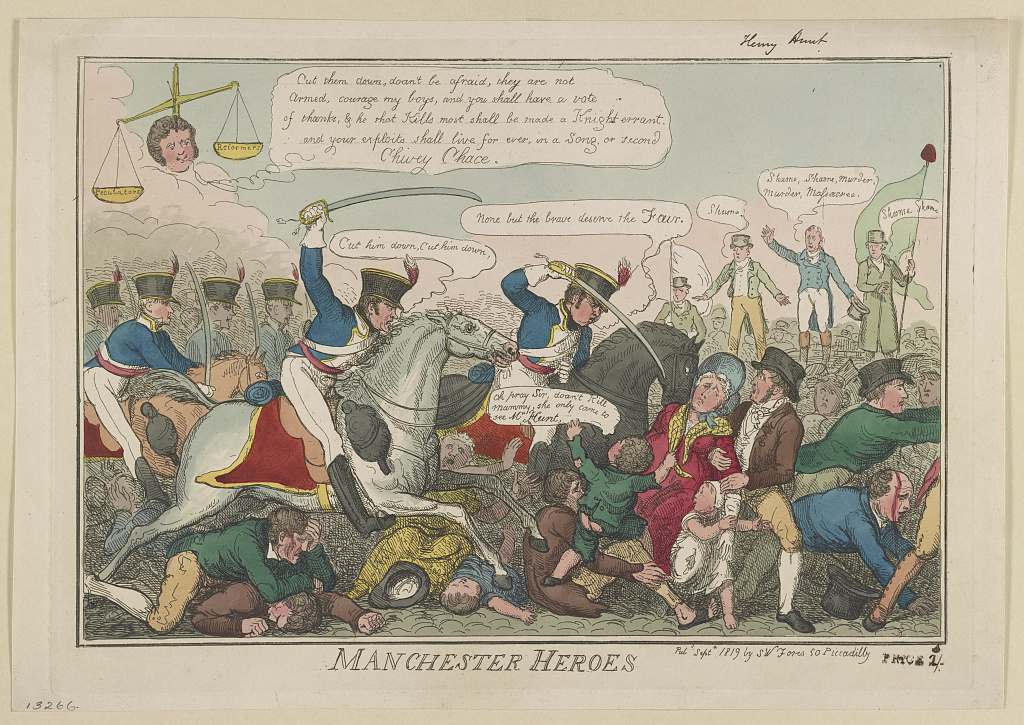
On 16 August 1819, a large and peaceful demonstration demanding parliamentary reform in St Peter’s Field, Manchester, was brutally dispersed when local yeomanry cavalry charged into the crowd. The ensuing chaos resulted in the deaths of an estimated 18 people and injuries to hundreds more.
This infamous episode, known as the Peterloo Massacre, represented a defining moment of popular resistance and violent state repression in 19th century Britain.
***
The years following the Napoleonic Wars were marked by economic distress and widespread political discontent. Severe unemployment was exacerbated by the demobilisation of soldiers; the controversial corn laws, enacted in 1815, had resulted in soaring bread prices. Industrial centres like Manchester, despite booming populations, had no dedicated MPs; places like Old Sarum in Salisbury, consisting of an uninhabited hill, did.
On 16 August, a crowd of an estimated 60,000 men, women and children gathered peacefully at St Peter’s Field to petition for reform of the corrupt and unrepresentative parliamentary system. The assembled masses, supporters of the Manchester Patriotic Union, were gathered to hear an address from renowned radical orator Henry Hunt.
Observing the large assembly from a nearby building, the local magistrates panicked and issued a warrant for Hunt’s arrest, ordering the Manchester and Salford Yeomanry to clear a path through the crowd to the hustings.
The poorly trained, sabre-wielding yeomanry charged into the densely packed field, resulting in several casualties, including the death of a child. As chaos erupted, the magistrates ordered the 15th Hussars, a regular cavalry regiment, to disperse the crowd. Eyewitness accounts describe soldiers cutting indiscriminately into the fleeing demonstrators. The exits were blocked by infantry, contributing to the killing.
News of the massacre provoked national outrage. The radical press coined the name ‘Peterloo’, a bitter inversion of the celebrated victory at Waterloo four years earlier.
Parliament reassembled on 23 November 1819, as scheduled, to debate the address from the throne. George Tierney, the Whig leader, moved an amendment that called for a “diligent and impartial inquiry”.
An inquiry, it was posited “may show that the measures of extraordinary severity, then resorted to, were the result of the most urgent and unavoidable necessity; or prove that an important constitutional privilege cannot be violated, and the lives of his majesty’s subjects sacrificed, with impunity.”
The leader of the House of Commons, Lord Castlereagh, denounced the amendment as a “barefaced trap” set by the radicals. If it were to punish the coroner or the magistrates, he insisted, the inquiry “would form an additional reason for levelling the throne and the constitution”.
It was defeated by 381 votes to 150, a majority of 231.
Indeed, the government, led by Lord Liverpool, responded with repression, not reform.
Hunt was later imprisoned for seditious conspiracy. The government, publicly backing the magistrates, portrayed the event as the honourable suppression of a potentially revolutionary gathering.
Parliament passed the infamous “Six Acts”, measures designed to clamp down on radical activity by severely restricting public meetings, curbing the press, and expediting trials for sedition. On 29 November 1819, Castlereagh said that the introduction of these “restrictive and coercive” bills was compelled “by an imperative sense of duty”.
He described a crisis of “imminent danger, unless parliament met the evil with manly firmness and vigour.”
Castlereagh blamed “a set of itinerant orators” for having poisoned “the minds of the lower orders in this country by artful tales about sinecures and pensions”.
On 3 December, Castlereagh introduced a bill to outlaw radical meetings. He told the commons: “I feel no wrath against the people. I am only doing my duty.”
***
A petition from working-class radical Samuel Bamford, presented to the commons on 30 November, expressed the belief of those in attendance at St Peter’s Field, Manchester, that they were “amply protected by the laws in exercising all those rights of a Freeman which the constitution has conferred upon him”.
Bamford, who was described as having conducted “a large body of individuals to the meeting at Manchester”, rejected the government’s account as comprising “untrue” allegations that “unfairly discoloured and distorted” the intentions of those in attendance.
He said the assembly was “intending mischief to none, and suspecting none towards themselves”, protesting that the intentions of participants were made manifest by their “indubitable pledge of their sincerity and sense of security, by taking in their company their wives and female relatives”.
He stated that “without any previous notice, riot, tumult, or disturbance, the assembly… found themselves suddenly assaulted by a charge of the Manchester yeomanry cavalry, who sabred, rode down, and trampled upon every individual who could not escape them; by which, as the petitioner believes, several hundred unoffending persons were severely wounded, and some killed on the spot”.
The petition implored parliament not to “adopt measures derogatory of its honour and dignity”, but to instead “institute such rigorous and solemn inquiries as may, through the means of its power, bring the criminal authors who appear to be above the reach of the ordinary tribunals, and above the humble means of the sufferers, to condign punishment”.
Shortly before Bamford’s petition was read, one MP by the name of Arthur Onslow condemned the Peterloo “military parade” as “directly illegal, seditious, and dangerous to the public peace.”
He said that the demand for “annual parliaments, universal suffrage, and, vote by ballot”, which was inscribed on one of the flags, “was utterly unconstitutional.”
The slogan “Liberty or Death”, he added, “was riotous and treasonable”.
Although Peterloo represented a brutal short-term defeat for the reform movement, its long-term impact was profound. It galvanised reformers, inspiring the Chartist movement of the 1830s and 1840s and radicals beyond.
***
Elected to parliament in 1830, Henry Hunt proved an enthusiastic conduit for pro-reform petitioners.
He opposed the Great Reform Act 1832 on the grounds that it did not go far enough in the extension of the franchise. Moreover, he thought it would be a block on future reform efforts rather than a “stepping stone”.
In his first recorded petition, presented February 1831, Hunt called for a wide range of reforms, including the commutation of tithes, the abolition of “all sinecures”, and of “parliament, by extending the franchise, and allowing the people to vote by ballot”.
He introduced himself as a “radical reformer”, having been one since 1815 and “the passing of the corn laws”.
In March 1832, Hunt introduced a resolution calling for a select committee to investigate the “military execution inflicted on a peaceable and unarmed multitude” at St Peter’s Field, Manchester, in 1819. Hunt hoped the pro-reform Whig government would investigate the “grossest misrepresentations” made of that day.
13 years on, Hunt provided his eye-witness account of the event.
He told the House: “It was a fine sight – there were many flags and banners, and a great many females were present – the people were allowed to assemble without interruption, no warning was given that they were about to act illegally; the proceedings, however, had but just commenced, when, without the least previous notice, the Manchester Yeomanry were let loose upon the assembled multitude; with sabres newly-sharpened for the occasion, they galloped over the people, cutting down all within their reach.
“No resistance was offered or intended.”
He declared by way of conclusion: “No lapse of years could extinguish the crime of murder.”
The Whig government under Earl Grey, however, argued that an inquiry was “inexpedient”. The minister on duty pointed to Hunt’s own conviction as proof the gathering was illegal.
Sir Robert Peel declared his opposition to an inquiry on behalf of the Tory party. He quoted the judgement of the Lord Chief Justice of England, who ruled that the magistrates had acted with “temperance and forbearance”.
Hunt’s motion was defeated by 206 votes to 31, a majority of 175.
***
On 1 August 1832, Hunt claimed to be the “only openly avowed radical in the House”.
True to form, on 3 August, Hunt presented the first recorded petition to the House of Commons specifically calling for women to be granted the parliamentary vote.
Hunt’s decision not to support the Great Reform Act is said to have alienated some of his erstwhile supporters in Preston. He lost his seat in 1833.
Hunt was magnanimous in defeat, telling his supporters: “I have done everything in my power to maintain, uphold, and secure your rights, but I have failed upon this occasion. I shall retire into private life with the reflection, that I have never, upon any occasion, flinched from performing my duty to you, and the whole of the working classes of the United Kingdom.”
Hunt died on 13 February 1835. The legacy of his life’s agitation would be felt almost immediately with the rise of Chartism – a mass working class movement he would have much admired.

Politics.co.uk Newsletters
DAILY
Politics@Lunch
WEEKLY
Week in Review