James II lands in Ireland and begins Williamite War
The Williamite War in Ireland or Cogadh an Dá Rí (the War of the Two Kings) began on 12 March 1689 when the deposed Catholic monarch, King James II, landed at Kinsale, County Cork, with French military support. This act marked the escalation of the struggle for the crowns of England, Scotland and Ireland, begun by the Glorious Revolution of 1688.
James landed in Ireland with the express purpose of upending the revolution settlement, which had seen him replaced by his Protestant daughter Mary II and her husband William of Orange, Stadtholder of the Dutch Republic, as joint sovereigns. Mary and William jointly assumed the throne on the invitation of English nobles, who judged James to have “vacated” his position. The incumbent monarch, in the face of his likely deposition, had fled to France.
The Declaration of Right, issued by parliament in February 1689, codified James’ perceived misdeeds, namely the suspension of the Test Acts, the prosecution of the Seven Bishops for petitioning the crown, the establishment of a standing army and the imposition of “cruel punishments”.
The declaration accused James of endeavouring to “subvert and extirpate the Protestant religion and the laws and liberties of the kingdom.”
***
Ireland was chosen as the base for the Jacobite counter-revolution due to its largely Catholic population. Meanwhile, James’ viceroy in Ireland, Richard Talbot, Earl of Tyrconnell, had maintained control of most of the country for the Jacobite cause.
Supported by his cousin, King Louis XIV le roi soleil of France, James arrived with 6,000 troops and a significant sum of money. He sought to rally an Irish army, subdue the remaining Williamite strongholds in Ulster, and launch an invasion of Britain. The involvement of King Louis marked the conflict as a key theatre in a wider European struggle known as the Nine Years’ War, fought between France and the Grand Alliance, led by William.
Ireland, suddenly, was at the centre of a European-wide struggle for power.
Louis’ calculation was informed by this bigger picture. But for Jacobites, the war was an effort to restore a legitimate, divinely appointed king. For many Irish Catholics, conflict represented an opportunity to restore their predominance.
For Williamites and the ‘whig’ historiographical tradition, the war that followed James’ deposition was a fight to defend the revolutionary settlement, Protestantism, religious freedom and property rights from ‘Popish’ absolutism.
***
The war ended with the Treaty of Limerick in October 1691, marking a comprehensive defeat for the Jacobite cause in Ireland.
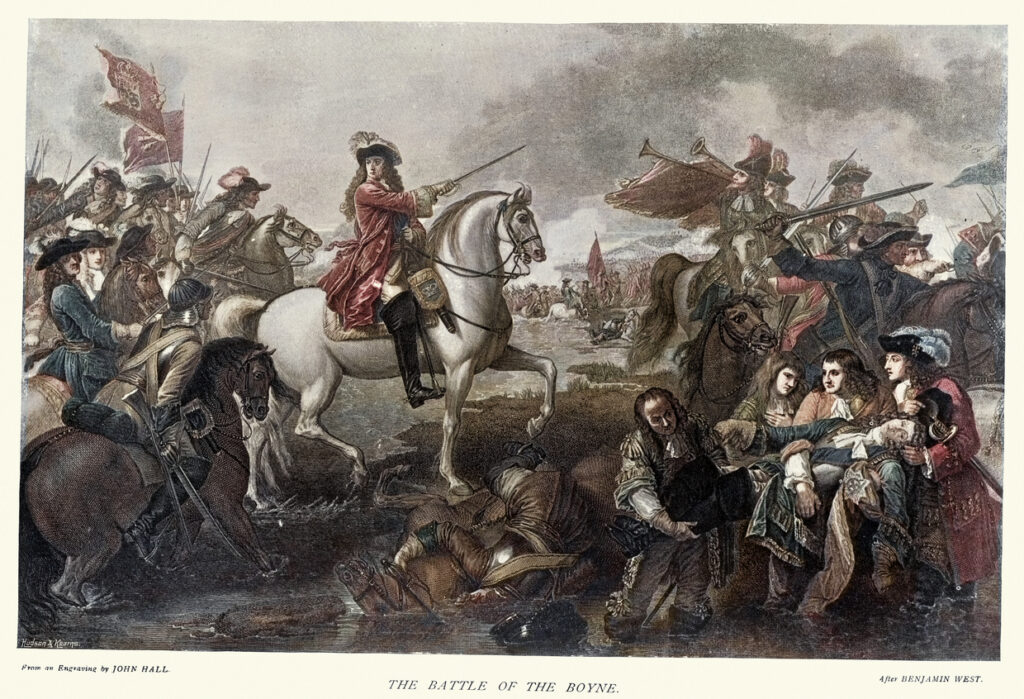
This outcome, sealed by Williamite victories such as the Siege of Derry and the Battle of the Boyne, established a ‘Protestant ascendancy’ in Ireland for more than a century, sustained by Catholic dispossession, socio-economic domination and sectarian division.
The subsequent extension of the Penal Laws effectively excluded the majority Catholic population from positions of power and influence.
The revolutionary settlement was subsequently consolidated by the 1701 Act of Settlement, which limited the line of succession to Protestants, and the 1707 Acts of Union, which created the Kingdom of Great Britain. From 1714, with George I’s accession, the Kingdom of Great Britain was ruled by the Hanoverian dynasty.
Jacobitism, which championed the claim to the throne of James VII/II, remained a problem for the Hanoverian regime. Jacobite leaders mounted two serious challenges to the Hanoverian succession: in 1715, led by James Edward Stuart (the “Old Pretender”), and 1745, led by Charles Edward Stuart, known as ‘Bonnie Prince Charlie’.
The end of the Williamite War in Ireland is commemorated each year on 12 July by Protestants and unionists in Ulster, particularly through marches organised by the Orange Order. The celebrations mark the victory of William over James at the Battle of the Boyne.

Politics.co.uk Newsletters
DAILY
Politics@Lunch
WEEKLY
Week in Review