Nigel Farage officially launches the Brexit Party
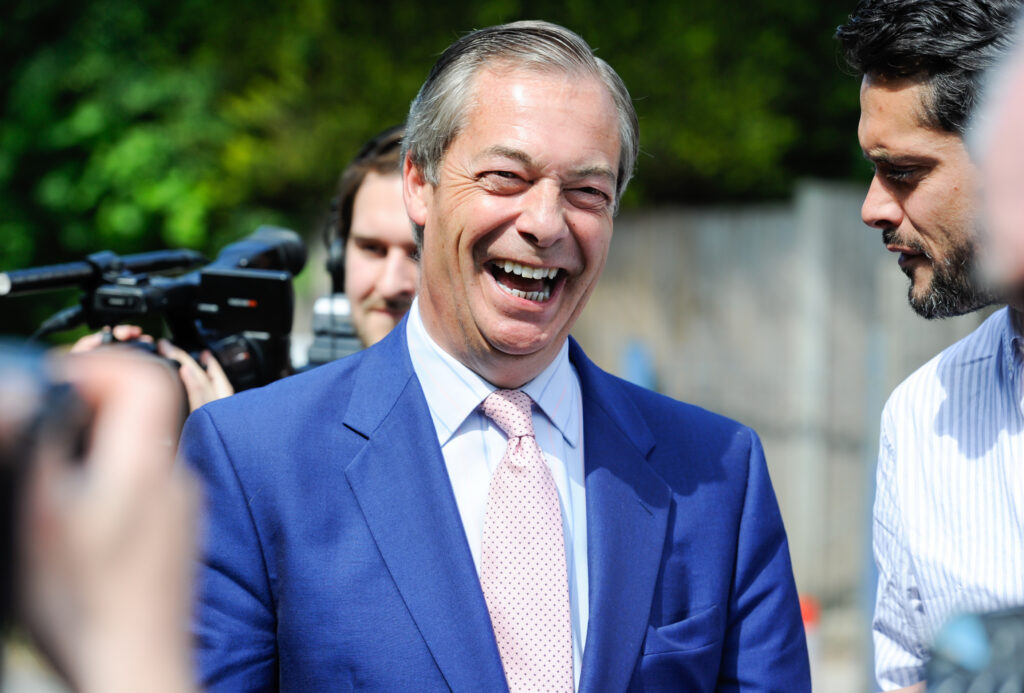
On 12 April 2019, Nigel Farage launched the Brexit Party at a metalworks plant in Coventry, promising a “democratic revolution”.
The launch occurred within 48 hours of Theresa May, the prime minister, securing a further extension to Article 50 – a move that would force the UK to participate in the upcoming European Parliament elections.
British political parties are traditionally constituted as unincorporated associations composed of a membership. The Brexit Party, however, was founded in November 2018 as a private limited company (Registration Number 11694874).
Catherine Blaiklock, a former economics spokeswoman for the UK Independence Party (Ukip), was initially registered as the party’s leader. But Nigel Farage, the former Ukip leader, was always likely to impose himself as the future public face of the party.
***
Farage, a founding member of Ukip in 1993, led the party to its electoral peak at the 2014 European parliament elections, winning 24 of the UK’s 73 seats in the continental legislature. Mere months later, Ukip gained its first MP in the form of Conservative defector Douglas Carswell. From 2010 to 2015, Ukip exerted considerable centrifugal pressure on the Conservative Party. This relationship was a critical factor in shaping Cameron’s 2013 pledge to hold an ‘in-out’ referendum on EU membership.
After the Brexit vote in 2016, with Farage seeking to step back as Ukip leader, the party descended into bitter internal disputes. In a June 2017 interview, Farage said he regretted the “reluctance” of Ukip to evolve and rebrand along the lines of the populist, anti-establishment Five Star party in Italy.
In 2018, Gerard Batten was elected unopposed in Ukip’s fourth leadership contest in 18 months. Batten shifted the party’s focus towards criticising Islam, and forged close ties with far-right activist Tommy Robinson. This move prompted a wave of resignations, including that of Farage.
Farage said Batten was “obsessed” with Islam and argued that “Ukip wasn’t founded to be a party based on fighting a religious crusade”.
The Brexit Party was incorporated with Companies House on 23 November 2018.
Blaiklock, serving as the party’s initial leader, announced that she had applied to register the new party with the Electoral Commission on 11 January 2019, saying it would be ready to fight any snap general election.
On 20 January, Farage said that Blaiklock had founded the party with his “full knowledge” and “full support”. Asked what role he would take in the new party, Farage told the Sun on Sunday: “It’s very early days.”
The comments came after May’s Brexit deal was rejected by 432 votes to 202 in the House of Commons – the largest defeat for a sitting government in modern parliamentary history – on 15 January.
On 5 February, the Brexit Party was officially recognised by the Electoral Commission with Blaiklock as leader. Writing in the Telegraph, Farage said he would stand as a Brexit Party candidate if Britain had not left the EU in time for the European parliament elections in May.
The Brexit Party constitution was eventually obtained following a freedom of information request. The party’s constitution defined its objectives in vaguely Thatcherite terms, asserting that it would seek to “diminish the role of the state”, lower the burden of taxation, and strengthen and guarantee the “essential, traditional freedoms and liberties of all people in the United Kingdom.”
The Brexit Party’s placeholder constitution said the United Kingdom should “only be governed by her own citizens” and “cease to be a member of the European Union.”
The FoI disclosure also revealed that the Electoral Commission initially told Blaiklock that her proposed constitution “appears to be the same as the constitution for the UK Independence Party.”
The commission added: “My initial view is that the constitution that you have provided does not adequately show the structure and organisation of the party. This is partly because it appears to be the structure of another party and partly as it will likely be difficult for a new party to entirely adopt such a large structure from point of registration – it would therefore not demonstrate the structure of your party.”
Blaiklock responded with amendments.
The commission further questioned who would be the overall leader of the party, given media reports that Farage could soon assume overall control. The commission said: “If this were the case, then it is not clear that the proposed leader is the overall leader of the party, as required by [Political Parties, Elections and Referendums Act 2000].”
Moreover, the proposed constitution stated that an extraordinary general meeting (EGM) and “no-confidence” vote in the leader could only be called by members if 50% of the party’s branches voted for it. However, the commission noted that, at the time of registration, the party had zero branches.
Overall, the correspondence suggested the party’s registration was handled with significant haste. Blaiklock repeatedly submitted the party’s “financial scheme” with the grey template text still inside. Multiple “FINAL VERSION” emails were sent before the scheme satisfied the commission.
As Blaiklock battled for registration, Ukip’s concerns that the Brexit Party name was too similar to its description (“UKIP Make Brexit Happen”) were dismissed by the commission.
***
A second meaningful vote on Theresa May’s Brexit deal was held in March 2019. MPs again rejected the withdrawal agreement by 391 votes to 242. On 20 March, May’s government sent a letter to Donald Tusk, the president of the European Council, asking for an extension of the Article 50 period until 30 June 2019.
A third meaningful vote on May’s deal was rejected by 344 votes to 286 on 29 March. As a result, May announced she would seek a further extension to the Article 50 process. The UK and EU ultimately agreed to extend Article 50 until 31 October 2019.
This extension meant the UK would fight the European Parliament elections.
Also on 20 March, Blaiklock resigned as leader of the Brexit Party after reports emerged that she had repeatedly posted and reposted racist social media messages. The posts reportedly came from an account that Blaiklock deleted shortly after she founded the Brexit Party.
In a statement, she said: “The out-of-character comments that I made on social media some time ago were unacceptable in tone and content. After speaking to Nigel Farage, I realise that my comments fall well short of what is expected in any walk of life.
“I have accordingly tendered my resignation as party leader.”
Two days later on 22 March, Farage announced he would take over from Blaiklock as Brexit Party leader.
On 12 April, Farage launched the Brexit Party, unveiling an “impressive list” of 70 candidates for the upcoming elections. The list included Richard Tice, as well as Annunziata Rees-Mogg, the sister of Conservative MP Jacob Rees-Mogg; Paul Nuttall, the former Ukip leader; Ann Widdecombe, the former Conservative MP and minister; Rupert Lowe, the former chairman of Southampton Football Club; Ben Habib, a British-Pakistani businessman; Nathan Gill, the former leader of Ukip in Wales; and Martin Daubney, the former editor of the men’s lifestyle magazine Loaded.
Farage declared: “This party is not here just to fight the European elections… this party is not just to express our anger – 23 May is the first step of the Brexit Party. We will change politics for good.”
Tice was appointed to the role of party chairman.
The Brexit Party topped the European Parliament elections in Britain with 31.6% of the vote, securing 29 seats. It emerged as the largest single party in the European parliament. The Conservatives suffered their worst national election result since the 1832 Great Reform Act, finishing in fifth place with just 9.1% of the vote and four MEPs (down 15).
On 24 May, between polling day and the declaration of results, Theresa May announced her intention to resign as prime minister. She was succeeded by Boris Johnson as Conservative leader and PM in July 2019. Blaiklock reportedly applied to join the Tories on the day Johnson became leader; her application was rejected.
The months from July 2019 to October 2019 represented some of the most fraught of the Brexit years. Johnson, having unlawfully prorogued parliament and begrudgingly applied for a further Brexit extension, forced through a vote on holding a general election in December.
In the wake of the European Parliament elections, Farage vowed to stand Brexit Party candidates at a future general election. On 1 November, launching the Brexit Party’s campaign, Farage called on Johnson to “build a leave alliance” and drop his renegotiated deal with the EU. Otherwise, he said, the Brexit Party would “contest every single seat in England, Scotland and Wales.”
On 11 November, Farage announced that the Brexit Party would stand down its candidates in the 317 constituencies won by the Conservatives at the 2017 general election. The decision came amid fears that Farage’s party could split the pro-Brexit vote. Farage had previously announced that he would not stand at the general election, saying he could “serve the cause better” campaigning across the country.
In the end, the Brexit Party stood 275 candidates, winning zero seats and 2.0% of the vote.
Reacting to the general election result, a Conservative majority of 80 seats, Farage said: “This victory for Boris was hugely helped by us and is far better than the Marxist Corbyn and a second referendum.”
***
During the 2019 general election campaign, Farage said the Brexit Party would change its name to the “Reform Party” after the UK left the European Union. The restyled party would campaign for changes to the voting system and the abolition of the House of Lords, Farage said.
The Reform name was a conscious reference to the Reform Party of Canada, which, under the leadership of Preston Manning from 1987 to 2000, supplanted the established Progressive Conservative Party as the largest party of the right in Canada. The Canadian Reform Party and the Progressive Conservatives eventually merged, creating a new more populist-flavoured conservative party.
One year later in November 2020, Farage and Richard Tice wrote a joint article for the Telegraph, announcing that the Brexit Party would be relaunched as “Reform UK”. Under this new name, subject to approval from the Electoral Commission, the party would oppose Covid-19 lockdown measures.
Tice and Farage wrote: “We are showing the courage needed to take on consensus thinking and vested interests on Covid. But there are so many areas of public life that can be improved to benefit ordinary people. That is why we will campaign for Reform.”
The Reform UK rebrand was approved by the Electoral Commission in January 2021.
Farage stepped down as Reform leader in March 2021 and was replaced by Tice. Farage took on the role of “honorary president” of the party. David Bull was appointed as deputy leader, and Nathan Gill became the leader of Reform UK Wales.
Reform UK gained political traction in late 2022 as it established itself as a vocal threat to Rishi Sunak’s right flank.
In May 2023, Farage said he regretted standing aside for Conservative incumbents at the 2019 general election and was thinking “very hard” about returning to frontline politics.
On 22 May 2024, Sunak defied Westminster’s expectations and called a general election for the summer. Farage, who claimed Sunak called the election to scupper his plans to return to frontline politics, initially announced that he would not stand in the general election as a Reform candidate.
Farage, a declared supporter of Donald Trump, said that he wanted to be free to campaign in the US presidential election. “Important though the general election is”, he wrote, “the contest in the United States of America on November 5 has huge global significance.”
But Farage soon U-turned, declaring his candidacy for the constituency of Clacton and announcing that he would take over as leader of Reform UK. Farage said that he had changed his mind on the campaign trail and wanted to lead a “political revolt”. Tice, a longstanding ally of Farage, willingly stood aside, assuming the position of party chairman.
The 2024 general election resulted in a historic breakthrough for Reform UK. Farage himself was elected in Clacton, and the party secured a total of five MPs. Speaking at his election count, Farage vowed: “We’re coming for Labour – be in no doubt about that.”

Politics.co.uk Newsletters
DAILY
Politics@Lunch
WEEKLY
Week in Review