Nelson Mandela arrives in UK for historic state visit
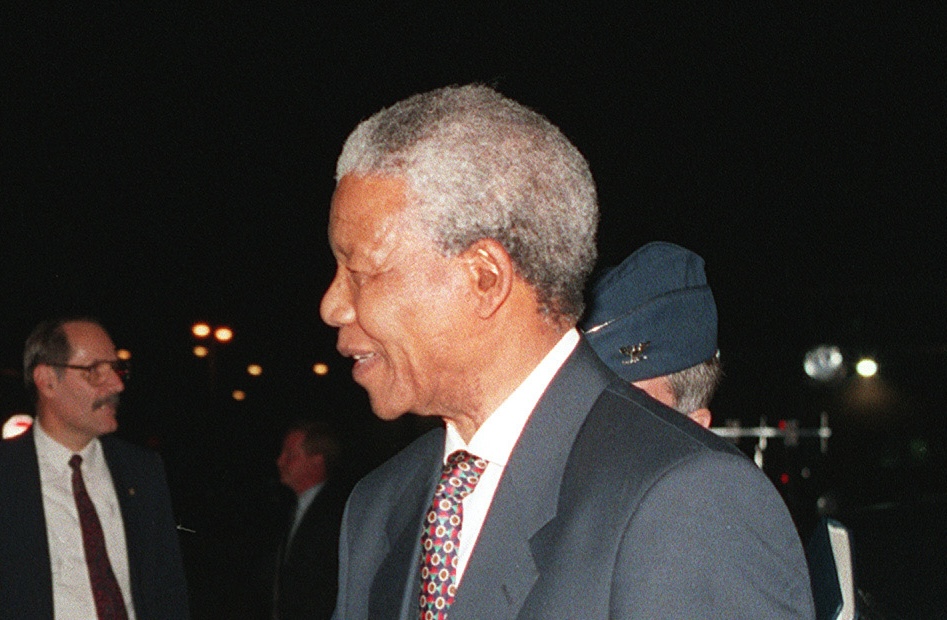
On 9 July 1996, the South African president, Nelson Mandela, 77, began a landmark four-day state visit to the United Kingdom.
The opening day was marked by major public celebration, with Mandela receiving a ceremonial welcome from Queen Elizabeth II at Horse Guards Parade. Vast crowds lined the Mall, cheering as he and the Queen rode in a carriage from Buckingham Palace, where he had attended a state banquet in his honour.
Attendees at the banquet included senior members of the Royal Family, former Conservative prime minister Ted Heath, former Labour leader Neil Kinnock, Labour MP Bernie Grant, and Archbishop of Canterbury George Carey.
Mandela’s 1996 visit was not his first time in the United Kingdom. He had visited the country on several occasions stretching back to 1962, when he met Labour leader Hugh Gaitskell and Liberal leader Jo Grimond; there was no audience with the prime minister, Harold Macmillan, at that time.
During a May 1993 visit, he met the family of Stephen Lawrence who, aged 18, was murdered in a racist attack in south east London two weeks previously.
***
The centrepiece of Mandela’s statement visit came on 11 July, when he addressed both Houses of Parliament in Westminster Hall. At the time, he was only the second foreign leader during a state visit, after France’s Charles de Gaulle in 1960, to be afforded the platform.
Mandela, two years into his tenure as South Africa’s first president, thanked the British people and its parliament for their role in the anti-apartheid movement, while addressing Britain’s colonial role in South Africa’s history.
He framed his visit as an opportunity to “close a circle which is two hundred years old… because the first time this country entered ours as a colonising power was the year 1795.”
Mandela added: “Despite that rebuff and the terrible cost we had to bear as a consequence, we return to this honoured place neither with pikes, nor with a desire for revenge, nor even with a plea to your distinguished selves to assuage our hunger for bread. We come to you as friends.”
He invoked Macmillan’s famous 1960 “wind of change” speech, delivered in South Africa, referencing its warning of a “stubborn and race-blinded white oligarchy”.
The South African president stated: “Change has come to our country, too, perhaps at last, but bringing with it joy, the promise of a better future and a protracted festival of hope across the globe.
“Racism is a blight on the human conscience. The idea that any people can be inferior to another to the point where those who consider themselves superior define and treat the rest as sub-human denies the humanity even of those who elevate themselves to the status of gods.”
The packed audience in Westminster Hall included the former Conservative prime minister, Margaret Thatcher, who once referred to Mandela and his African National Congress (ANC) party as terrorists.
Mandela described the end of apartheid as a victory for the “millions of Britons who… stood up to say no”, declaring that “our emancipation is their reward.”
He outlined the “founding stones” of the new South Africa: national reconciliation, the establishment of a democratic system, the ending of racial and gender disparities in “wealth, income and opportunity”, and the “rebuilding and modernisation” of the economy.
He said: “The successes we seek and must achieve in politics, the economy and social development are African successes which must be part of an African renaissance. They are integrated within a process which must lift and banish the clouds of despair that continue to cast a dark shadow over our continent.”
Mandela hoped his presence in parliament might “symbolise the closing of a circle which, for us, has been two centuries in the drawing.”
He told assembled MPs and peers: “It is perhaps in this regard that our presence here today might, as we have said, symbolise the closing of a circle which, for us, has been two centuries in the drawing. For centuries, an ancient continent has bled from many gaping sword wounds.
“At an earlier time, it lost millions of its most able sons and daughters to a trade in slaves which defined those Africans as fit for slavery because they were African. To his day, we continue to lose some of the best among ourselves because the lights in the developed world shine brighter.”
Mandela concluded with an appeal for a new era of cooperation, urging the two nations to “close the chapter of two centuries.”
He declared: “To close the circle, let our peoples, the ones formerly poor citizens and the others good patricians – politicians, business people, educators, health workers, scientists, engineers and technicians, sports people and entertainers, activists for a charitable relief, join hands to build on what we have achieved together and help construct a humane African world whose emergence will say a new universal order is born in which we are each our brothers’ and our sisters’ keeper.”
***
Betty Boothroyd, the speaker of the House of Commons, formally thanked Mandela for his remarks in her own address.
Boothroyd observed that in a century of “major horrors”, Mandela’s life represented “an outstanding victory of the human spirit over evil.”
She said: “Mr President, as a result of your determination to end apartheid you spent more than a third of your life in prison, though your spirit was freer there than that of your captors outside”.
Mandela’s address is now commemorated by a brass plaque in the historic hall.
On 12 July, the last day of his state visit, the South African president journeyed to Brixton, the scene of violent riots in the 1980s, alongside Prince Charles and his daughter Zenani.

Politics.co.uk Newsletters
DAILY
Politics@Lunch
WEEKLY
Week in Review