National Government forced to abandon gold standard
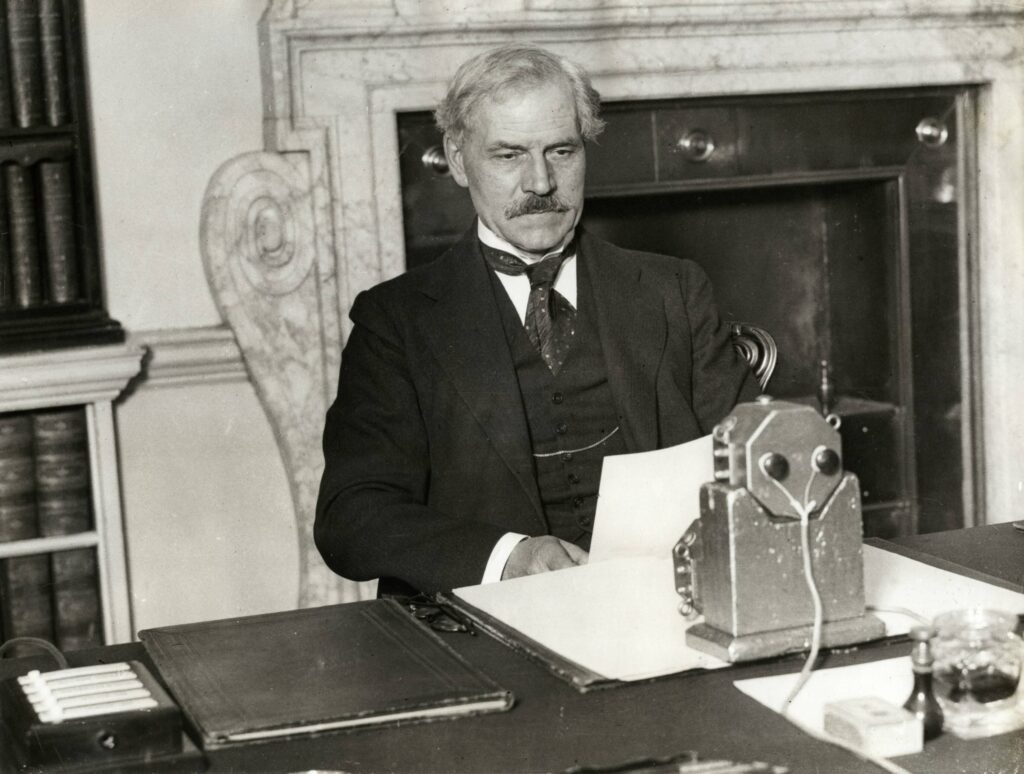
On 21 September 1931, the newly formed National Government, led by Ramsay MacDonald as prime minister, was forced to suspend the gold standard. Facing a run on the pound, the government rushed the Gold Standard (Amendment) Bill through all its parliamentary stages in a single day.
MacDonald’s second Labour government collapsed in August 1931 with the cabinet unable to agree a common position on the austerity measures recommended in the ‘May Report’. With the government paralysed, MacDonald travelled to Buckingham Palace on 24 August to tender his resignation to King George V. But MacDonald, at the urging of George V, formed the National Government with Conservatives and Liberals. This effective defection resulted in his expulsion from the Labour Party and his enduring vilification as a traitor.
Against the backdrop of the Great Depression, MacDonald’s National Government was initially formed as a temporary measure to balance the budget and defend the gold standard.
Under the standard, the Bank of England was required to exchange sterling for gold at a fixed rate. Proponents argued it ensured price stability and solidified international trade. Britain had returned to the gold standard in 1925 during Winston Churchill’s tenure as chancellor, with sterling fixed at its pre-war parity of $4.86.
***
Philip Snowden, chancellor in the National Government, introduced an emergency budget on 10 September 1931. He immediately instituted a round of cuts in public spending and wages – true to the recommendations of the May report. Public sector wages and unemployment pay were cut by 10%, and income tax was raised from 22.5% to 25%.
On 15 September, 1,000 sailors in the Royal Navy at Invergordon mutinied in opposition to the pay cuts. News of the non-violent protest effectively destroyed the last vestiges of international confidence in sterling, triggering a run on the pound.
Private investors and central banks the world over converted their sterling into gold. In total, over £200 million in gold and foreign exchange left the Bank of England in the two months that led to Britain’s suspension of the gold standard. On the day before the suspension was announced, outflows reached nearly £18 million.
On 20 September, the government announced that it would abandon the gold standard.
The Treasury press notice read: “His Majesty’s government have decided after consultation with the Bank of England that it has become necessary to suspend for the time being the operation of Subsection (2) of Section 1 of the Gold Standard Act of 1925 which requires the Bank to sell gold at a fixed price.”
It added: “His Majesty’s government are well aware that the present step is bound to have serious consequences both at home and abroad.
“But during the last few days the International financial markets have become demoralised and seem bent on liquidating their foreign assets in a spirit of panic. In the circumstances there was no alternative but to protect the economy of this country by the only means at our disposal.”
The following day, parliament convened to debate the Gold Standard (Amendment) Bill. Introducing the emergency legislation, Snowden accused his former party, the Labour opposition, of undermining confidence in Britain’s finances.
He claimed that the formation of the National Government had “the immediate effect of restoring confidence”.
The chancellor continued: “Unfortunately, however, we could not present a united front. Speeches were made and articles were written by prominent people advocating inflation and repudiation, which had a most damaging effect.
“There was political uncertainty, and the news of the unrest that occurred in the Navy was recorded in scare headlines in every foreign newspaper.
“At the same time, in the general atmosphere of nervousness, difficulties developed in foreign countries, and people began to scramble to liquidate their positions. This was as much due to nervousness about their own position as to a loss of faith in sterling.”
He insisted that the government had been forced to suspend the gold standard “by reason of an exchange crisis and not because of any disorder in our own internal finances.”
Snowden concluded by appealing to MPs “not to use words at this moment which will make things more difficult… it is the duty of everyone to keep cool and not to aggravate the situation by panic.”
He added: “If we do this, our inherent strength will pull us through these temporary difficulties.”
The Labour opposition, led by former foreign secretary Arthur Henderson, felt vindicated by the development. Appointed Labour leader after MacDonald’s apostasy, Henderson referred to the recent budget. He posited that the National Government’s economic programme had “failed in the object they had in view.”
He argued that if the government was genuine about a “united front” then the “programme upon which the government set out… should be withdrawn”.
Nonetheless, Henderson indicated that his Labour party would not oppose the bill. And the Gold Standard (Amendment) Act secured royal assent that same day.
As a result, the pound fell sharply on foreign exchanges, depreciating from $4.86 to around $3.69 by December 1931. The depreciation made British exports significantly more competitive, boosting industries including textiles, coal and shipbuilding.
With monetary policy now liberated, the bank rate came down from 6% to 2% in 1932.
John Maynard Keynes, the seminal economist, observed: “There are few Englishmen who do not rejoice at the breaking of our gold fetters. We feel that we have at last a free hand to do what is sensible.
“The romantic phase is over, and we can begin to discuss realistically what policy is for the best.”
The New York Times reported from across the pond: “In August it seemed incredible, indeed almost disgraceful, that Britain’s currency should be in danger of slipping from its gold parity; by October the abandonment of the gold standard appeared eminently reasonable, if not an act of virtue.”
The (permanent) suspension of the Gold Standard in 1931 is widely regarded as an important factor in Britain’s recovery from the Great Depression. The catastrophic consequences predicted by some contemporaneous analysts did not materialise.
Dozens of other countries abandoned the gold standard in the months that followed.
***
MacDonald was subsequently persuaded by his National Government colleagues to call a general election. Campaigning for a so-called ‘Doctor’s mandate’ to rescue Britain through the Great Depression, the October 1931 election produced a crushing landslide victory for the National Government.
The coalition captured two-thirds of the votes cast and won 554 (90.1%) of the 615 available commons seats.
MacDonald, Britain’s first Labour prime minister, witnessed the near-total collapse of the party he had brought to power. Henderson was among more than 200 Labour MPs who lost their seats.
The National Government, dominated by the Conservative Party, continued in various forms until the outbreak of war in 1939.
MacDonald served as prime minister until June 1935, when he was succeeded by Stanley Baldwin. The pair swapped roles and MacDonald, suffering from ill health, became commons leader.

Politics.co.uk Newsletters
DAILY
Politics@Lunch
WEEKLY
Week in Review