Minister offers resignation for lateness in House of Lords
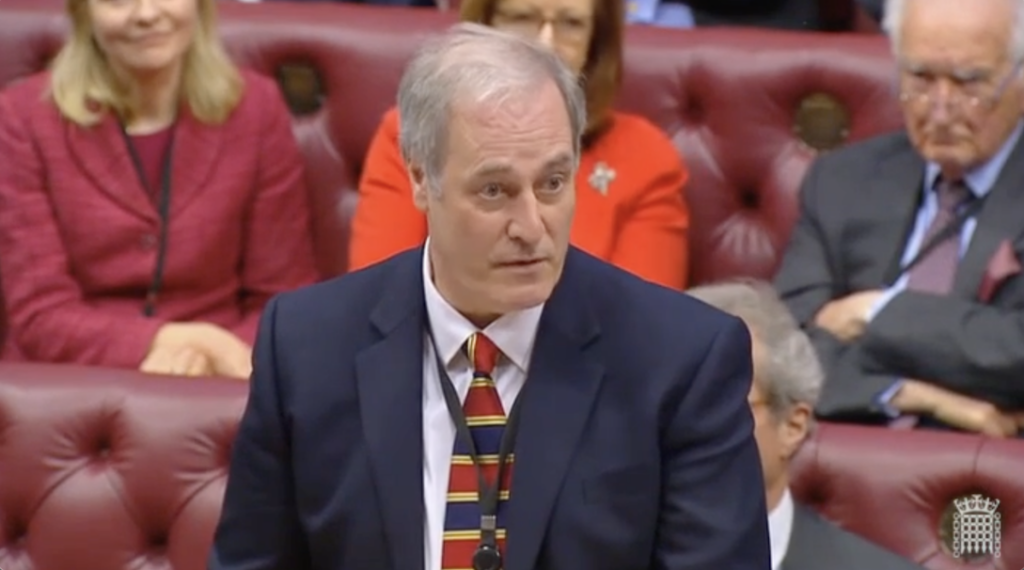
On 31 January 2018, Lord Bates attempted to resign as minister of state for international development for the “discourtesy” of arriving late to answer an oral question in the House of Lords. The resignation, which Bates announced at the government’s dispatch box in the upper chamber, was later refused by Theresa May as prime minister.
***
Oral questions in the House of Lords were scheduled to begin at 3:00 pm. Labour peer Baroness Lister was called to ask the first question of the session, directed to the Department for International Development, regarding the government’s policy on income inequality.
Lord Bates, the relevant minister of state, was not in his place. In his absence, the government’s response was provided by the chief whip in the upper chamber, Lord Taylor. The senior peer was said to have been “caught off guard” by his sudden responsibility.
It was reported that Lord Bates, a former Conservative MP, had himself been caught out by a change in the daily schedule; the usual prayers at the beginning of proceedings had been held earlier on the morning of 31 January. Bates arrived in the chamber approximately one minute after the question had been asked.
At the conclusion of oral questions, Bates rose to make a personal statement. He offered his “sincere apologies” to Baroness Lister “for my discourtesy in not being in my place to answer her question on a very important matter at the beginning of questions.”
He added: “I am thoroughly ashamed at not having been in my place, and therefore I shall be offering my resignation to the prime minister with immediate effect.”
Bates then tucked his ministerial papers under his arm and promptly walked out of the chamber. His departure was met with audible gasps and spontaneous cries of “No!” from peers on all sides of the House.
Some peers literally reached out in a futile effort to pull Bates back to the dispatch box.
Baroness Smith of Basildon, the leader of the opposition in the Lords, immediately rose to insist that an apology was “perfectly sufficient”.
She added: “It was a minor discourtesy, of which any of us can be guilty on occasion.”
Lord Hague, the former Conservative leader and cabinet minister, expressed his hope that Bates would rescind his resignation. “I hope my noble friend Lord Bates, who has given 20 years of strong public service, will resume his place on the frontbench”, Hague said.
Lister later referred to Bates as “one of the most courteous of ministers”, telling the Guardian: “Of all the ministers I’d want to cause to resign, he’d be the last.”
***
Within hours of the incident, a spokesperson for 10 Downing Street confirmed that the prime minister had refused to accept the resignation.
The spokesperson described Bates as a “hard-working and diligent minister”.
They said: “With typical sincerity, Lord Bates today offered to tender his resignation, but his resignation was refused as it was judged this was unnecessary.
“As a hard-working and diligent minister, it is typical of his approach that he takes his responsibilities to parliament so seriously.
“He has received support from across the House and we are pleased he has decided to continue in his important roles at the Department for International Development and HM Treasury.”
Lord Bates remained in his post for over a year following the 2018 incident. He successfully resigned from the government in April 2019.
In an article for the House magazine, published on 24 April 2019, Bates cited the “toxic” nature of the political discourse surrounding Brexit – as opposed to any minor procedural discourtesy.
He wrote: “In recent months it has become clear to me that the greatest problem facing this country is not how and when we leave the European Union, but rather how we heal the divisions which have opened as a result of that process…
“There is an aggressiveness, intolerance and incivility which has emerged in our public discourse which is doing our country immense long-term harm.”
Bates pointed to his decision to walk over 8,000 miles across twenty-five countries to promote peace and reconciliation.
He added: “Over the past eight years we have walked over 8,000 miles in twenty-five countries promoting peace and reconciliation, including from London to Derry in 2013 when we finished at the Peace Bridge across the Foyle connecting the previously divided communities of that great city.
“That is why I have taken the decision to step down from my role in government and step out on a walk.
“To listen and to think for ourselves how there might be a process of coming together and rebuilding that unity of purpose at home and close friendships abroad.”

Politics.co.uk Newsletters
DAILY
Politics@Lunch
WEEKLY
Week in Review