May fails to assert authority in ‘night of the blunt stiletto’ reshuffle
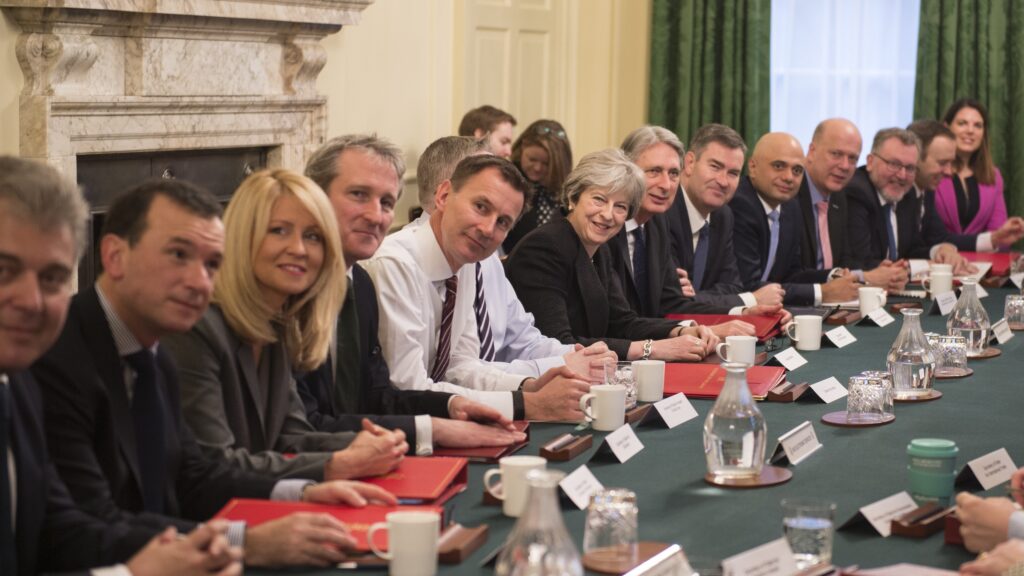
On 8 January 2018, prime minister Theresa May attempted a cabinet reshuffle intended to reassert her ailing authority and refresh her frontbench. However, the reshuffle rapidly degenerated into a political farce, with senior ministers stubbornly refusing to move.
***
The 2017 general election produced a hung parliament and a minority Conservative government, dependent on a confidence and supply agreement with the Democratic Unionist Party (DUP). May was severely weakened by her decision to call the snap election and the disastrous campaign that followed.
The reshuffle was framed as an attempt by May to build back political capital after a bruising year. A ministerial rejig had been anticipated at least since December 2017, when Damian Green, a key ally of the prime minister, resigned as first secretary of state.
The day of 8 January 2018 began chaotically when the Conservative Party’s official Twitter (now X) account announced Chris Grayling as the new party chairman. The post was hastily deleted, with Brandon Lewis later announced as Tory chair and “minister without porfolio [sic]”.
https://x.com/RupaHuq/status/950358073616482304/photo/1
The health secretary, Jeremy Hunt, was then called to Downing Street, reportedly to be shifted to the Department for Business, Energy and Industrial Strategy (BEIS). He refused to accept the new brief and, after a lengthy meeting, successfully negotiated to remain in his post with an expanded remit.
Hunt emerged from No 10 Downing Street as secretary of state for health and social care.
Justine Greening, the education secretary, was told she would be shuffled into the Department for Work and Pensions. But Greening chose to resign from the government rather than take up the role.
She posted to Twitter: “Honour and privilege to serve in government since 2010. Social mobility matters to me and our country more than my ministerial career. I’ll continue to do everything I can to create a country that has equality of opportunity for young people”.
The comments were interpreted as criticism of May’s grammar schools policy.
Greening’s treatment, especially when compared to that of Jeremy Hunt, was met with cross-party criticism. Hunt later apologised for liking a Twitter post about Greening’s sacking, saying: “Like button pressed by accident”.
https://x.com/wikiguido/status/950460518434856961
Damian Hinds was Greening’s replacement as education secretary. Esther McVey secured the work and pensions brief.
Matt Hancock was promoted to the cabinet as culture secretary.
David Gauke, Karen Bradley and David Lidington were all shuffled sideways – to the positions of justice secretary, Northern Ireland secretary and chancellor of the Duchy of Lancaster respectively.
***
After all was said and done, 20 of May’s 29 cabinet attendees held effectively the same portfolio as before.
Significantly, the most senior ‘great offices of state’ remained unchanged. Philip Hammond (chancellor) and Amber Rudd (home secretary) kept their seat at the cabinet table. Boris Johnson stayed on as foreign secretary despite his well-evidenced proclivity for embarrassing gaffes and diplomatic faux pas.
David Davis, notwithstanding reports of internal friction, survived as secretary of state for exiting the European Union (Brexit secretary).
In the end, May showed that she was in far too weak a position politically to risk upsetting the cabinet’s fragile Brexit balance. The episode was dubbed the “night of the blunt stiletto” – a reference to a far more ruthless and wide-ranging reshuffle.
In July 1962, the prime minister, Harold Macmillan, carried out what is often cited as the most brutal cabinet reshuffle in modern British political history, sacking seven senior ministers – a third of his cabinet – in a single day. The purge is today known as the ‘Night of the Long Knives’.
Nicholas Soames, the veteran Conservative MP, responded to May’s reshuffle with the observation: “Is that it?”
Some commentators referred back to May’s widely mocked statement during the 2017 election campaign, delivered after modifying plans for social care (the so-called dementia tax), that “nothing has changed.”
In an Evening Standard editorial, published 9 January 2018, former chancellor George Osborne described Theresa May’s botched reshuffle as the “worst in modern history”.
Osborne wrote: “You have to hand it to this prime minister: she’s given us the hat-trick of the worst reshuffle, the worst party conference speech and the worst manifesto in modern history. If they were not facing one of the worst oppositions we’ve ever had, the Tories would be finished.
“As it is, because the Corbynista alternative is so unpalatable to many mainstream voters, there is still hope…
“Still unresolved is the big issue of the premiership itself: the Conservative Party assumes Mrs May will go at some point; Mrs May, as she made clear on Sunday, intends to stay. How that biggest of all potential reshuffles is resolved remains unclear.
“This week’s farce will not have dampened the speculation or expectation in Westminster.”
***
May’s reshuffle, intended to demonstrate strength, thus reinforced the perception of a weakened prime minister unable to impose her will. This narrative would crystallise over the remaining months of May’s premiership as she tried and failed to pass her Brexit deal through parliament.
Both David Davis and Boris Johnson would resign from the cabinet in July 2018 in protest at the government’s Brexit strategy.

Politics.co.uk Newsletters
DAILY
Politics@Lunch
WEEKLY
Week in Review