May expels 23 Russian diplomats over Salisbury poisoning
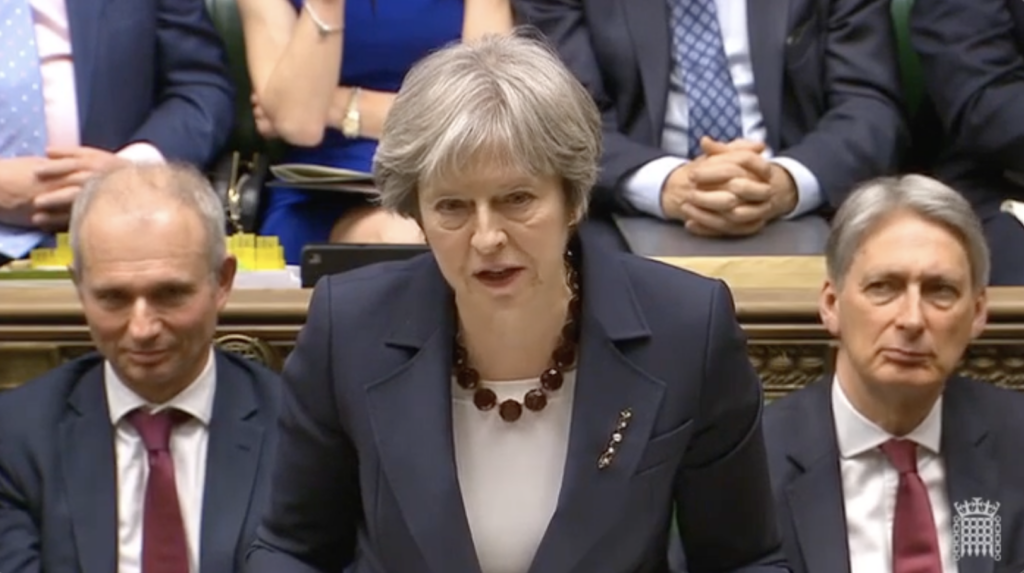
On 14 March 2018, the prime minister, Theresa May, announced a series of punitive measures against Russia in response to the attempted assassinations of the former Russian double agent Sergei Skripal, 66, and his daughter Yulia, 33, in Salisbury.
The announcement followed the expiry of a deadline the prime minister had set for Moscow to provide a credible explanation for the incident. At the time, the Skripals were critically ill in the hospital.
***
In a statement to the House of Commons, May declared that the Russian state was “culpable” for the attack, which was carried out using a Novichok military-grade nerve agent.
May told MPs that the Kremlin had responded with “sarcasm, contempt and defiance” to the deadline and went on to spell out a robust package of sanctions “to dismantle the Russian espionage network in the UK”.
May said: “There is no alternative conclusion other than the Russian state was responsible for the attempted murder of Mr Skripal and his daughter.”
The centrepiece was the expulsion of 23 Russian diplomats who had been identified as “undeclared intelligence officers”, the largest such expulsion from the United Kingdom in more than 30 years.
Further measures included the suspension of all high-level bilateral contacts and a boycott of the 2018 FIFA World Cup in Russia by government ministers and members of the royal family. The Foreign Office had previously called for an urgent meeting of the UN security council to update members on the UK’s investigation.
May declared: “We will not tolerate the threat to life of British people and others on British soil from the Russian government. Nor will we tolerate such a flagrant breach of Russia’s international obligations.
“We will freeze Russian state assets wherever we have evidence that they may be used to threaten the life or property of UK nationals or residents. There is no place for these people – or their money – in our country.”
The prime minister also pledged to introduce new government powers to counter hostile state activity, a crackdown on “corrupt elites” and to increase checks on private flights and freight. Some measures, May said, could “not be shared publicly for reasons of national security”.
***
In his response to May’s statement, Corbyn offered the government only equivocal backing.
The Labour leader’s spokesperson infamously cast aspersions on the evidence that had been presented, raising Iraq as the reason to be suspicious over intelligence presented to the public. They said the most likely explanation was Russia that was “directly or indirectly responsible” for the attack but “culpability takes many forms”.
A succession of Labour MPs pointedly expressed their fulsome support for the government’s response.
Pat McFadden, a former frontbencher, said showing resolve when your country was threatened was an “essential component of political leadership” and “more than words” was needed as a response.
The Russian embassy in London appeared to brush off the severity of the proposals, posting to Twitter (now X): “The temperature of Russia-UK relations drops to minus 23, but we are not afraid of cold weather.”
The UK’s response received strong international backing, leading to a co-ordinated expulsion of 143 Russian diplomats by the UK’s allies in the subsequent weeks.
In a statement issued on 14 March, Nato requested Russia provide “full and complete disclosure of the Novichok programme to the Organisation for the Prohibition of Chemical Weapons [OPCW]”.
Politics.co.uk Newsletters
DAILY
Politics@Lunch
WEEKLY
Week in Review