Theresa May defends ordering Syrian airstrikes without a vote
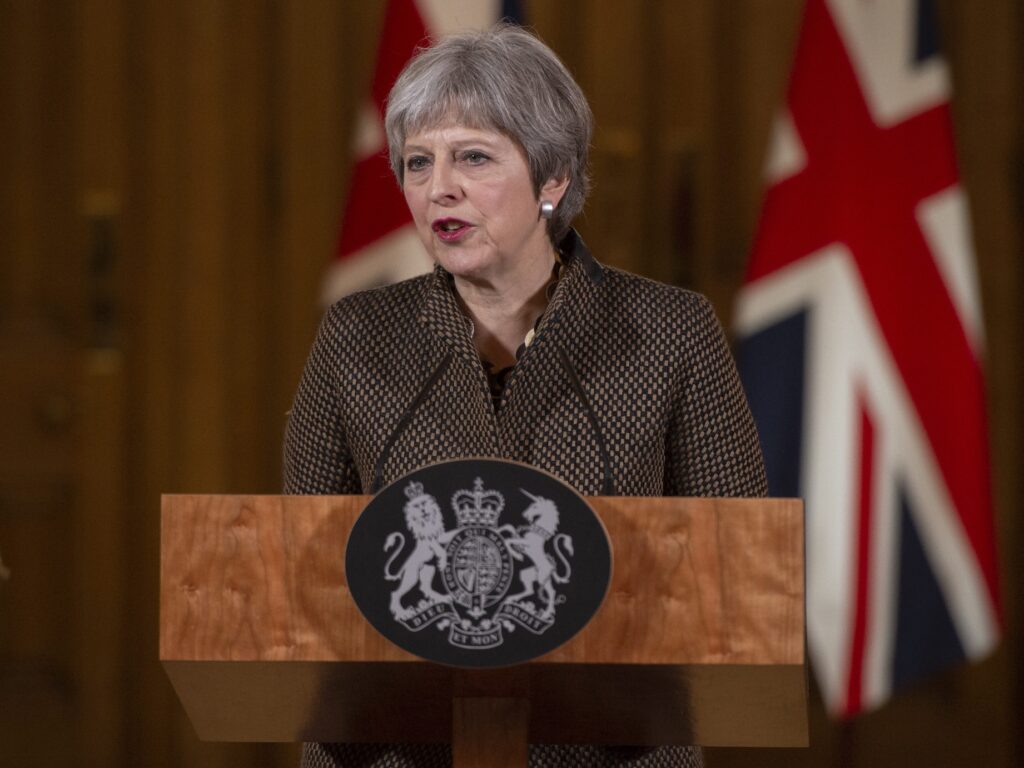
On 16 April 2018, the prime minister, Theresa May, faced MPs in the House of Commons to defend her decision to authorise military airstrikes against Syria without first seeking parliamentary consent. The action, taken in coordination with the United States and France, was a direct response to a suspected chemical weapons attack in the Syrian city of Douma on 7 April, which resulted in civilian casualties.
Two days earlier, on 14 April, four Royal Air Force Tornado jets had fired Storm Shadow missiles at a Syrian military facility near Homs, which was believed to be involved in the production of chemical weapons.
***
The decision to act without a parliamentary vote proved controversial, with opposition parties and some Conservative backbenchers arguing it ignored an emerging constitutional convention established since the 2003 Iraq War.
In her statement, May argued that the targeted strikes were “not just morally right but also legally right… to alleviate further humanitarian suffering.” She insisted the action was not “about intervening in a civil war”.
She added: “It was about a limited, targeted and effective strike that sought to alleviate the humanitarian suffering of the Syrian people by degrading the Syrian Regime’s chemical weapons capability and deterring their use.”
May went on to set out the “legal basis” for the action, which she said was composed of three conditions.
She told the House: “First, there must be convincing evidence, generally accepted by the international community as a whole, of extreme humanitarian distress on a large scale, requiring immediate and urgent relief.
“Second, it must be objectively clear that there is no practicable alternative to the use of force if lives are to be saved.
“And third, the proposed use of force must be necessary and proportionate to the aim of relief of humanitarian suffering and must be strictly limited in time and in scope to this aim.”
May repeatedly contended that seeking a vote would have involved the disclosure of sensitive intelligence, placing military operations at risk. She argued that the speed with which the government acted was “essential in co-operating with our partners to alleviate further humanitarian suffering and to maintain the vital security of our operations.”
May insisted that she, as prime minister, took a “decision that required the evaluation of intelligence and information, much of which was of a nature that could not be shared with parliament.”
The prime minister was plain in asserting her right to authorise military action – a royal prerogative power.
She told MPs: “It is parliament’s responsibility to hold me to account for such decisions, and parliament will do so. But it is my responsibility as prime minister to make these decisions – and I will make them”.
Corbyn, however, accused May of adhering to the “whims” of Donald Trump, the then US president.
The Labour leader declared: “This statement serves as a reminder that the prime minister is accountable to this parliament, not to the whims of the US president.”
Corbyn called for a “war powers Act in this country to transform a now broken convention into a legal obligation.” He contradicted May and claimed all “non-military means had not been exhausted”.
He added: “Her predecessor [David Cameron] came to this House to seek authority for military action in Libya, and in Syria in 2015, and the House had a vote on Iraq in 2003. There is no more serious issue than the life-and-death matters of military action.”
May took questions for nearly three hours in the chamber, defending her decision not to seek parliamentary approval.
Mike Gapes, the Labour MP for Ilford North, defended the prime minister’s action and criticised Corbyn. He referenced a “long-standing and noble tradition on these benches of supporting humanitarian intervention and the responsibility to protect.”
***
Later on 16 April, the government won a symbolic vote on whether the House had sufficiently debated the matter of Syria by 314 to 36 votes – a majority of 278. That division came following an emergency debate forced by the Scottish National Party (SNP).
The following day, 17 April, MPs considered the principle of parliament’s right to approve military action in a debate led by Corbyn as leader of the opposition.
Upon returning to the chamber, May set out her belief that the action taken did not fall within the remit of the convention on securing parliamentary approval for military action.
She argued that “there are situations – not least major deployments like the Iraq war – when the scale of the military build-up requires the movement of military assets over weeks, and when it is absolutely right and appropriate for parliament to debate military action in advance”.
But she maintained that this did not “mean that that is always appropriate.”
She added: “This therefore cannot and should not be codified into a parliamentary right to debate every possible overseas mission in advance.”
May set out “four fundamental reasons” why the strikes did not fall within the remit of the convention: effectiveness, and not wanting to compromise the safety of armed forces personnel; protecting intelligence; the imperative to work closely with allies and keeping allied plans secret; and an existing legal basis for the intervention, that of humanitarian emergency.
She asserted: “So it was right for me, as prime minister — with the full support of the cabinet, and drawing on the advice of security and military officials — to take the decision on this military strike last weekend, and for parliament to be able to hold me to account for it.”
May’s actions ultimately cast some doubt on the shape of the convention that had developed since 2003. Her decision to pursue military intervention without parliamentary approval appeared to rely on possible exceptions to the convention, allowing for the government to act at speed.
In a written statement issued in 2016, the defence secretary, Michael Fallon, declared: “In observing the convention, we must ensure that the ability of our armed forces to act quickly and decisively, and to maintain the security of their operations, is not compromised.”
May explicitly cited this statement during her appearance before the commons on 16 April.

Politics.co.uk Newsletters
DAILY
Politics@Lunch
WEEKLY
Week in Review
