John Major succeeds Thatcher as prime minister
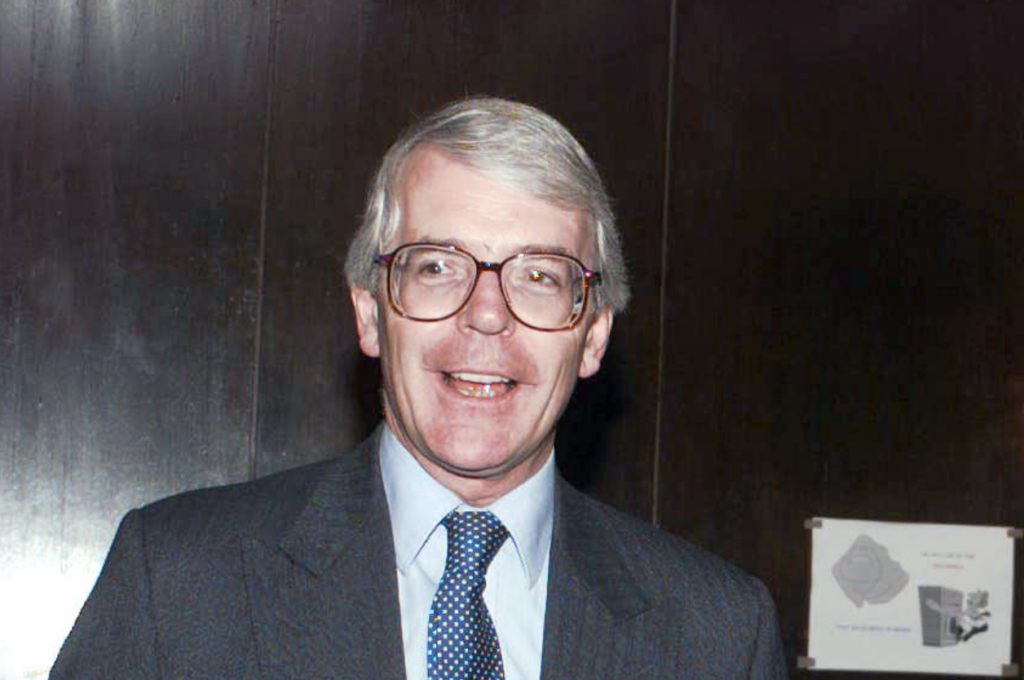
On 27 November 1990, John Major was declared the new leader of the Conservative Party and the next prime minister, following the dramatic resignation of Margaret Thatcher. Major, who had served as chancellor of the exchequer for just over a year, defeated Michael Heseltine and Douglas Hurd in the second ballot of Conservative MPs.
Major secured 185 votes – two short of an outright majority. But his commanding lead over Heseltine (131) and Hurd (56) prompted both rivals to withdraw.
***
Major’s remarkable rise to prominence was a consequence of the rolling crises that afflicted Thatcher in 1989/1990. He was appointed as foreign secretary in July 1989, succeeding Geoffrey Howe. Thatcher chose to demote Howe, with whom she disagreed on European integration, to the post of commons leader.
Major was then appointed as chancellor of the exchequer on 26 October, replacing Nigel Lawson. The outgoing chancellor resigned over the influence of Alan Walters, Thatcher’s personal economic adviser. Walters – unlike Howe and Lawson – opposed Britain’s entry into the Exchange Rate Mechanism (ERM).
From 1987 to 1989, Major served as chief secretary to the Treasury.
Major, seen as a rising star in the party, entered the 1990 Conservative leadership race after Thatcher failed to win the first ballot outright on 20 November. Heseltine had triggered the contest in the wake of Geoffrey Howe’s scathing resignation speech on 13 November.
Thatcher, who was attending a summit in Paris, secured 204 votes (54.8%) to Heseltine’s 152 (40.9%) in the first round. Under the Conservative Party’s leadership contest rules, a candidate required a majority of 15% of the total electorate to win outright. Thatcher’s majority was 52 votes; she needed 56.
Major, the chancellor of the exchequer, and Hurd, the home secretary, declared their candidacies for the Tory leadership mere hours after Thatcher announced her resignation as prime minister. Both cabinet ministers were both seen as eligible candidates to stop Heseltine, a long-standing critic of the outgoing prime minister.
In a joint statement, Major and Hurd said: “We have decided to let both our names go forward in friendly contest so that our party colleagues who take the decision can choose which of us is better placed to unite the party.”
Major worked to position himself as a unity candidate. His campaign, managed by Norman Lamont, successfully mobilised support from ‘dries’ on the Thatcherite right – who viewed him as the best-placed candidate to stop Heseltine – as well as from some ‘wets’ who welcomed his pledge to review the deeply unpopular poll tax.
Heseltine was identified as the candidate who, as prime minister, would deliver the most definitive break with Thatcherism. He drew support from Geoffrey Howe and Nigel Lawson, whose resignations had badly damaged Thatcher – as well as from long-standing Tory wets, including Jim Prior and Norman St John-Stevas.
Major, who grew up in a rented apartment in Brixton and did not attend university, emphasised his background as symbolising a meritocratic conservatism. Heseltine, a multi-millionaire, and Hurd, an Old Etonian, were seen as weaker candidates in this regard.
***
In the end, Heseltine – he who wielded the knife – was denied the crown.
Following his victory, Major was formally invited by Queen Elizabeth II to form a government on 28 November 1990. Major, aged 47, became the youngest prime minister since the Earl of Rosebery in 1894.
Speaking on Downing Street shortly after the results were announced on 27 November, Major paid tribute to Hurd and Heseltine “for the way they conducted the election”.
He added: “It is a very exciting thing to become leader of the Conservative Party and particularly exciting I think, to follow one of the most remarkable leaders that the Conservative Party has ever had.
“I believe as time proceeds and Margaret Thatcher’s period as prime minister is seen in a proper perspective, it will be seen that she has been a very great prime minister indeed.”
Major said the Conservative Party would now “unite” and “win the next general election”.
Thatcher said she wanted “everyone in the party to rally behind [Major]”.
Major immediately set out to unite the Conservative Party, which had so ruthlessly ousted his predecessor. He appointed Heseltine to his cabinet; as environment secretary, Heseltine was tasked with dismantling the poll tax. Hurd emerged as foreign secretary.
Lamont, Major’s campaign manager, was made chancellor of the exchequer.
Major’s initial period in office was marked by a restoration of cabinet government and rising public support – reinforced by the successful conclusion of the Gulf War in 1991 and the negotiation of the Maastricht Treaty.
Against the expectations of most pollsters, Major led the Conservatives to a fourth consecutive general election victory in April 1992. The party won a majority of 21 seats and secured over 14 million votes – the highest popular vote in British history.
Major’s standing, however, was soon severely damaged by “Black Wednesday” in September 1992, which forced Britain out of the ERM. The leading political casualty of the currency crisis was the Conservative Party’s reputation for economic competence.
The latter years of Major’s premiership were plagued by internal warfare over Europe, particularly the ratification of the Maastricht Treaty, as well as a series of ‘Tory sleaze’ scandals.
The nature of Major’s accession, whereby he symbolised continuity to some Conservative MPs and change to others, was arguably unstable. From 1990 to 1997, Thatcher – who resented those who produced her political downfall – continued to make political interventions. Her reported remark that she would prove a “very good back-seat driver” was prescient in this respect.
Major later remarked of his predecessor: “I found Margaret’s behaviour very puzzling… she seemed to be actively persuading new and relatively impressionable MPs to vote against the government on policy issues.
“And many of her speeches abroad trickled back here with what could only have been construed as criticism of the government policy… She was, if not actively encouraging, certainly looking in a very sunny fashion upon James Goldsmith [founder of the Referendum Party].”
Major added: “In retrospect, I can now say, I think her behaviour was intolerable. And I hope none of my successors are ever treated that way by their predecessors, or indeed by anyone else.”
Major’s government was eventually swept from power in the 1997 general election. Tony Blair, elected Labour leader in 1994, led his party – restyled as ‘New Labour’ – to a landslide victory.
Major immediately resigned as party leader and was succeeded by William Hague. He stood down from parliament at the 2001 general election.

Politics.co.uk Newsletters
DAILY
Politics@Lunch
WEEKLY
Week in Review
