New legislation grants women right to stand for parliament
The Parliament (Qualification of Women) Act 1918 received royal assent on 21 November 1918, establishing the right of women to stand for election to the House of Commons. The legislation, which remains the shortest statute in the UK statute book at just 27 operative words, was rushed through parliament in the final weeks of the First World War to ensure women could be candidates in the general election scheduled for December 1918.
The act was a legislative corrective to the earlier Representation of the People Act 1918, which extended the parliamentary franchise to women, granting the vote to those aged 30 and who were either: a property owner, a graduate voting in a university constituency, a member or married to a member of the local government register (which lists who can vote in local elections).
The Representation of the People Act, which received royal assent on 6 February, enfranchised approximately 8.4 million women. It did not, however, address the right of women to hold office.
This position was formally established when Nina Boyle, a suffragette and member of the Women’s Freedom League (WFL), attempted to stand in a by-election for the constituency of Keighley. The law lords, asked to consider the matter, held that the Great Reform Act 1832 expressly excluded women from standing for parliament, and that nothing in the Representation of the People Act 1918 altered that position.
The coalition government led by David Lloyd George as prime minister moved to clarify the law in time for the 1918 general election.
The proposed legislation simply stated that a woman “shall not be disqualified by sex or marriage for being elected to or sitting or voting as a Member of the Commons House of Parliament.”
***
The bill received its commons second reading on 4 November 1918. Curiously, it was sponsored by the Foreign Office, represented by Lord Robert Cecil, who joked that this was because his department was “the most enlightened office in the state.”
He added: “Beyond that I do not know that there is any special reason which connects it with the measure, though perhaps the leader of the House asked me to take charge of it because I had taken a great interest in the subject from the first.”
On this same theme, Liberal MP Charles Henry questioned whether there had been “some secret diplomacy between our allies or something in the contemplated League of Nations to the effect that women shall be admitted to the different senates and houses of deputies in the allied countries.”
He added: “That the minister of blockade should be responsible for this Bill is rather astounding, for this is not a bill for blockade, but rather for entry.”
The debate also highlighted a constitutional anomaly created by the bill – that while women could not vote until the age of 30, the new act allowed them to stand for parliament at the age of 21. During the bill’s commons committee stage on 6 November, Henry moved an amendment to align the age of candidacy with the voting age of 30. He argued it was illogical to give women “legislative functions when they have not the franchise.”
He also argued that if women of 21 were allowed to sit in the House, MPs would seize on this anomaly and produce a “bill to reduce the age qualification from 30 to 21.”
Cecil rejected the amendment, arguing that the right to vote and the right to be elected were distinct. He said that “no one would seriously suggest that a woman of 25 is less capable of giving a vote than a woman of 35.”
Henry responded by withdrawing his amendment.
Opposition to the bill was limited but colourful.
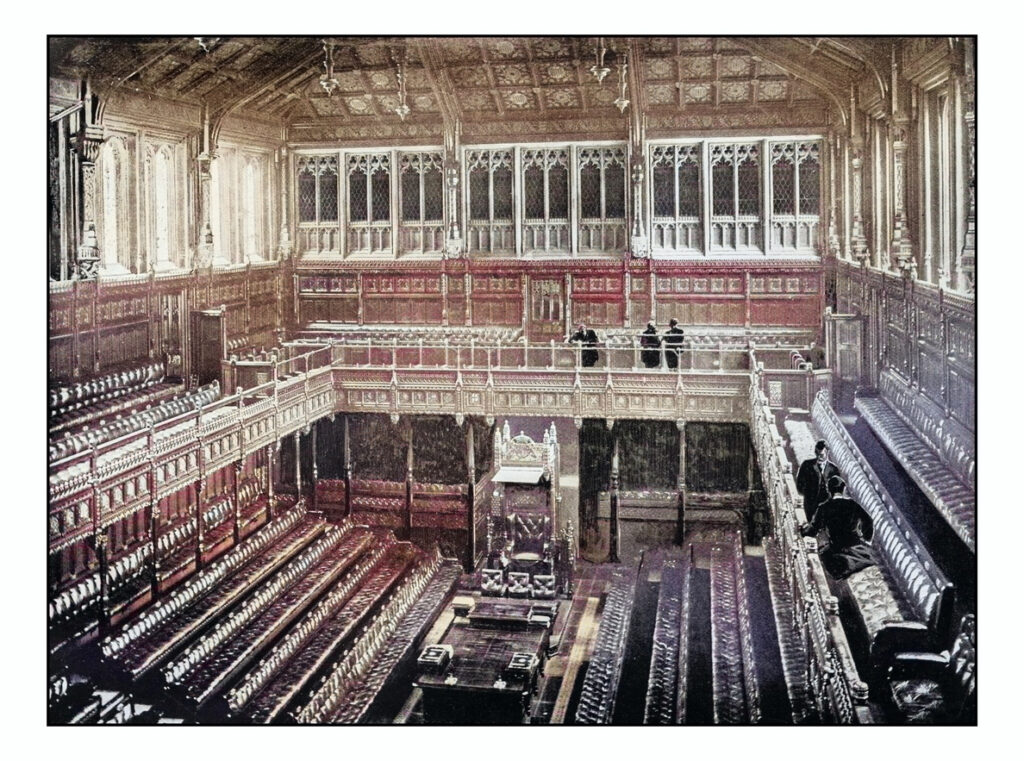
Conservative MP Hedworth Meux, a former admiral of the Fleet, addressed the House at second reading. He claimed that the House was unsuitable for women because it was too crowded, with members “packed on the benches like herrings”. He asked whether ministers had “taken any steps to enlarge this House” to accommodate women.
Meux also called on Cecil to “explain what class of women he wants” in the chamber. “He certainly does not want the noblest class of women, the women who are producing children”, Meux stated.
He continued: “We want as many children in this country as we can get? Why was Belgium destroyed? Why was Serbia overrun? Because there were not enough men to resist the invaders.
“Therefore, that class of women – and the ambition of every right-minded woman when she is married is to produce a beautiful child, a boy more beautiful than her husband or a girl more beautiful than herself – cannot possibly come into this House.”
Meux went on to warn of the prospect of women becoming ministers.
He told the House: “Suppose you have a female prime minister, and suppose she is in a state which every woman who loves her husband ought to be, what is going to happen?”
Meux said that if there were to be women in the House, he hoped “to see the really nice ones, women around whom we shall see members swarming like bees, women something of the noble character of the charming heroines of whom we read, like Rosalind, Imogene, or Portia.”
He concluded by quoting Alexander Pope: “Who dares think one thing, and another tell, My heart detests him as the gates of hell.”
Cecil responded that Meux had delivered a speech “of the kind with which the House is becoming, perhaps, rather too familiar”. The minister said he would not pretend that Meux had “presented any serious argument on the subject”.
Conservative MP Henry Terrell argued that the parliament has “exhausted” its mandate, which concerned the “prosecution of the war” – and did not include such a “grave constitutional change in our government”.
John Hills, also a Conservative MP, expressed his support for the bill, but called on the government to remove all professional disqualifications on women. He said that the bill removed “one disqualification, but there are many more which call for removal, such as their disqualification for acting as solicitors.”
The speaker promptly ruled Hills’ intervention out of order.
Charles Hobhouse, a Liberal anti-suffragist, conceded that the right of women to sit in the commons was “logical” and “could not be denied” in the wake of the Representation of the People Act 1918. But he reiterated his objection that public service would draw the “most gifted” women away from their “primary obligation and duty… the creation, management, and control of the home”.
Liberal MP Hamar Greenwood responded by condemning this “unreasonable view of the capacity of womanhood in this country”.
He stated his belief that “those women who shine most as wives and mothers are likely to be the most effective as administrators and legislators if the opportunity is given them.”
He added: “I protest against the idea that there is anything unwomanly or unmatronly in a woman doing her share in carrying on the affairs of a democratic country.”
***
The bill faced further challenge in the House of Lords.
On 12 November, Viscount Chaplin attempted to torpedo the bill by moving that it be read “this day six months”. He argued it was a “scrambling” piece of legislation introduced to parliament “at a period when the session is coming to a close.”
Chaplin contended that “women do not think, as a rule, that they ought” to serve as MPs.
Viscount Haldane, a longstanding proponent of women’s suffrage, said Chaplin had presented a “magnificent spectacle of one left high and dry upon the beach” – ignoring the “ocean” of public opinion stimulated by the war.
Haldane argued the war had “revolutionised” the debate. He said the conflict on the continent had “brought about a great change of opinion, and one of those changes which we cannot neglect, and which a wise Conservatism will prevent us from neglecting, is the new recognition of the status of women.”
Chaplin’s motion failed as fewer than 30 peers were present to vote.
Haldane returned to the Lords for the bill’s committee stage on 15 November. He moved an amendment to extend the right to sit to the House of Lords, which would have allowed peeresses in their own right to take their seats.
Haldane’s amendment stated that women should not be excluded from receiving a “writ of summons to the House of Lords or from sitting and voting in that House.”
The government opposed this, arguing it was beyond the scope of a bill designed for the commons and involved complex issues regarding royal writs of summons. Cecil had rejected a similar amendment in the commons, fearing that such a provision might “arouse a great deal of opposition” among peers, thereby imperilling the entire bill.
Haldane’s amendment was defeated by 33 votes to 14.
This decision created another constitutional anomaly: women could now sit in the commons, but hereditary female peers remained excluded from the Lords until the Peerage Act 1963, and life peers until 1958.
***
The Parliament (Qualification of Women) Act 1918 was passed in a matter of weeks, receiving royal assent on 21 November.
17 women stood as candidates in the general election held on 14 December 1918. These included the suffragette leader Christabel Pankhurst, who stood for the Women’s Party in Smethwick. She narrowly lost to the Labour candidate, John Davison, by 775 votes.
The only woman to win a seat in 1918 was Constance Markievicz, who was elected for the constituency of Dublin St Patrick’s while detained in Holloway Prison.
As a member of Sinn Féin, Markievicz adhered to her party’s abstentionist policy and refused to take her seat in Westminster. Instead, she sat in the First Dáil in Dublin.
Consequently, the distinction of being the first woman to take up her seat in the House of Commons fell to Nancy Astor (Viscountess Astor), who won the Plymouth Sutton by-election in November 1919, succeeding her husband.
Under the implied terms of the Parliament (Qualification of Women) Act, women also became eligible to serve as government ministers. The first woman to serve as a cabinet minister was Margaret Bondfield as minister of labour in Ramsay MacDonald’s second government (1929-31).
The Representation of the People (Equal Franchise) Act 1928, passed by Stanley Baldwin’s Conservative government, granted the vote to all women over the age of 21, rectifying one of the anomalies created in 1918.

Politics.co.uk Newsletters
DAILY
Politics@Lunch
WEEKLY
Week in Review