Woodrow Wilson and king toast ‘historic epoch’ in first ever presidential state visit
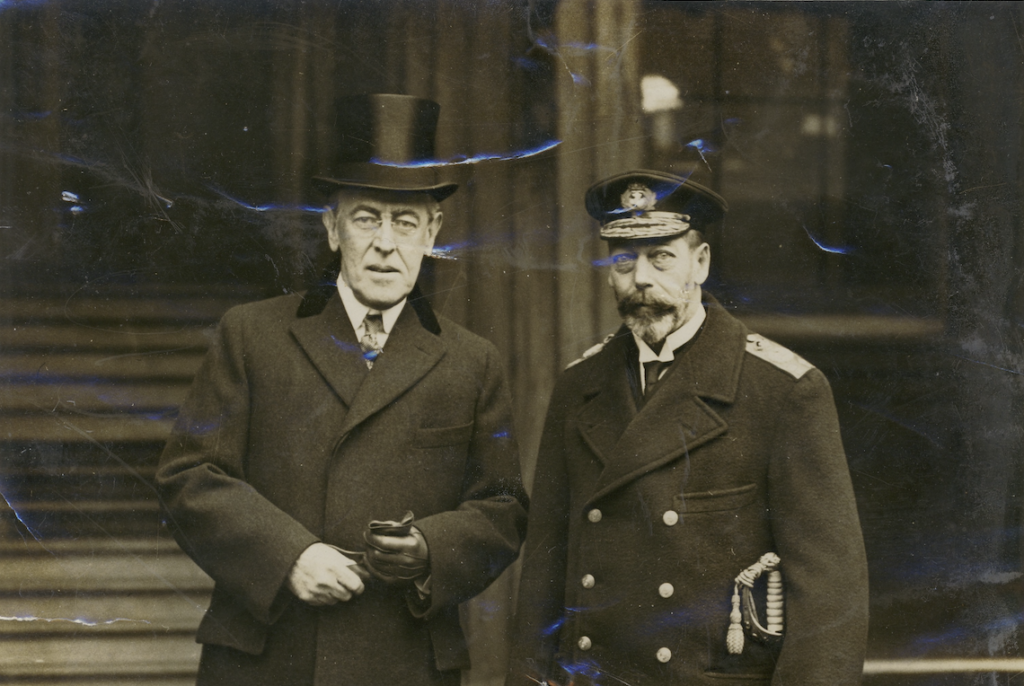
On 27 December 1918, US president Woodrow Wilson and the first lady, Edith Wilson, were the guests of honour at a state banquet at Buckingham Palace. The dinner marked the ceremonial summit of the first state visit to Britain by a sitting US president, held as the Allied Powers prepared to convene at the Paris Peace Conference following the end of the First World War.
It followed 24 hours of extensive diplomatic discussions with David Lloyd George, the British prime minister, and Arthur Balfour, the foreign secretary.
***
After nine days at sea aboard the SS George Washington, the presidential party arrived in France on Christmas day. Wilson, the first US president to visit the continent whilst in office, reviewed 10,000 American troops in a field in Chaumont. The US president confessed to being “all choked up” at the sight of veterans carrying their nation’s flag on foreign soil.
Wilson crossed to Britain on 26 December, arriving at Dover to a salute from the castle guns. In a brief speech, he described Britain and the United States as “comrades and associates”.
He said that the sea had been “kind to us this morning and gave us a very pleasant passage, so that it tallied perfectly with our expectations of the pleasure we should have in landing in England.”
He added: “We have come through many serious times together, and, therefore, can regard each other in a new light as comrades and associates, because nothing brings men together like a common understanding and a common purpose.”
Rose petals were then scattered at Wilson’s feet as he made his way to the train.
The presidential party arrived at Charing Cross station on Boxing Day; they were greeted on the platform by King George V, Queen Mary and all the members of the cabinet.
The band of the Grenadier Guards played the Star-Spangled Banner.
Lloyd George, in office since 1916, was described in the American press as “in origin far more a man of the people” than Wilson. At the time of Wilson’s visit, the British prime minister was riding a wave of domestic popularity as “the man who won the war”. On 28 December, the results of the 1918 general election confirmed a historic majority for Lloyd George’s Conservative-dominated coalition.
Wilson’s reception in London suggested that he, too, enjoyed considerable popularity with the British public. The royal and presidential procession, which passed through Trafalgar Square en route to Buckingham Palace, was witnessed by an estimated two million people. The Manchester Guardian reported that there had “not been such a show of colour or such genuine lightheartedness in the crowd since coronation days in the world before the war.”
Back in the United States, however, Wilson’s unprecedented decision to travel to Europe was highly controversial. The congressional elections in November 1918 had resulted in a series of Republican gains; both the House of Representatives and Senate were now in Republican control.
Outside Buckingham Palace, however, a crowd of some 20,000 waited for the president to appear on the balcony, chanting: “We want Wilson!”
Outside Buckingham Palace, with a 20,000-strong crowd waiting for the president to emerge from the balcony, onlookers chanted: “We want Wilson!”
One onlooker was reported to have asked: “Hasn’t the president drunk that cup of tea yet?”
When Wilson finally appeared on the palace balcony alongside the king and queen, Mary handed her guest a small Union Jack to wave. A witness noted that the US president waved his hat “with all the abandon of a schoolboy”
Addressing the crowd from the balcony, Wilson dedicated his remarks to those wounded soldiers among the crowd.
He spoke of how much he honoured those “men who have been wounded in this fight for freedom and to thank you all for the welcome you have so generously given me.”
He added: “I hope each and every one of you will come through safely to enjoy the fruits of the victory for which you so courageously fought.”
On 27 December, Wilson engaged in five hours of talks with Lloyd George and Balfour, first at the palace and later at 10 Downing Street. The working day was separated by a lunch, where the US president was joined by a “dozen leading British statesmen”, including Bonar Law, the chancellor, H.H. Asquith, the former prime minister, and Arthur Henderson, the former Labour cabinet minister.
It marked Asquith’s first visit to Downing Street since the Liberal leader was ousted by Lloyd George, his former chancellor, in 1916. William Adamson, the Labour leader, was reportedly invited but could not attend.
Lloyd George reportedly pointed to the surrounding portraits, which depicted Edmund Burke and Charles James Fox. He suggested that the room needed a picture of Pitt the Younger to “complete the group of men who opposed England’s policy in the Revolutionary War.”
The focus of the main discussions, conducted between Wilson, Lloyd George and Balfour, were the US president’s “Fourteen Points” – the principles he believed should shape the post-war peace settlement.
The primary source of friction, one can speculate from surrounding developments, was the British government’s opposition to Wilson’s doctrine of “freedom of the seas”.
Meanwhile, the US first lady, Edith Wilson, was entertained by the Countess of Reading. Also in attendance were Margaret Lloyd George and Margot Asquith. She later visited the American Women’s Club.
The Daily Chronicle reported: “No Queen could have a more queenly manner… Mrs. Wilson herself is the most picturesque expression of her husband’s ideal that it is character which counts.”
***
On the evening of 27 December, the presidential party and its hosts re-assembled for the state banquet. George V, who proposed a toast to the president, said his visit marked a “historic epoch”.
He declared: “Nearly 150 years have passed since your republic began its independent life, and now, for the first time, a president of the United States is our guest in England.”
George described his guest as “one whose insight, calmness, and dignity in the discharge of his high duties we have watched with admiration.”
He added: “We see in you the happy union of the gifts of a scholar with those of a statesman.”
The king said Wilson arrived as “spokesman of a mighty commonwealth bound to us by the closest ties.”
He continued: “Its people speak the tongue of Shakespeare and Milton… You share with us the traditions of free self-government as old as the Magna Carta [sic].”
George said it now fell to Britain and America to see how the “principles of popular self-government based upon equal laws… can be applied beyond our own borders for the good of the world.”
He concluded: “The British Nation wishes all success to the deliberations on which you and we and the great free nations allied with us are now to enter moved by disinterested good will and a sense of duty commensurate with the power which we hold as a solemn trust…
“I drink to the health of the president of the United States and Mrs Wilson and to the happiness and prosperity of the great American nation.”
In his reply, Wilson declared that “it would take more courage to resist the great moral tide now running in the world than to yield to it, than to obey it.”
He said: “There is a great tide running in the hearts of men. The hearts of men have never beaten so singularly in unison before.
“Men have never before been so conscious of their brotherhood.
“Men have never before realised how little difference there was between right and justice in one latitude and in another, under one sovereignty and under another.”
In closing, the US president said it would be the privilege of the Allied Powers “to steady the forces of mankind, and to make the right and the justice to which great nations like our own have devoted themselves the predominant and controlling force of the world.”
***
On 28 December, after two days of detailed discussions, Lloyd George suggested the two nations were in complete agreement on the general principles regarding the post-war peace settlement.
Addressing a large audience in Guildhall, Wilson said it had been “delightful in my conferences with the leaders of your government to find how our minds moved along exactly the same line.”
In his wide-ranging address, the US president articulated the principles that would guide his negotiations heading into the Paris Peace Conference. In particular, he sought to sell his plan for a “league of nations”, the fourteenth of his Fourteen Points.
He interpreted the rapturous reception he had received in the streets of London as the “voice of one people speaking to another.”
Wilson also referred to a “consciousness that the business is not yet done, the consciousness that it now rests upon others to see that those lives were not lost in vain”. He argued that the armies of the free nations had fought to destroy an “old order” defined by “that unstable thing which we used to call the ‘balance of power’”
The US president denigrated this old system as determined “by the sword which was thrown in the one side or the other” and the “unstable equilibrium of competitive interests”. It was maintained, he said, by “jealous watchfulness and an antagonism of interests”.
Wilson declared: “The men who have fought in this war have been the men from free nations who were determined that that sort of thing should end now and forever.”
In place of the old system, Wilson proposed a “single overwhelming, powerful group of nations who shall be the trustee of the peace of the world”. He maintained that the specific items of the peace treaty would be “worthless” unless backed by a “permanent concert of power for their maintenance.”
The US president claimed that “the practical leading minds of the world” were now determined to achieve such a league of nations.
By way of conclusion, Wilson directed a message to those in the United States who had criticised his decision to leave American territory while in office. “It was this incomparably great object [a league of nations] that brought me overseas”, he said.
He described it as his “paramount duty to turn away even from the imperative tasks at home to lend such counsel and aid as I could to this great, may I not say, final enterprise of humanity.”
***
Wilson travelled north on 29 December to Carlisle, the birthplace of his mother, Janet Woodrow.
The president described the visit as a “pilgrimage of the heart”.
He visited the site of the chapel on Annetwell Street where his grandfather, the Reverend Thomas Woodrow, had preached.
Finally, on 30 December, Wilson concluded his tour with an address at the Free Trade Hall in Manchester. He reiterated the principles that would guide his diplomacy in Paris.
The US president stated: “Interest does not bind men together. Interest separates men, for the moment there is the slightest departure from the nice adjustment of interests jealousies begin to spring up.
“There is only one thing that can bind peoples together and that is a common devotion to right.”
Wilson addressed the traditional American aversion to foreign entanglements. He said that the United States, from its very beginning, has felt “she must keep herself separate from any kind of connection with European politics”.
He added: “I want to say very frankly to you that she is not now interested in European politics. But she is interested in the partnership of right between America and Europe.
“If the future had nothing for us but a new attempt to keep the world at a right poise by a balance of power, the United States would take no interest, because she will join no combination of power which is not the combination of all of us.”
He called for an “easy and constant method of conference, so that troubles may be taken when they are little and not allowed to grow until they are big.”
Wilson concluded: “I wish that it were possible for us to do something like some of my very stern ancestors did, for among my ancestors are those very determined persons who were known as the Covenanters.
“I wish we could, not only for Great Britain and the United States, but for France and Italy and the world, enter into a great league and covenant, declaring ourselves, first of all, friends of mankind and uniting ourselves together for the maintenance and the triumph of right.”
During his appearance in Manchester, the US president received the freedom of the city.
Wilson then departed for Italy, where he met Pope Benedict XV at the Vatican, before arriving in France for the historic Paris Peace Conference.
The result of the negotiations in Paris, the Treaty of Versailles, placed the responsibility for the war on “the aggression of Germany and her allies” and imposed significant territorial, military and financial conditions on the defeated power. The League of Nations was established, but the United States never joined.
The post-war settlement was ultimately a far cry from the idealistic “peace between equals” Wilson had crossed the Atlantic to secure.
Instead, the treaty’s provisions sowed the seeds of resentment that would shape the political landscape in the 1920s and 30s.

Politics.co.uk Newsletters
DAILY
Politics@Lunch
WEEKLY
Week in Review