Levellers crushed by Cromwell after Banbury mutiny
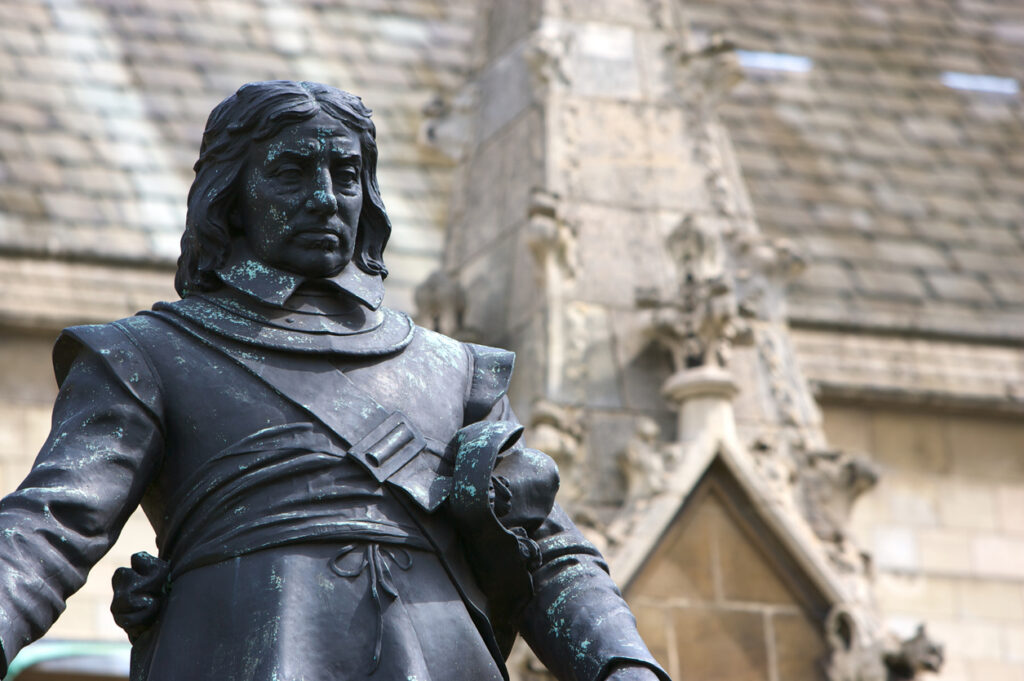
On the night of 14-15 May 1649, a mutiny by soldiers sympathetic to the Leveller movement was crushed by Oliver Cromwell and Sir Thomas Fairfax at Burford, Oxfordshire. The event consolidated the authority of senior officers in the army (the “grandees”) and effectively signalled the end of radical political influence within the New Model Army.
The Banbury mutiny of May 1649 was one of a series of collisions between the soldiers and the grandees in the wake of the First English Civil War.
The Levellers were a political movement that espoused the principles of popular sovereignty and equality before the law. These ideological demands were interwoven with practical grievances among the general soldiery, who pressed for greater internal representation, settlement of pay disputes and guarantees regarding their deployment for the conquest of Ireland.
In May 1649, the mutinying regiments included those commanded by colonels Scrope, Hewson, Harrison, Skippon, Ireton and Reynolds. Some, notably the troops of Colonel Adrian Scrope’s cavalry regiment, billeted in Salisbury, committed their claims to writing. The Resolutions of the Private Souldiery of Col. Scroops Regiment of Horse called for “Freedom, Peace, and Happiness [to be] Setled in the Nation” and demanded “Satisfaction” prior to the Irish expedition.
The soldiers also appealed to the Solemn Engagement of 1647, a compact agreed by army officers and troops alike, vowing “not to go out of the Land, nor suffer our selves to be divided or disbanded, upon any pretense whatsoever”.
***
Leveller doctrine was articulated most famously in the Agreement of the People manifestos. These tracts voiced support for expanded suffrage, equally proportioned electoral districts, freedom of conscience and the abolition of the House of Lords (unicameralism).
The most fully developed edition of the Agreement, issued on 1 May 1649, declared: “We the free People of England, to whom God hath given hearts, means and opportunity to effect the same… agree to ascertain our Government, to abolish all arbitrary Power, and to set bounds and limits both to our Supreme, and all Subordinate Authority, and remove all known Grievances.”
The modern-sounding May Agreement, the third of its kind, was styled as a written constitution for the new Commonwealth of England. It contained 30 clauses, which called for the right to vote for all men over the age of 21 (excepting servants, beggars and royalists); annual elections to parliament with one-term limits; equality of all persons before the law; trials to be heard before 12 jurymen freely chosen by their community; an end to imprisonment for debt; the death penalty to only be applied in cases of murder; and the abolition of military conscription, monopolies and excise taxes.
An early expression of army radicalism appeared in the Solemn Engagement, agreed at Newmarket and Thriplow Heath on 4-5 June 1647.
The Solemn Engagement took the form of a military covenant, delivered in defiance of parliament’s order to disband. Significantly, it came as a New Model Army troop re-arrested the king; this action, led by Cornet George Joyce of Thomas Fairfax’s cavalry regiment, represented a symbolic affront to parliament’s authority.
The Engagement was adopted at a general rendezvous. It vowed that the (increasingly unpaid) army would only disband or serve in the Irish conquest once it was guaranteed that the “free-borne people of England… shall not remaine subject to… oppression, injury or abuse”.
It also provided for the maintenance of the general council of the army to afford meaningful representation to the rank and file soldier. The council was composed of senior officers along with two commissioned officers and two private soldiers, or “agitators”, chosen by each regiment. The result was a form of army democracy and an official channel for troops to register their grievances with their “grandee” officers.
The Engagement laid the groundwork for a second statement: A Declaration or Representation from His Excellency Sir Thomas Fairfax, and the Army under His Command.
This declaration, an external manifesto that defined the army’s political demands, was presented to parliamentary commissioners on 14 June.
It famously insisted that the army was “not a meer mercenary Army hired to serve any Arbitrary power of a State, but called forth and conjured by the severall Declarations of Parliament, to the defence of our owne and the peoples just Rights and Liberties”.
The declaration added: “And we cannot but be sensible of the great complaints that have been made to us generally in the Kingdome from the people where we march, of Arbitrarinesse and Injustice, to their great and insupportable oppressions.”
***
These concerns were aired at the momentous Putney Debates, held for two weeks from 28 October 1647.
In a series of discussions at St. Mary’s Church, chaired by Cromwell and Fairfax, newly elected army agitators – referred to as the “new agents” – were invited to debate proposals for a new political settlement contained in their in their pamphlet, The Case of the Armie Truly Stated. (This opening salvo formed the basis of the first Agreement of the People.)
The Case of the Armie accused the grandees of breaking the Solemn Engagement by allowing the army to be divided and disbanded before the people’s rights were secure. It also observed that parliament was still filled with “Delinquents” (Royalist sympathisers) and “usurpers”.
The pamphlet called for a “law paramount” or constitution, which would be “unalterable by Parliaments”, regular elections and for the commons to be declared as the “supreame power” in the land.
The Case of the Armie was accompanied by a letter, addressed to Fairfax and penned by the “new agents”. They identified a moment of national crisis.
The agents stated: “We cannot behold… the Lands of our Nativity, Your Excellency, this Army, our selves, or Posterities, ready to be swallowed and devoured up in Confusion, Thraldom and Ruin…
“The Safety of the People is above all Forms and Customs… and no Forms are lawful longer than they preserve or accomplish the same.”
Meanwhile, the grandees’ suggested settlement, set out in the Heads of Proposals, was regarded by rank-and-file representatives of the army as overly conciliatory – particularly in its treatment of the king. This disquiet helped to prepare the ground for a growing split between the soldiers of the New Model Army and their officers.
The Putney Debates represented a strikingly open – and, by the standards of the time, remarkably democratic – attempt to agree a way forward.
On 28 October, Cromwell addressed the constitutional proposals outlined in the very first Agreement of the People, the publication of which coincided with the Putney Debates. The landmark document set out the “foundations of freedom” and narrated a series of “native rights”, which would be maintained “with our utmost possibilities against all opposition whatsoever.”
Cromwell, however, said the tract contained “very great alterations of the very government of the kingdom, alterations from that government that it hath been under, I believe I may almost say, since it was a nation.”
He asked whether “the spirits and temper of the people of this nation are prepared to receive and to go on along with it.”
On 29 October, Henry Ireton questioned whether the agreement meant “that every man that is an inhabitant is to be equally considered, and to have an equal voice in the election of those representers”.
Thomas Rainsborough, the leading Leveller and soldier, objected to the conservative impulses of the grandees.
He famously declared: “For really I think that the poorest he that is in England hath a life to live, as the greatest he; and therefore truly, sir, I think it’s clear, that every man that is to live under a government ought first by his own consent to put himself under that government”.
The Putney Debates did not produce a settlement.
Rather, the radicalism displayed by the army’s junior officers and their Leveller associates alarmed the grandees, who abruptly brought proceedings to a close on 8 November 1647. The agitator representatives of the army on the general council were ordered back to their regiments “there to reside” until a forthcoming rendezvous.
With the king having escaped his captivity, a committee was convened to produce a new compact and restore discipline within the army.
***
The result was the Remonstrance of the Army. Under this scheme, every soldier would be asked to sign a declaration of loyalty to Fairfax and the general army council.
The Remonstrance reaffirmed the commitment of the grandees to the Solemn Engagement, contradicting the accusations of the radical agitators. It maintained that “the General Officers and General Council of the Army (to which that Engagement refers) have been doing their Duty and best Endeavour for the Good of the Army and Kingdom, according to the Ends of that Engagement.”
It further pledged to remind “parliament of, and mediate with them for, redress of the common grievances of… all other things that the Army have declared their desire for” – a response to soldiers’ material demands on pay, arrears, provision for widows and orphans etc.
But the Remonstrance was principally a means by which the grandees sought to restore discipline. Fairfax pointedly dismissed those “who (without any Authority, or just Call thereunto, that we know of, assuming the Name of Agents for several Regiments) have (for what Ends we know not) taken upon them to act as a divided Party”.
The tract even featured a threat from Fairfax to resign “without Redress of these Abuses and Disorders”. He professed his willingness “to adhere to, and to conduct, and live and die with the Army in the lawful prosecution” – so long as parliament pursued certain specified aims and discipline was restored. As such, the Remonstrance also vowed to make the future House of Commons “as near as may be, an equal representative of the people that are to elect.”
The subsequent rendezvous were held across four days at three locations between 15 and 18 November, curbing the opportunity for mutiny.
The vast majority of the troops present at Corkbush Field near Ware, the scene of the first rendezvous, readily accepted the Remonstrance. It was agreed that, “for the Matter of Ordering, Conduct, and Government of the Army”, they would be “observant of, and subject to, his Excellency, his Council of War, and every One of us to our Superior Officers in this Regiment and the Army, according to the Discipline of War.”
This first rendezvous led to the swift suppression of two radical regiments, led by Robert Lilburne and Thomas Harrison. These regiments had been ordered elsewhere but arrived to support the mass acclamation of the original Agreement. Rainsborough was also present, hoping to seduce the regiments into mutiny under the Leveller slogan: “England’s Freedom! Soldiers Rights!”
But the ringleaders were rounded up.
Three of their number drew lots for their lives. And Private Richard Arnold came up short.
The last meeting of the general army council took place on 8 January 1648, when it agreed to “take their leaves each of other before they be dispersed into the several garrisons and great towns, which the Army will punctually perform against the 15th of January.” A dinner at Windsor Castle marked the effective end of the army as a deliberative political body and the influence of the agitators.
It came as parliament passed the monumental “Vote of No Addresses”, which declared that “no more Addresses be made from the Parliament to the King.” In one of its final acts, the grandee-dominated army council expressed its support for “settling and securing of the Parliament and Kingdom, without the King and against him, or any other that shall hereafter partake with him.”
***
In April 1648, in the midst of the Second English Civil War, the leadership of the New Model Army resolved “to call Charles Stuart, that man of blood, to an account for that blood he had shed, and mischief he had done”. In December, parliament was finally purged of perceived royalists – clearing the way for the king’s trial the following month.
But the Rump Parliament, so-called after “Pride’s Purge”, had no intention of acting upon Leveller demands. A second version of the Agreement of the People was presented to the Rump on 20 January 1649, the very same day that the trial of Charles I began.
The Agreement was effectively ignored.
In February, the grandees moved to ban soldiers from petitioning parliament. Eight troops confronted Fairfax to demand the restoration of this historic right; five were cashiered from the army.
On 28 March 1649, John Lilburne, Richard Overton, William Walwyn and Thomas Prince were all imprisoned in the Tower of London. They were accused of publishing a “false, scandalous… reproachful” and “highly seditious” pamphlet, The Second Part of England’s New-Chaines Discovered.
The pamphlet was coruscating in its criticisms of Cromwell and the new political settlement. It highlighted modifications made to the original Agreement of the People; attacked the council of state, the ruling body that replaced the privy council upon the king’s execution; and called on the soldiers to oppose the new regime.
The Levellers said it was incredible “that a Parliament trusted by the people to deliver them from all kinds of oppression, and who made so liberal effusion of their bloud, and waste of their estates (upon pretense of doing thereof) should yet so soon as they were in power, opress with the same kind of oppressions.”
It accused the new regime of “weeding the choisest and best resolved men, to make the Army wholy mercinary, slavish, and the Executioners of a few mens lusts and lawlesse Pleasures.”
On top of this, The Hunting of the Foxes (21 March 1649) spoke of the “palpable contrariety and disparity” between the Solemn Engagement and the actions of the army leadership. This Leveller pamphlet was signed by Robert Ward, Thomas Watson, Simon Graunt, George Jellis and William Sawyer – the five soldiers cashiered for demanding their right to petition. Its central argument, which castigated Cromwell as a hypocrite and called for open rebellion, is understood to be the work of Overton.
In response, parliament resolved, “That the Authors, Contrivers, and Framers of the said Paper [New-Chaines] are guilty of High Treason; and shall be proceeded against as Traitors: And that all Persons whosoever, that shall join with, or adhere unto, and hereafter voluntarily aid or assist the Authors, Framers, and Contrivers of the aforesaid Paper, in the Prosecution thereof, shall be esteemed as Traitors to the Commonwealth; and be proceeded against accordingly.”
During their imprisonment, the Leveller leaders penned the final edition of the Agreement (produced 1 May 1649). The 30-clause Agreement referred to their “causelesse captivity in the Tower of London”.
Upon the arrest of Lilburne and the Leveller leaders, Cromwell is said to have told the council of state: “I tel you Sir, you have no other way to deale with these men, but to break them in pieces… if you do not breake them, they will break you; yea, and bring all the guilt of the blood and treasure shed and spent in this Kingdom upon your heads and shoulders; and frustrate and make voide all that worke, that with so many yeares industry, toile and paines you have done, and so render you to all rationall men in the world, as the most contemptiblest generation, of silly, low spirited men in the earth, to be broken and routed by such a despicabic contemptible generation of men as they are; and therfore Sir I tel you againe, you are necessitated to break them.”
In early April, 300 men from Colonel John Hewson’s regiment were dismissed without arrears of pay after they refused to serve in the conquest of Ireland – lest their Leveller-inspired political demands be satisfied.
The treatment of Hewson’s men became a further cause of resentment in the army.
On 24 April, around 30 New Model Army troops in Colonel Whalley’s regiment refused orders to leave London. The Bishopsgate mutiny resulted in the arrest of 15 soldiers – but only one, Robert Lockyer, was executed. Lockyer was styled as a martyr, and thousands of supporters followed his funeral procession through London, sporting green (the chosen colour of the Levellers).
The scale of the demonstration surpassed that which had accompanied the funeral of Thomas Rainsborough in November 1648. Historian Christopher Hill described it as “one of the greatest political demonstrations of the revolution.”
***
On 14 May, the Rump Parliament agreed treason legislation containing a series of new capital offences.
As the Rump passed this legislation, a group of 400 troops mutinied in Banbury under the command of Captain William Thompson. The action followed a familiar pattern. The troops, having refused to serve in Ireland unless their demands were met, revolted in support of Lilburne and the Agreement.
Thompson issued a manifesto, England’s Standard Advanced, “on behalf of the oppressed People of the nation”. It listed a series of grievances, including the breaking of the Solemn Engagement, the dissolution by stealth of the general army council, the imprisonment of Leveller leaders, and the suppression of the right to petition parliament. The manifesto also included the full text of the May Agreement.
Thompson accused the grandees of having “Arnold shot to death at Ware”, noting also the deaths of “Robert Lockyer, and divers others, who of late, by Martial Law, were murthered at London”.
He described the “treachery of some eminent persons”, evident in the “solemn Engagement of the Army at Newmarket and Thriplow Heath, by them destroyed, the Councel of Agitators dissolved, the blood of War, shed in time of Peace, Petitioners for Common Freedom suppressed by force of Arms, and Petitioners abused and terrified.”
Thompson’s troops set off from Banbury to engage with other disaffected regiments to coordinate their political demands.
Cromwell and Fairfax, determined to suppress challenges to their authority, led a flying column from London. They had initially dismissed, by way of an interlocutor (Major Francis White), the need for reprisals and vowed to enter into negotiations with the men. But in a surprise night-time raid on 14-15 May, they surprised the main body of mutineers quartered in the town of Burford.
In the ensuing skirmish, several mutineers were killed, and the rest – numbering around 300 – were captured and imprisoned for several days in Burford parish church. (A carving from one “prisner” incarcerated soldier in Burford parish church, Anthony Sedley, is visible to this day).
On 17 May, three of the ringleaders, Cornet James Thompson (brother of William), Corporal Perkins, and Private John Church, were executed by firing squad in the churchyard, in full view of their former comrades, some of whom were assembled on the church roof. The remaining prisoners were pardoned.
Having first escaped, Captain William Thompson was killed a few days later in a skirmish near Wellingborough.
One of the insurgency’s purported leaders, Cornet Henry Denne, was spared from reprisal by turning informant and propagandist. In a pamphlet entitled the Levellers Designe Discovered, Denne looked to distance himself from the mutiny and disparaged its motives. He condemned the Levellers as a “dangerous… destructive Faction”, and thanked “the great providence of God” for stopping the group “from turning all things upside down”.
This intervention didn’t exactly endear Denne to his former comrades. He was referred to as “that wretched Judas Den” and “that perfidious Apostate, Cornet Den” in a rival tract.
This pamphlet, penned by veterans of the Banbury mutiny, appealed to previous agreements. The mutineers, including Robert Everard, reasoned they were “departed from our obedience to you because you keep not Covenant with us”.
They stated: “We resolved to stand to our former Engagements made at Newmarket; which the proceedings of the General and our Officers, did expressly contradict and make voyd.”
***
Cromwell reported the successful suppression of the Levellers at Burford to the Rump Parliament.
On 26 May, MPs resolved that a day “be appointed, and set apart for Publick Thanksgiving to Almighty God, for his great Mercy vouchsafed to this whole Commonwealth, by the Success he hath given to the Parliament Forces, in timely suppressing the late Insurrection and Rebellion, and delivering the Parliament and Nation from the dangerous and sad Effects which the same did threaten.”
The swift and ruthless suppression of the Banbury mutiny effectively broke the power of the Levellers within the army. The response demonstrated the grandees’ determination to impose discipline, silenced opponents of the new political settlement and paved the way for the reconquest of Ireland.
The New Model Army landed in Ireland on 15 August 1649, with bloody consequences. The Irish conquest would provide opportunities for loot and land settlement, thus attending to the material demands of the New Model Army’s unpaid soldiery.
The period from 1647 to 1649 saw a decisive shift in the balance of power within the army. The brief ascendancy of the rank and file – symbolised by the Solemn Engagement and the Putney Debates – was progressively suppressed by the officer grandees. Following the formation of the Rump Parliament, political power consolidated around the New Model Army leadership.
Upon the release of the Leveller leadership on 8 November 1649, who were imprisoned in the Tower of London at the time of the May mutinies, the movement was spent as a political force. Dissent within the New Model Army had been curbed, and Cromwell had solidified the standing of his new council of state.
***
Labour MP Tony Benn, active some centuries later, identified with the radical cause of the Levellers and was a prominent supporter of commemorative activities.
In 1976, the then-cabinet minister delivered a speech on “Levellers Day” (17 May) at the Burford Church, referring to the debt owed to the mutineers and their political allies.
Benn said: “The elimination of the Levellers as an organised political movement could not obliterate the ideas which they had propagated. From that day to this, the same principles of religious and political freedom and equality have reappeared again and again in the history of the labour movement and throughout the world”.
In 1979, Benn unveiled a plaque commemorating the “three levellers” – Cornet Thompson, Corporal Perkins and Private Church – at Burford parish church.
In a Guardian article, published May 2001, Benn wrote: “The wording of Clause IV in the modern Labour Party constitution, now dropped in the hope of electoral gain, can be traced back to [the Levellers]…
“Looked at today, all these ideas have a special relevance and it is not difficult to identify what the Levellers might be saying to this generation when the divine right to rule has merely been transferred from the palace to Number 10 Downing Street and crown prerogatives are still used to make our laws in Brussels without the necessity of parliamentary approval.”
Through the works of English radical Tom Paine, the influence of the Levellers has been traced to the Declaration of Independence (1776) and the political thought of the American revolutionaries.

Politics.co.uk Newsletters
DAILY
Politics@Lunch
WEEKLY
Week in Review

