Labour wins surprise landslide victory in post-war general election
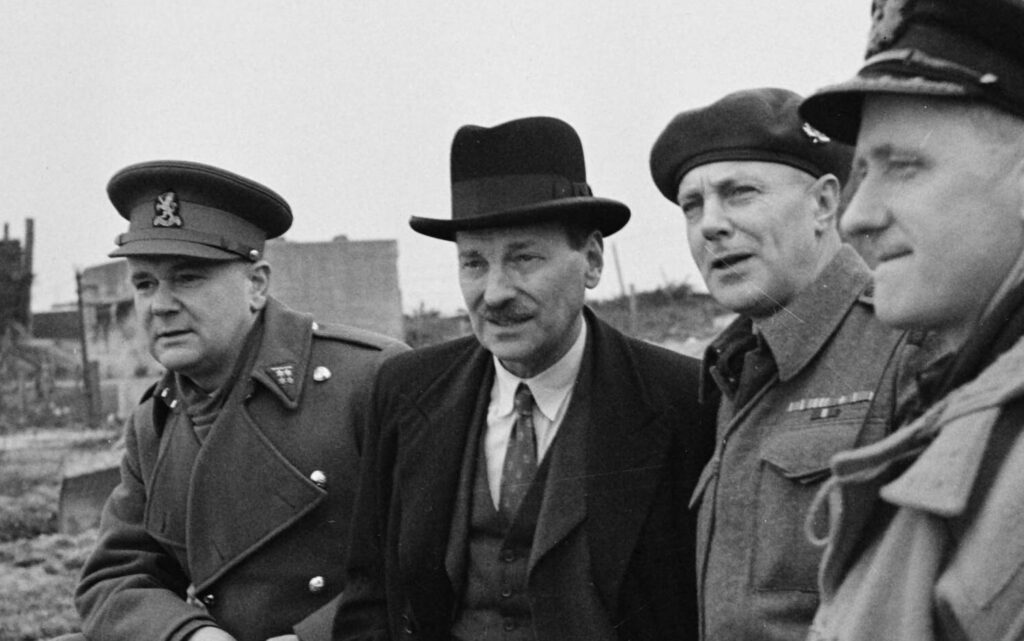
On 5 July 1945, the United Kingdom went to the polls for the first general election in nearly a decade, resulting in a stunning landslide victory for the Labour party led by Clement Attlee.
The result, declared three weeks later on 26 July after allowing time for postal votes from service personnel overseas to be counted, saw the defeat of Winston Churchill’s Conservatives, despite his immense prestige as the victorious wartime prime minister.
The election was called following the break-up of the wartime coalition government shortly after VE Day in May 1945. Churchill initially wanted to maintain the cross-party wartime coalition until victory in the Pacific was secured; Attlee expressed his wish for the swift dissolution of parliament.
***
Labour’s legitimacy as a political force was reinforced by its participation in the wartime national government. And the party successfully captured the public mood with a radical manifesto, entitled Let Us Face the Future.
The party’s platform drew heavily on the principles of the 1942 Beveridge Report, which argued that the state should provide a safety net for its citizens from “cradle to grave”. It called for widespread reforms to the system of social welfare, identifying “Want” as one of the “five giants on the road of reconstruction”.
Labour promised the recommended social and economic reforms, including the creation of a national health service – as well as the nationalisation of the “commanding heights” of the British economy (the Bank of England, coal, power, transport and iron and steel industries).
The Labour manifesto argued that “Victory in War must be followed by a Prosperous Peace”.
The Conservative campaign attempted to capitalise on Churchill’s post-war political stature, appealing to voters to “help him finish the job”. The party’s manifesto was literally titled Mr. Churchill’s Declaration of Policy to the Electors.
Churchill’s general emphasis on the need for stability and continuity was widely seen as complacent and out of touch with the aspirations of a population weary of war and determined to build a fairer society.
Unlike Attlee, Churchill had not embraced the findings of the Beveridge Report. Rather, the incumbent prime minister was somewhat dismissive of its recommendations. In a March 1943 radio broadcast, entitled After the War, Winston Churchill said he was aware of attempts to “over-persuade or even to coerce” the government into accepting the terms of a post-war settlement.
He said this amounted to a campaign “to impose great new expenditure on the state without any relation to the circumstances which might prevail at that time, and to make them pledge themselves to particular schemes without relation to other extremely important aspects of our post-war needs.”
Moreover, Churchill’s attempt to paint Labour as extremists backfired badly – most notably with his infamous “Gestapo speech” which claimed a socialist government led by his former deputy would require secret police. The Daily Express newspaper, edited by Tory media mogul Lord Beaverbrook and Churchill ally, responded with the headline “GESTAPO IN BRITAIN IF SOCIALISTS WIN”.
Attlee’s response to the ‘Gestapo speech’ emphasised a distinction between Churchill the popular war-leader and Churchill the partisan politician. The message legitimised the apparent ruthlessness of voting out a war hero – crystallising an emerging view that, while Churchill had won the war, he could not win the immediate peace.
Margaret Thatcher recalled in her memoirs: “I vividly remember sitting in the student common room in Somerville listening to Churchill’s famous (or notorious) election broadcast to the effect that socialism would require ‘some sort of Gestapo’ to enforce it, and thinking, ‘He’s gone too far.’”
The Conservatives were also still suffering politically from their association with the roundly discredited policy of appeasement, as pursued by Churchill’s predecessors.
***
In the end, Labour won 393 seats, a net gain of 239, and a landslide parliamentary majority of 146.
The Conservatives were reduced to 197 seats, losing 190. The Liberal Party continued its decline, winning just 12 seats, down nine. Sir Archibald Sinclair, the Liberal leader, lost his seat.
The Liberal National Party lost 22 seats, returning 11 MPs. The party went on to merge with the Conservatives in 1947.
The swing of 12 points to Labour was unprecedented. Both Churchill and Attlee were said to be astounded at the result.
Churchill tendered his resignation to the king almost immediately.
On 26 July, Attlee was appointed prime minister by King George VI – the first prime minister of a majority Labour government.
Attlee moved to implement Beveridge’s recommendations. This led to a raft of legislation, including the National Insurance Act 1946, which established a comprehensive system of social security; the National Health Service Act 1946, which established a “comprehensive health service designed to secure improvement in the physical and mental health of the people of England and Wales”; and the National Assistance Act 1948, which abolished the existing poor law system and made “provision for the welfare of disabled, sick, aged and other persons”.
The 1945 general election was therefore a watershed moment in British political history.
It ushered in a period of transformative social democratic government that crafted the post-war consensus.
Churchill continued as Conservative leader and later returned as prime minister following the 1951 general election.
As leader of the opposition, Churchill’s global stature endured. On 5 March 1946, in a speech at Westminster College in Fulton, Missouri, the former prime minister gave one of the defining addresses of the post-war era, declaring that an “iron curtain” had descended across Europe.
The speech helped frame the emerging Cold War, defining a conflict between democratic West and Soviet-dominated East.

Politics.co.uk Newsletters
DAILY
Politics@Lunch
WEEKLY
Week in Review