Churchill’s ‘Gestapo’ jibe backfires in election broadcast
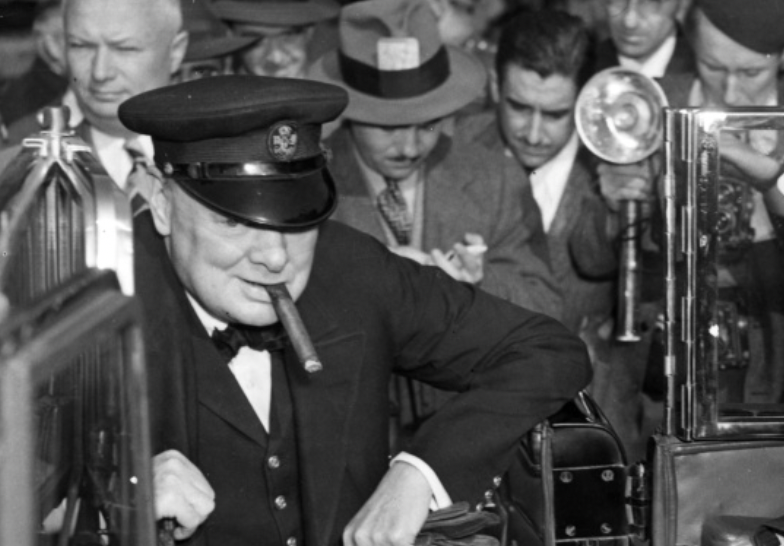
On 4 June 1945, Winston Churchill opened the general election campaign with a radio broadcast in which he claimed that a socialist government would require “some form of Gestapo” to enforce its policies. The attack, aimed at his Labour party opponents who had been his coalition partners throughout the war, badly misjudged the public mood.
Churchill called a general election following the break-up of the wartime coalition government shortly after VE Day in May 1945. The prime minister initially wanted to maintain the cross-party wartime coalition until victory in the Pacific was secured; however, Clement Attlee, the leader of the Labour Party, expressed his wish for the swift dissolution of parliament.
The contest represented Churchill’s first as leader of the Conservative Party – and the first in over 10 years.
***
The prime minister sought to frame the election as a choice between free enterprise and the threat of socialism.
In a broadcast to the nation, delivered less than a month after VE Day, Churchill launched a vitriolic rhetorical assault on Labour’s programme, likening it to the totalitarian regimes Britain had just defeated. The Tory leader described socialism as “abhorrent to the British ideas of freedom” and “inseparably interwoven with totalitarianism”.
Churchill questioned how citizens could “stand up against this formidable machine, which, once it is in power, will prescribe for every one of them where they are to work”. A socialist state, he insisted, “could not afford to suffer opposition” or sustain itself without a “political police”.
Broadcasting from Chequers in transgressive tones, Churchill argued: “No socialist government conducting the entire life and industry of the country could afford to allow free, sharp, or violently-worded expressions of public discontent.
“They would have to fall back on some form of Gestapo, no doubt very humanely directed in the first instance. And this would nip opinion in the bud; it would stop criticism as it reared its head, and it would gather all the power to the supreme party and the party leaders, rising like stately pinnacles above their vast bureaucracies of civil servants, no longer servants and no longer civil.
“And where would the ordinary simple folk – the common people, as they like to call them in America – where would they be, once this mighty organism had got them in its grip?”
The incumbent prime minister maintained that he stood for the “sovereign freedom of the individual within the laws which freely elected parliaments have freely passed.”
He added: “I stand for the rights of the ordinary man to say what he thinks of the government of the day, however powerful, and to turn them out neck and crop if he thinks he can better his temper or his home thereby and can persuade enough others to vote with him.”
In conclusion, the Conservative leader conceded that wartime conditions necessitated strict controls, but urged voters to cast off the “shackles and burdens which we imposed upon ourselves” and to “quit the gloomy caverns of war and march out into the breezy fields, where the sun is shining and where all may walk joyfully in its warm and golden rays.”
Lord Beaverbrook’s Daily Express newspaper celebrated the Gestapo attack line.
The media mogul and Conservative peer, who also served as a minister in the wartime coalition, responded with the headline: “GESTAPO IN BRITAIN IF SOCIALISTS WIN”.
More broadly, however, the comparison of the Labour party to the Nazi secret police was met with both disbelief and derision.
Herbert Morrison, the Labour home secretary in the wartime coalition government, referred dismissively to “Churchill’s crazy broadcast”.
Attlee, who had served as Churchill’s deputy prime minister during the war, described the jibe as a “travesty of the policy of the Labour Party”. He seized on the speech to highlight possible differences between Churchill the heroic war leader and Churchill the political partisan.
In his broadcast reply, Attlee countered that Churchill’s address represented “a travesty of the policy of the Labour Party”. But he also hinted at the prime minister’s true “object”.
The Labour leader stated: “He wanted the electors to understand how great was the difference between Winston Churchill, the great leader in war of a united nation, and Mr Churchill, the party leader of the Conservatives.
“He feared lest those who had accepted his leadership in war might be tempted out of gratitude to follow him further. I thank him for having disillusioned them so thoroughly. The voice we heard last night was that of Mr Churchill, but the mind was that of Lord Beaverbrook.”
The Labour manifesto, entitled Let Us Face the Future, further responded to accusations that an Attlee-led government would be somehow authoritarian.
It stated: “The Labour Party stands for freedom – for freedom of worship, freedom of speech, freedom of the Press. The Labour Party will see to it that we keep and enlarge these freedoms, and that we enjoy again the personal civil liberties we have, of our own free will, sacrificed to win the war…
“But there are certain so-called freedoms that Labour will not tolerate: freedom to exploit other people; freedom to pay poor wages and to push up prices for selfish profit; freedom to deprive the people of the means of living full, happy, healthy lives.”
Leo Amery, who served as secretary of state for India in the wartime coalition, remarked that Churchill had “jumped straight off his pedestal as world statesman to deliver a fantastical exaggerated onslaught on socialism”.
He described Attlee’s counter as “a very adroit quiet reply to Winston’s rodomontade”.
Margaret Thatcher recalled in her memoirs: “I vividly remember sitting in the student common room in Somerville listening to Churchill’s famous (or notorious) election broadcast to the effect that socialism would require ‘some sort of Gestapo’ to enforce it, and thinking, ‘He’s gone too far.’”
***
Mere weeks after Churchill’s broadcast, Labour won 393 seats at the 1945 general election – a net gain of 239. This landslide amounted to a parliamentary majority of 145.
The Conservative Party was reduced to 197 seats, losing 190.
The 1945 general election was a watershed moment in British political history, ushering in a period of transformative social democratic government that shaped the post-war consensus in its image. The Labour election platform drew heavily on the principles of the 1942 Beveridge Report, which Churchill had only cautiously embraced.
Churchill continued as Conservative leader through the 1945 to 1950 parliament. He returned as prime minister after the 1951 general election, aged 76. He became the second oldest prime minister in history – second only to William Gladstone.
Politics.co.uk Newsletters
DAILY
Politics@Lunch
WEEKLY
Week in Review