Clement Attlee becomes first PM of majority Labour government
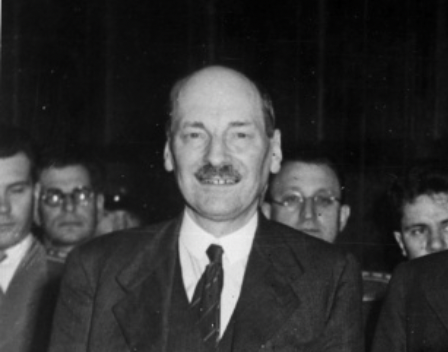
On 26 July 1945, Clement Attlee was appointed prime minister by King George VI, marking the beginning of a politically transformative tenure.
Attlee’s appointment followed the declaration of the 1945 general election results. The election had been held on 5 July, but the count was delayed for three weeks to allow time for the collection and counting of votes from service personnel stationed overseas. When the results were finally announced, they revealed a stunning Labour landslide. Attlee’s party had won 393 seats, securing a parliamentary majority of 145.
Winston Churchill, the celebrated wartime leader, tendered his resignation to the King almost immediately.
Later that same day, Attlee, who had served as Churchill’s deputy prime minister in the wartime coalition government, travelled to Buckingham Palace to accept the King’s invitation to form the next administration. Upon meeting King George VI, the notoriously blunt Attlee declared: “I’ve won the election”.
The king, displeased by the socialist triumph, is said to have responded: “I know. I heard it on the six o’clock news.”
***
Attlee returned to Downing Street as prime minister to form his cabinet. Ernest Bevin was appointed foreign secretary, Hugh Dalton as chancellor, James Chuter Ede as home secretary, Herbert Morrison as commons leader, Stafford Cripps as president of the Board of Trade, and Aneurin Bevan as minister of health.
In 1947, Attlee appointed a 31-year-old Harold Wilson to cabinet as president of the Board of Trade.
The new government’s in-tray comprised a series of daunting problems – including, but not limited to, demobilisation, righting a devastated economy, housing shortages, continued rationing, and establishing Britain’s place in a fast-changing world.
The Attlee government responded with a programme of radical reform outlined in its 1945 election manifesto, Let Us Face the Future, and recommended by the 1942 Beveridge Report.
In his first speech in the commons as prime minister, Attlee paid tribute to the “transcendent services” of his immediate predecessor. He styled Churchill as the man who “expressed supremely the courage and determination never to yield which animated all the men and women of this country” and “crystallised the unspoken feeling of all”.
Turning to the government’s agenda, Attlee stressed the “gravity of the issues which confront us at home and abroad”.
He said the post-war years would require “no less effort, no less unselfishness and no less hard work” than the war itself.
He stated the core principle that would inform the government’s nationalisation programme: “It is our policy that the industries and services of this country shall make their maximum contribution to the public good.”
He added: “I freely admit that the programme of work we have laid before this Parliament is heavy, but we are living in a time when great changes are due. The country will expect much from this House.
“I do not think it will be disappointed.”
***
Over the next six years, the first majority Labour government established the National Health Service (NHS), created a “cradle to grave” welfare state, nationalised around 20% of the economy, constructed new towns, and began the process of decolonisation – most notably granting independence to India in 1947.
Under Attlee’s leadership, Britain was also one of the founding members of Nato in 1949.
But notable divisions emerged over the introduction of prescription fees in the NHS, the continuation of rationing, and Britain’s commitment to the Korean War. Wilson and Bevan were among those to resign in April 1951 in protest at the introduction of prescription fees.
The Labour Party lost 78 seats at the 1950 general election, returning 315 MPs. Attlee’s majority was cut from 146 seats to just 5. The Conservative Party, still led by Churchill, had largely accepted the new economic consensus shaped by the Attlee government.
So when Churchill returned to Downing Street and Attlee the opposition benches after the next general election, the bulk of the 1945-1951 Labour government’s work endured.
Attlee remained leader of the opposition until December 1955 – but he set the agenda of British politics for decades.
The post-1945 orthodoxy only began to unravel with the rise of Thatcherism after the 1979 election.

Politics.co.uk Newsletters
DAILY
Politics@Lunch
WEEKLY
Week in Review