Labour leader Hugh Gaitskell dies
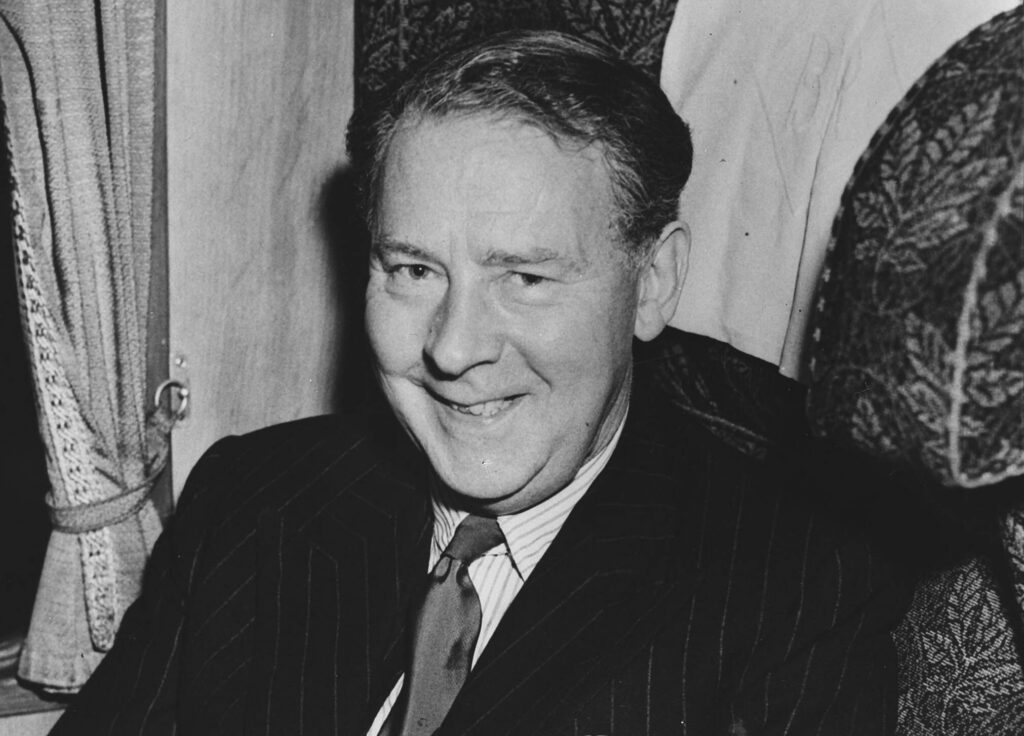
On 18 January 1963, the leader of the Labour Party, Hugh Gaitskell, died unexpectedly at the age of 56 at the height of his influence following a short illness. His death, caused by lupus, a rare autoimmune disease, sent shockwaves through British politics.
***
Gaitskell succeeded Clement Attlee as leader of the Labour Party in late 1955. Attlee’s resignation and the leadership contest that followed pitted Gaitskell against the party’s “old guard” represented by Herbert Morrison, aged 67, and Aneurin Bevan, the architect of the National Health Service (NHS) and darling of the Labour left. Bevan had resigned from Attlee’s cabinet in 1951 in protest at the decision – taken by Gaitskell as chancellor – to impose prescription charges on glasses and false teeth.
In the ballot of Labour MPs held on 14 December 1955, Gaitskell won 157 votes (58.8%), easily defeating Bevan.
A standard-bearer for the social democratic wing of the party, Gaitskell first made his mark as Labour leader during the parliamentary debates over the Suez Crisis. He opposed the invasion from the outset, which elicited much condescension from Conservative benches. In a masterful statement on 31 October 1956, Gaitskell accused the government of “an act of disastrous folly whose tragic consequences we shall regret for years.”
As Labour leader, he was tasked with managing the schism between Bevanites and Gaitskellites.
He led the party into the 1959 general election, which resulted in losses for the Labour Party. Gaitskell, who blamed his party’s defeat on doubts over its economic credibility, responded with an offensive against what he viewed as outdated and superfluous socialist dogma.
In the wake of the 1959 general election, Gaitskell battled his party over nationalisation and nuclear disarmament. He attempted unsuccessfully to amend Labour’s Clause IV, which committed the party to calling for common ownership of industry. The clause was seen as a symbolic expression of the party’s socialist identity. In October 1960, as Labour conference prepared to vote for unilateral disarmament, Gaitskell vowed to “fight, fight and fight again to save the party we love”.
He added: “We will fight and fight and fight again to bring back sanity and honesty and dignity, so that our movement with its great past may retain its glory and greatness.”
In November 1960, Gaitskell was challenged for the Labour leadership from the left of the party by Harold Wilson.
However, as the Conservative government under Harold Macmillan faltered, and with Labour consistently leading in the opinion polls, Gaitskell was widely regarded as a prime minister-in-waiting.
***
In October 1962, Gaitskell delivered a celebrated conference speech in which he passionately argued against Britain joining the European Economic Community (EEC), warning it would mean “the end of a thousand years of history”.
Gaitskell questioned what exactly was involved in “the concept of political union”.
He said: “We hear a lot about it; we are told that the Economic community is not just a customs union, that all who framed it saw it as a stepping stone towards political integration. We ought to be told what is meant by that, for, if this be true, our entry into the common market carries with it some very serious political obligations.”
Gaitskell argued that a federal Europe would see powers taken “from national governments”. This settlement, he added, would reduce Britain to “no more than a state… in the United States of Europe, such as Texas and California.”
He declared: “This is what it means; it does mean the end of Britain as an independent nation state. It may be a good thing or a bad thing, but we must recognise that this is so.”
The Labour leader added: “We must be clear about this; it does mean, if this is the idea, the end of Britain as an independent European state. I make no apology for repeating it. It means the end of a thousand years of history.
“You may say: ‘Let it end.’ But, my goodness, it is a decision that needs a little care and thought.
“And it does mean the end of the Commonwealth. How can one really seriously suppose that, if the centre of the Commonwealth is a province of Europe, it could continue to exist as the mother country of a series of independent nations? It is sheer nonsense.”
In mid-December 1962, Gaitskell fell ill with flu. But a medical check-up showed he was fit to travel to the USSR on 1 January for talks with Soviet leader Nikita Khrushchev.
In a new year message, Gaitskell accused the Macmillan government of “sheer misjudgment and incompetence”. The government’s failures, he stated, were “deserved failures, springing from wrong decisions taken in the wrong way for the wrong reasons.”
Gaitskell’s condition soon deteriorated. Labour’s deputy leader, George Brown, stepped up as acting leader.
A medical bulletin issued at 7.45 pm on 16 January said the Labour leader was in a “very grave” condition.
It stated: “Gaitskell’s condition has deteriorated further with the development of serious renal and abdominal complications. The outlook is very grave unless there is some response to treatment during the next 24 hours.”
A short statement issued to journalists after his death said: “Mr Gaitskell’s heart condition deteriorated suddenly and he died peacefully”.
Gaitskell was survived by his two daughters Julia, 23, and Cressida, 20.
Tributes and messages of sympathy followed from Queen Elizabeth II, Winston Churchill, Clement Attlee and the then US President, John F Kennedy, among others.
In a statement, Kennedy said: “I am deeply grieved by the death of Hugh Gaitskell. His strength of character, force of intelligence, and generosity of purpose made him one of the foremost figures in the Western community.
“In his passing, freedom loses a gallant champion. Mrs. Kennedy and I send our deepest sympathy to Mrs. Gaitskell and to Mr. Gaitskell’s friends and associates in Britain and throughout the world.”
***
MPs paid tribute to Gaitskell in the House of Commons on 22 January.
Macmillan opened proceedings on 22 January by moving an immediate adjournment of the House. The prime minister recalled Gaitskell’s “rapid and spectacular” rise in parliament.
He told MPs: “From a private member in 1945, he passed through several offices to become chancellor of the exchequer only five years later. He was elected leader of the opposition in 1955, ten years after entering the House of Commons. This, I think, is a unique record.”
Macmillan described Gaitskell as possessing a “rare power of lucid exposition” that never diminished his capacity for “rhetorical and emotional appeal”.
He said that the role of leader of the opposition was a “difficult” and “unrewarding” role. He further noted its “special responsibility to parliament and to the nation.”
The prime minister maintained that “Hugh Gaitskell carried out his difficult duties effectively and honourably.”
He added: “As a debater he was formidable. As a questioner, he would press his point to the full, but never unfairly. To the ordinary conduct of our daily business he brought always courtesy and urbanity as well as a great sense of the traditions of the House.
“He was, I repeat, a notable parliamentarian of increasing strength and stature year by year. Had he lived, I feel sure that he would have taken his place in the ranks of some of our greatest figures.”
The prime minister concluded: “We therefore mourn today a man of quite outstanding parts, clearly destined, had he been spared, to play an ever-increasing role in the world of affairs.”
George Brown, speaking from the opposition frontbench, characterised the occasion as “peculiarly difficult and emotional”. He noted that he and Gaitskell remained close despite being “so dissimilar” in personality and temperament.
Brown said that the nature of the task Gaitskell undertook in the Labour Party was “so courageous and so vital that the accomplishment of it captured the imagination of the nation irrespective of one’s political alignments and views.”
He added: “Come what may in the future, politically the impact of Hugh Gaitskell will always be seen very clearly etched from hereon on our party.”
He confessed that arguing with Gaitskell was often a “nightmare” because of a mind that proceeded in the “most orderly, logical and clear progression.”
Brown concluded: “To his associates he gave unstinting sympathetic support in all weathers. He never needed to know why one was in trouble. It was sufficient that you were his friend and his colleague and that you needed help…
“I, for one, acknowledge an enormous duty to him in this respect which I shall never be able to discharge.”
Gaitskell’s sudden passing triggered an immediate leadership contest, which was ultimately won by Harold Wilson.
Wilson then led Labour to victory in the 1964 general election.
Gaitskell is sometimes described as “the best prime minister Britain never had”.

Politics.co.uk Newsletters
DAILY
Politics@Lunch
WEEKLY
Week in Review
