Wilson defeats George Brown in Labour leadership contest
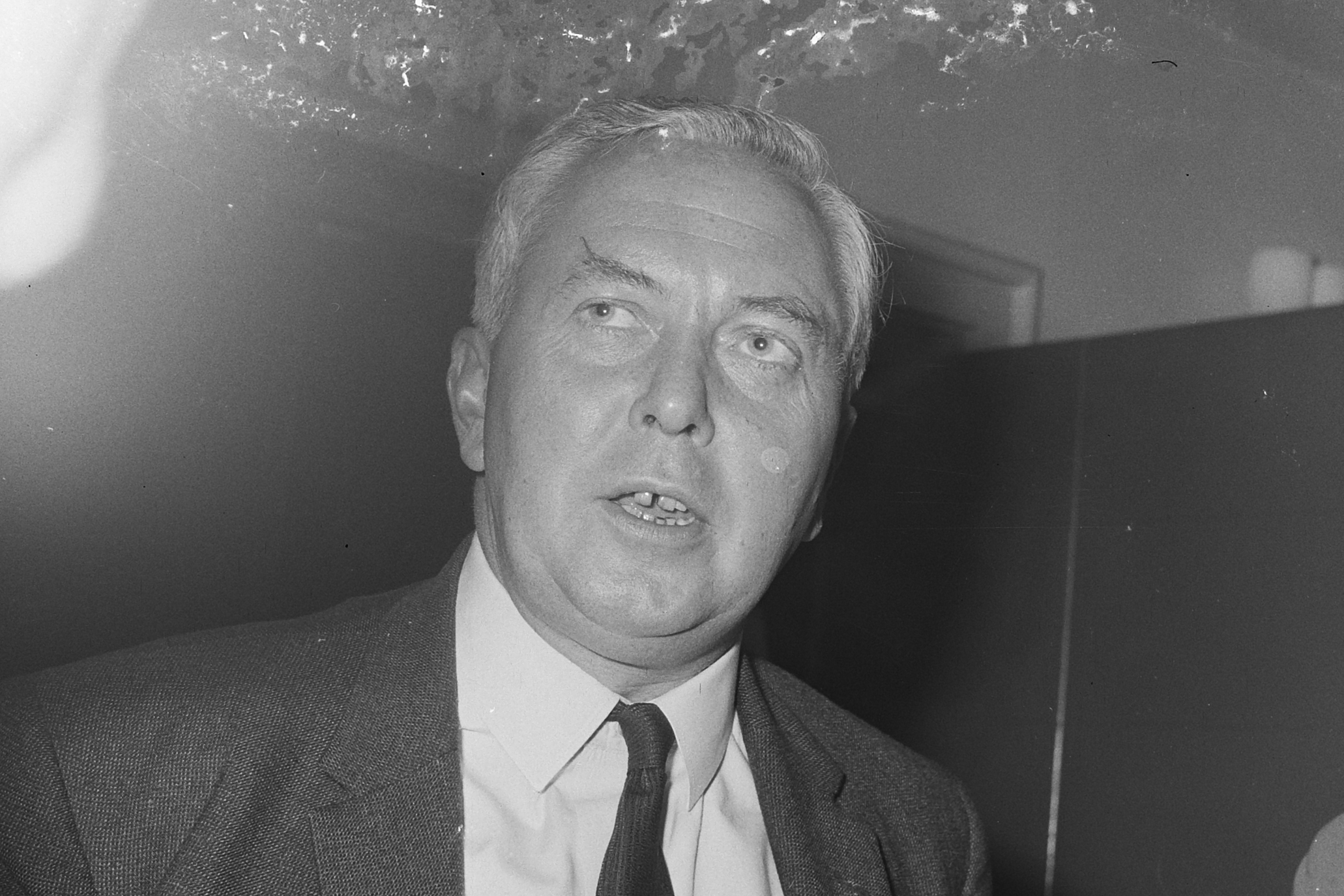
On 14 February 1963, Harold Wilson was elected leader of the Labour Party, winning a decisive victory over George Brown, who had been serving as the party’s interim leader.
The leadership contest was triggered by the sudden death of Hugh Gaitskell on 18 January. Gaitskell’s death, caused by lupus, a rare autoimmune disease, sent shockwaves through British politics.
A standard-bearer for the social democratic wing of the party, Gaitskell first made his mark as Labour leader during the parliamentary debates over the Suez Crisis. In the wake of the 1959 general election, Gaitskell battled his party over nationalisation and nuclear disarmament, attempting unsuccessfully to amend Labour’s Clause IV, which committed the party to calling for common ownership of industry.
In November 1960, Harold Wilson unsuccessfully challenged Gaitskell for the Labour leadership from the left of the party. Wilson, the shadow chancellor of the exchequer, was reported to have expressed indirect criticism of Gaitskell’s position on Clause IV.
The ballot, which saw Gaitskell re-elected by 166 votes to Wilson’s 81, marked the first formal challenge to an incumbent Labour leader since 1955. Wilson was subsequently moved to the position of shadow foreign secretary in 1961. He challenged George Brown in 1962 for the deputy leadership from the left.
At the time of his death in January 1963, with the Conservative government under Harold Macmillan faltering and with Labour consistently leading in the opinion polls, Gaitskell was regarded as a prime minister-in-waiting.
MPs paid tribute to Gaitskell in the House of Commons on 22 January. Brown, speaking from the opposition frontbench, characterised the occasion as “peculiarly difficult and emotional”. He noted that he and Gaitskell remained close despite being “so dissimilar” in personality and temperament.
Brown said that the nature of the task Gaitskell undertook in the Labour Party was “so courageous and so vital that the accomplishment of it captured the imagination of the nation irrespective of one’s political alignments and views.”
***
The 1963 Labour leadership election, decided exclusively by Labour MPs via exhaustive ballot, initially featured three candidates. In the first ballot on 7 February, Wilson, the shadow foreign secretary, topped the poll with 115 votes. He was followed by the deputy leader, Brown, with 88 votes.
The shadow chancellor, James Callaghan, was eliminated with 41 votes in the first ballot.
Brown refused to stand down. In the final ballot a week later, Wilson secured his victory with 144 votes to Brown’s 103.
Wilson’s election at the age of 46 was seen as representing a generational shift. He had previously served in cabinet during Clement Attlee’s tenure as prime minister, resigning in 1951 on the issue of prescription charges in the NHS alongside Aneurin “Nye” Bevan.
Wilson was generally seen as a Bevanite figure. His success in the 1963 leadership contest has been attributed to splits on the right of the party (between supporters of Brown and Callaghan), and Brown’s own divisive campaign. The latter factor allowed Wilson to assume the mantle of unity candidate – a somewhat surprising development given his reputation going into the race.
Roy Hattersley, who entered parliament as a Labour MP in 1964, later remarked that “even many of [Wilson’s] supporters – wrongly I now believe – thought him a politician without principle.”
Hattersley added: “Wilson came from behind to win because of the belated recognition that his character weaknesses were less of a liability than the fatal flaws of his chief rival. George Brown – brilliant and mercurial – was an alcoholic and a bully. While Wilson ran an emollient campaign, Brown attempted to intimidate.”
Leading Gaitskellite Tony Crosland famously described the selection between Brown and Wilson as akin to choosing “between a crook and a drunk.”
A contemporary Guardian report referred to Wilson as “unequalled” as a parliamentary performer and the “most powerful demolition agent since Aneurin Bevan”.
A report in the New York Times stated: “In selecting Mr Wilson, a suave, pipe-smoking intellectual, the Opposition party chose the man it felt would have the widest appeal in the general election that many predict will be held later this year.”
Wilson reportedly vowed to continue with Gaitskell’s policies and prioritise party unity. He played down the suggestion that his success amounted to a victory for any particular section of the party.
In the first months of his leadership, Conservative hopes that Wilson would alienate moderate votes proved somewhat unfounded. Jeremy Thorpe, a leading Liberal MP, soon described Wilson as the “supreme compromiser” in balancing his party’s ideological factions.
Polls at the time of the contest placed Labour ahead of the Conservatives by around 10 to 15 points.
In October 1963, Brown acknowledged Wilson’s victory in a speech to Labour conference in Scarborough.
He stated: “Though I had my doubts about the way we reached our decision on the leadership, I’m very glad today, sincerely and honestly, to pay tribute to the way we are being led now.”
It came as Wilson, the undisputed Labour leader, delivered his famous speech referring to the “white heat of technology”.
Wilson declared: “In all our plans for the future, we are re-defining and we are re-stating our socialism in terms of the scientific revolution. But that revolution cannot become a reality unless we are prepared to make far-reaching changes in economic and social attitudes which permeate our whole system of society.
“The Britain that is going to be forged in the white heat of this revolution will be no place for restrictive practices or for outdated methods on either side of industry.”
***
In March 1963, shortly after winning the Labour leadership, Wilson flew to the United States for discussions with the US president, John F Kennedy.
One of Wilson’s first tasks as leader of the Labour Party was to respond to the Radcliffe Tribunal report into the infamous Vassall case. John Vassall’s confession and conviction as a Soviet agent sent shockwaves through the political establishment.
Wilson, addressing the commons in May 1963, contended that the central fact of the case was that “a man of pretty limited intelligence, not a master spy, just a small-time traitor, who, for seven years, was able to remain undetected and to abstract secret – top secret – documents almost at will.”
Wilson argued that the “wilder press accusations” would have been “avoided if the prime minister had proceeded to set up an inquiry as soon as the case for it became clear”. He called on Macmillan to take responsibility for the security failings.
The Vassall scandal, alongside the Profumo affair the following year, contributed to a public perception of a government beset by sleaze, complacency and incompetence. Macmillan resigned as prime minister on health grounds in October 1963 and was succeeded by Alec Douglas-Home.
Douglas-Home, a distant and aristocratic figure, found an unforgiving contrast in Wilson.
Wilson led Labour to a narrow general election victory in 1964, defeating Douglas-Home’s Conservatives. He became the youngest prime minister since the Earl of Rosebery in 1894. Wilson’s working parliamentary majority of just four seats was the smallest since 1847.
The Labour Party secured a slight majority of four seats.
Wilson won a landslide majority of 98 seats two years later in 1966.
As Labour leader, Wilson won four of the five general elections he contested, in 1964, 1966, 1970, February 1974 and October 1974. He was succeeded as prime minister and Labour leader by Callaghan in 1976.
George Brown served as foreign secretary from 1966 to 1968, when he chaotically resigned from Wilson’s government.
In 1981, Baron George-Brown was one of the signatories to the Limehouse Declaration that precipitated the formation of the Social Democratic Party (SDP). George-Brown, who lost his seat in the 1970 election and hyphenated his name upon his elevation to the peerage, announced that he had joined the splinter party four years later.
George-Brown died following a stroke on 2 June 1985 at the age of 70.

Politics.co.uk Newsletters
DAILY
Politics@Lunch
WEEKLY
Week in Review