Keir Starmer resigns as prime minister
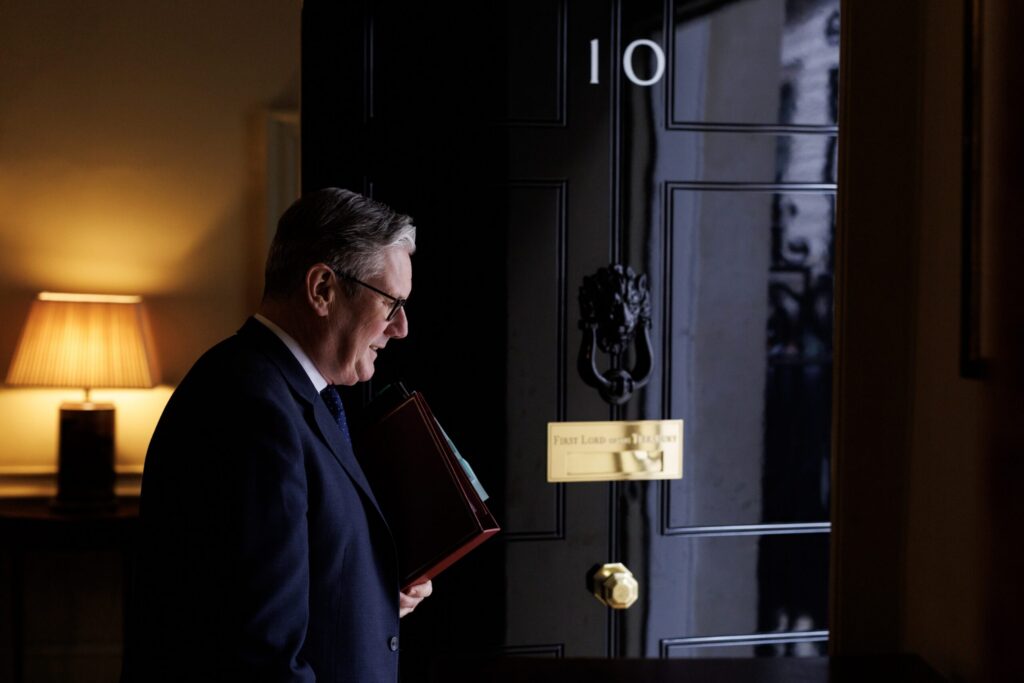
On 22 June 2026, Keir Starmer announced his resignation as prime minister and Labour leader outside 10 Downing Street, becoming the sixth person to leave the office in 10 years.
***
Starmer was first elected as leader of the Labour Party on 4 April 2020, succeeding Jeremy Corbyn after the 2019 general election resulted in the party’s worst performance since 1935.
Starmer’s election ultimately represented an ideological and strategic shift for the party. From 2020 until his election as prime minister in 2024, the Labour leader signalled a series of symbolic breaks with Corbyn’s tumultuous tenure. After barring Corbyn from standing as a Labour candidate, Starmer celebrated the “changed” nature of his Labour Party.
Starmer led Labour into the 2024 general election, which resulted in a spectacular landslide victory and brought 14 years of Conservative government to a definitive end. Labour secured 411 seats and a commanding House of Commons majority of 174. But Labour’s vote was spread widely and thinly throughout the country. The party’s landslide victory came on a vote share of 33.7% – the lowest vote share of any majority government in British history. Labour’s vote only increased by 1.6 points compared to their historic defeat in 2019.
From 2024 to 2026, a series of missteps increased tension in the parliamentary Labour Party and eroded confidence in Starmer’s leadership. The decision to cut the winter fuel payment, which was announced in the weeks following the 2024 general election, provoked a considerable backlash. Starmer’s position was further weakened by the June/July 2025 welfare bill revolt and the Peter Mandelson vetting scandal.
Starmer’s resignation as prime minister in June 2026 followed a period of immense political pressure precipitated by the May 2026 local elections and simultaneous elections to the devolved Scottish Parliament and Senedd Cymru. The results of the elections, which were confirmed from 8 to 9 May, sparked an intense political crisis as Labour MPs lined up to call on Starmer to step down/set out a timetable for his departure. In total, over 90 MPs called for Starmer to resign as prime minister.
In their statements, several MPs expressed support for Andy Burnham, the mayor of Greater Manchester, as the person best-positioned to succeed Starmer and restore Labour’s standing. Burnham had previously run in the 2010 and 2015 leadership elections, and under Starmer – especially during his tenure as prime minister – he had emerged as a critic. In a remarkable intervention at Labour’s annual conference in 2025, Burnham criticised a “climate of fear” in the party.
Matters came to a head on 14 May when Wes Streeting resigned as secretary of state for health and social care and Josh Simons, a former minister, announced his intention to stand down from parliament.
Simons’ resignation was designed to create a vacancy that Burnham could exploit to return to parliament. Burnham, who had previously been blocked from standing as the Labour candidate in the February 2026 Gorton and Denton by-election, was ultimately approved by the party’s national executive committee (NEC).
***
In Makerfield, Burnham stood on a platform of “changing” Labour. During a BBC Question Time special on 4 June, he confirmed that he would seek to enter any future Labour leadership contest should he win the Makerfield by-election. He argued that “Wes Streeting seems to have launched a leadership contest, so if that is running I would seek to join it.”
During the Makerfield by-election campaign, Starmer suffered another considerable setback when John Healey resigned as defence secretary over a dispute regarding military spending and the defence investment plan (DIP) specifically. In his resignation letter to the prime minister, dated 11 June, Healey said the proposed defence investment plan “falls well short of what is required for defence and the country at this dangerous time”.
Healey said the prime minister, Keir Starmer, had been “unable” and the Treasury “unwilling” to “commit the resources that the nation needs to defend the country at this time of rising threats”.
Healey was joined in his resignation by Al Carns, the armed forces minister, and the two parliamentary private secretaries (PPSs) at the Ministry of Defence (Pamela Nash and Rachel Hopkins). In his resignation letter, Carns contended that the government was “asking our Armed Forces to operate in a more dangerous world on a budget written for a calmer one.”
Carns subsequently suggested that he could join a leadership contest to succeed Starmer as prime minister. In an interview with LBC Radio, he was asked about how he would respond if there was a leadership election and “the ball comes out from the back of the scrum.”
Carns responded: “I’m good at rugby and football, but we’ll see what happens… I’m always up for playing.”
In the early hours of Friday 19 June, Burnham was declared as the winner of the Makerfield by-election. Burnham secured 24,927 votes (54.8%) and a significant majority of 9,231, while the Reform UK candidate, Robert Kenyon, finished in second place with 15,696 votes (34.5%).
Burnham’s Makerfield victory ensured that he was now eligible to stand in a leadership contest to succeed Starmer. In response, several Labour MPs called for the prime minister to step down, pushing the number of MPs publicly demanding Starmer’s resignation to over 100.
Starmer spent the weekend of 20-21 June at Chequers, the prime minister’s country retreat, to mull his political future.
On 21 June, a leading Starmer ally, business and trade secretary Peter Kyle, confirmed that Starmer was considering his position as prime minister. Kyle said Starmer was going over the “political realities” after Burnham’s resounding win in Makerfield.
***
In a statement on Monday morning, Starmer confirmed his intention to resign.
Speaking on the steps of Downing Street, Starmer said that he had inherited a Labour Party that was “politically, financially and morally bankrupt” upon his election as leader in 2020. He described entering office as prime minister following the 2024 general election as “the proudest moment of my life.”
Starmer proclaimed that he had ripped out the “poison of antisemitism” and ensured his party could stand “with, not against, our national flag.”
Turning to the political situation, the outgoing prime minister declared: “But I know the question being asked now is not who was best placed to change the Labour Party, to take us into power, and to begin the vital work of improving lives for millions of people. Those questions have been answered.
“The question my party is asking now is whether I am best placed to lead us into the next general election. I have heard the answer of my parliamentary party to that question. And I accept that answer with good grace.”
Starmer revealed that he had spoken to King Charles III, informing him of his intention to resign as Labour leader, and had urged the party’s national executive committee to initiate the necessary steps for a leadership contest.
Starmer confirmed that the nominations for a leadership contest would open on 9 July to ensure, in the event of a contest, that a new prime minister was in place by the close of parliament’s summer recess.
Starmer said he would remain in post as prime minister until the process was complete.
In an emotional peroration, reminiscent of Theresa May’s resignation as prime minister, Starmer said it had been an honour to serve the “country I love”.
His voice cracked as he paid tribute to his wife, Victoria, and his sons.
Starmer stated: “I want to thank the brilliant No 10 staff and our country’s extraordinary civil service, who dedicate their lives to public service.
“And when I leave, the biggest job in the country. I shall spend more time on the most important job. Being the best husband I can to my fantastic wife, Vic, who has been a rock by my side, through good times and bad. And being the best dad I can to my beautiful children, who are my pride and my joy.”
In the hours that followed Starmer’s address, Burnham confirmed that he would be standing for the Labour leadership.
The statement was posted to social media while Burnham was travelling to Westminster from Manchester Piccadilly. In it, Burnham thanked Starmer for giving “huge service to our country”.
He said: “His decision marks the beginning of a transition and it is important that this process is conducted in an orderly and responsible way. I will put myself forward as part of this process…
“The Labour movement has always been at its strongest when it looks forward with confidence and purpose. This is what we will do from here and we will make sure this transition is a positive process of renewal for our party and our country.”
Almost immediately, Streeting endorsed Burnham and abandoned his own leadership bid.
The former health secretary said he had spoken to Burnham “at length” in recent days.
In a post to social media, he added: “We could spend the summer exaggerating small differences, or we can roll up our sleeves and help him to deliver the change our party and country needs. That is the choice I am making and I hope that everyone else will back Andy, too.”
When Burnham’s train arrived at Euston – some 20 minutes late – he was pressed by journalists on his next steps. Asked whether he would call a general election if he reached Downing Street, having himself demanded one when Rishi Sunak replaced Liz Truss without a vote in 2022, Burnham responded: “I think you’re jumping several hurdles there.”
In a social media post on 20 October 2022, Burnham stated: “#GeneralElectionNow”.
***
Burnham was sworn in as MP for Makerfield in the commons shortly after 2:30pm, where he was greeted by sustained cheering from the Labour benches in a crowded chamber. One MP heckled “Rome is saved”, while a Conservative chuntered “you’re not the messiah!”
Burnham retorted: “Naughty boy, is it?”
Nigel Farage, the leader of Reform UK, responded to Starmer’s resignation by calling for an immediate general election.
Farage told Sky News: “Whoever becomes the prime minister will not have been voted for by the British public, and if the next prime minister is the next MP for Makerfield, Andy Burnham, he didn’t even stand for the last election at all.”
Kemi Badenoch, the leader of the Conservative Party, said there were “critical decisions that need to be made and the prime minister is setting out his farewell tour while Andy Burnham wants a summer holiday.”
Angela Rayner, who resigned as deputy prime minister in September 2025, said that history would “remember not just the challenges [Starmer] faced but the achievements he oversaw”. She added that, “as a new chapter begins, we must now redouble our efforts to deliver for working people.”
Gordon Brown, who served as prime minister from 2007 to 2010, said that Starmer’s place in history was “assured”.
Brown stated: “Keir Starmer’s place in history is assured. We owe Keir a debt of gratitude for taking Labour from its worst electoral defeat in 2019, bringing Labour back into government with a huge majority in 2024 and then guiding Britain through difficult times nationally and globally.
“I know Keir as a decent honourable leader who has at all times been determined to put the needs of the country first. Today we think also of the huge support given by Vic and their family and wish them all well in the future.”
Volodymyr Zelenskyy, the president of Ukraine, said Starmer would “always” be a “welcome guest in Ukraine.”

Politics.co.uk Newsletters
DAILY
Politics@Lunch
WEEKLY
Week in Review
