Keir Hardie makes anti-war appeal as Europe mobilises
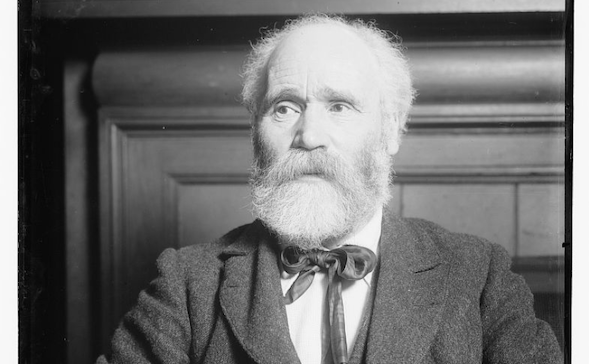
On 2 August 1914, the founder of the Labour party, Keir Hardie, addressed a protest in Trafalgar Square, urging British workers to join with those across Europe in opposing armed conflict. This latest intervention, issued just two days before Britain declared war on Germany, marked the beginning of Hardie’s isolation from the mainstream labour movement he helped create.
Hardie’s intervention came after his return from a meeting of the International Socialist Bureau. He produced a manifesto calling on British workers to join an international general strike opposing participation in the war.
The manifesto, co-signed by fellow Labour MP Arthur Henderson, warned that the “long-threatened European war is now upon us” and that for “more than 100 years no such danger has confronted civilisation.”
It called on workers “to act promptly and vigorously in the interests of peace”.
The manifesto stated: “You have never been consulted about the war…
“Everywhere Socialists and the organised forces of Labour are taking this course. Everywhere vehement protests are made against the greed and intrigues of militarists and armament-mongers.
“We call upon you to do the same here in Great Britain upon an even more impressive scale. Hold vast demonstrations in London and in every industrial centre….
“There is no time to lose. Already, by secret agreements and understandings of which the democracies of the civilised world know only by rumour, steps are being taken which may fling us all into the fray…
“Down with class rule! Down with the rule of brute force! Down with war! Up with the peaceful rule of the people!”
***
The manifesto’s central appeal was derived from Hardie’s sincere pacifism, and the belief that working-class solidarity transcended national boundaries.
This stance split the labour movement. But Hardie was not entirely alone in his pacifism – at least not before the war’s formal declaration.
On 2 August, one Ernest Bevin addressed a mass meeting of Bristol dockers on an anti-war platform; a fellow trade union leader brandished the Hardie-Henderson manifesto. The gathering passed a resolution urging the government to “immediately declare its neutrality in connection with the European war”, calling on the Trades Union Congress (TUC) and Labour Party to convene a conference to prevent the country going to war.
At the same time, Hardie addressed a mass meeting in Trafalgar Square alongside Labour allies Henderson and George Lansbury. A resolution was passed proclaiming that the “government of Britain should rigidly decline to engage in war, but should confine itself to efforts to bring about peace as speedily as possible.”
The commons debated the prospect of war on 3 August.
Sir Edward Grey, the foreign secretary, declared that, with Germany and Russia already at war, the “peace of Europe cannot be preserved”. He said the government had “consistently worked with a single mind, with all the earnestness in our power, to preserve peace”, but that the present crisis had begun to force the issue of war.
Ramsay MacDonald, the leader of the Labour Party, set out his opposition to the policy of the government. “I think he is wrong. I think the government… is wrong. I think the verdict of history will be that they are wrong”, he said.
MacDonald insisted that Britain “ought to have remained neutral”.
He told MPs: “So far as we are concerned, whatever may happen, whatever may be said about us, whatever attacks may be made upon us, [Labour] will take the action that we will take of saying that this country ought to have remained neutral, because in the deepest parts of our hearts we believe that that was right and that that alone was consistent with the honour of the country and the traditions of the party that are now in office.”
Grey returned to the dispatch box to update the House on correspondence from the Belgian government. Germany, he said, had delivered “a note proposing to Belgium friendly neutrality, covering free passage on Belgian territory… and threatening, in case of refusal, to treat Belgium as an enemy.”
Grey added: “I can only say that the government are prepared to take into grave consideration the information which it has received. I make no further comment upon it.”
Hardie rose to speak, restating his intention to mobilise opposition to the war. He said that, “whether we take part in the conflict or not, there is bound to be much suffering. That involves starving children.”
He argued that the government’s decision for war had been made “without consulting the country” and expressed a “feeling akin to wonder” at the foreign secretary’s refusal “to consider the offers made on behalf of the German government to keep this country out of the dispute.”
The Labour MP declared: “I say respectfully to the House that some of us will do all we can to rouse the working classes of the country in opposition to this proposal of the government.”
Hardie predicted that “a few years hence… we shall look back in wonder and amazement at the flimsy reasons which induced the government to take part in it.”
The speech, met with cries of “No, no!” and “Shame!”, was in vain.
Britain declared war on Germany at 23:00 on Tuesday, 4 August 1914.
While the smaller Independent Labour Party (ILP) wing mostly maintained its pacifist position, the vast majority of the parliamentary Labourites swung behind the government’s war effort. Only four of the 37 Labour MPs are said to have opposed the war, Hardie and MacDonald included.
***
On 6 August, parliament granted the government’s request for a credit of £100,000,000 for the war effort (“for all measures which may be taken for the security of the country”) without a division.
MacDonald had resigned his leadership of the party in the commons the previous day. He was replaced by Henderson, who – with his pleas for peace having failed – committed himself and his party to supporting the war effort.
On 6 August, Hardie delivered an anti-war speech in his constituency of Aberdare; he was confronted with protesters, who repeatedly barracked the veteran politician.
A patriotic zeal descended over Britain, and appeals to sign up to fight were remarkably successful.
The Women’s Social and Political Union (WSPU) announced it would cease its campaigns – and the government responded with the release of all WSPU suffragettes from prison. Many suffragettes took to issuing white feathers to those men who did not enlist.
On 24 August, the parliamentary committee of the TUC resolved that all unions would observe an industrial truce for the duration of the war.
The following year, upon the construction of the wartime coalition, Henderson was appointed president of the Board of Education – making him the first Labour figure to attend cabinet.
Hardie’s anti-war conviction, however, did not waiver.
The Labour MP’s friend and colleague J. R. Clynes, who supported military involvement, later wrote that the split drove a “sword into his heart”. Clynes described Hardie as becoming a “broken man” – unable to reconcile his conscience with the actions of the movement he had built. He “shrank into a travesty of his former self, never spoke in debates and said little to anyone.
“The great leader of Labour was dying on his feet.”
The strain is said to have taken a significant toll on Hardie’s health. He suffered a stroke in December 1914.
On 25 February, in his final significant contribution to parliament, Hardie rose to protest the “encroachments which are being made on the educational by-laws, chiefly in the agricultural districts”.
Upon his resignation as Labour’s parliamentary leader in 1908, Hardie had dedicated himself to the cause of women’s suffrage – campaigning alongside the likes of Sylvia Pankhurst.
Pankhurst later recalled that the war, “the great slaughter, the rending of the bonds of international fraternity, on which he had built his hopes, had broken him.”
Hardie left London for the last time in early 1915, returning to Scotland. He died in Glasgow on 25 September 1915, aged 59.
Clynes wrote in 1937: “Hardie died of a broken heart.”

Politics.co.uk Newsletters
DAILY
Politics@Lunch
WEEKLY
Week in Review